

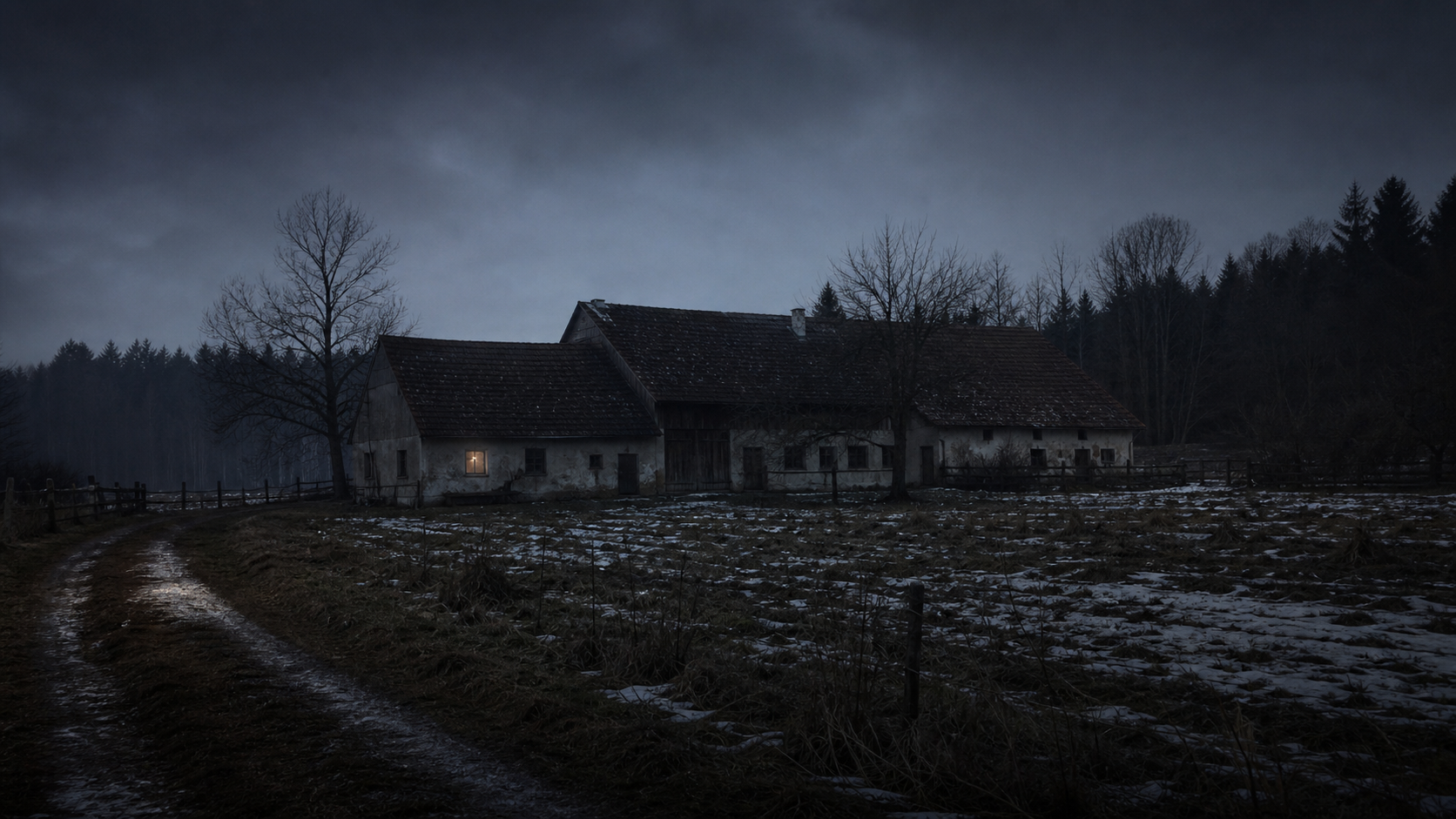
On April 4, 1922, three men walked toward an isolated Bavarian farm because its six residents had vanished from daily life. Smoke had been seen, cattle still required care, and a seven-year-old girl had missed school. Inside Hinterkaifeck, they discovered that every person living there had been killed.
The Hinterkaifeck murders remain unsolved more than a century later. Yet the case is often retold with invented ghosts, exaggerated clues, and confident accusations that the surviving evidence cannot support. Original police files preserved in Bavaria reveal something more disturbing than folklore: a remote household, a badly compromised crime scene, and a killer who disappeared without leaving a provable identity.
The six people who lived at Hinterkaifeck
Hinterkaifeck was a small farmstead near Gröbern and Waidhofen, roughly 70 kilometers north of Munich. The property combined living quarters, a barn, and animal stalls beneath connected roofs. Its position away from the village gave the family privacy, but it also meant that unusual activity could pass without immediate scrutiny.
The household consisted of Andreas Gruber, 63; his wife, Cäzilia Gruber, 72; their widowed daughter, Viktoria Gabriel, 35; Viktoria’s children, seven-year-old Cäzilia and two-year-old Josef; and Maria Baumgartner, 44. Baumgartner was a new maid who arrived at the farm on March 31, the day investigators later identified as the likely date of the killings.
These names matter because sensational retellings often reduce the family to characters in a locked-room puzzle. Two of the victims were children. Baumgartner had barely entered the household before she died. Whatever theory readers find persuasive, the case begins with six individual lives rather than the mythology built around their deaths.

What happened before the murders?
Several unsettling incidents were recorded in statements gathered after the crime. Andreas Gruber reportedly spoke about tracks in the snow that approached the farm from the forest without an obvious return trail. A Munich newspaper, uncommon in the immediate area, had appeared on the property. He also described noises in the attic and a missing house key.
These details are among the most famous elements of the Hinterkaifeck story, but they require caution. They survive through later testimony about what Gruber allegedly told other people. Investigators could not independently reconstruct every event, and decades of repetition have made the accounts sound more precise than the surviving record allows.
The previous maid had left months earlier. Some versions claim she believed the farm was haunted, although that statement does not establish anything supernatural. A frightening noise in an old connected farmhouse might have many ordinary causes. In retrospect, however, reports of unexplained access and movement feel ominous because someone soon killed the entire household.
Hinterkaifeck murders timeline
| Date | Documented event |
|---|---|
| March 31, 1922 | Maria Baumgartner arrived. Authorities later placed the killings between approximately 7 p.m. and 10 p.m. |
| April 1 to 3 | The family missed school, church, and normal appointments. Signs of activity continued around the farm. |
| April 4 | Concerned locals entered the property and discovered the victims. |
| April 1922 onward | Munich police pursued suspects and collected extensive witness testimony. |
| 1923 | The farm was demolished. A Reuthaue, a heavy agricultural tool identified as the weapon, was found concealed in the building. |
Four members of the Gruber-Gabriel family were found in the barn area. Maria Baumgartner and young Josef were found inside the residential section. The official archival summary states that all six died from severe head injuries. Claims that every victim’s throat was cut, repeated in some online versions, are inaccurate.
The bodies remained undiscovered for several days. During that interval, animals appear to have been fed and smoke was observed from the chimney. This created the enduring possibility that the perpetrator stayed at the farm after the killings, carrying out ordinary chores only meters from the dead. It is a chilling inference, although investigators could not establish every movement made on the property during those missing days.
A crime scene damaged before police arrived
The first people to enter Hinterkaifeck were neighbors, not forensic investigators. Others followed as news spread. Bodies and objects were disturbed before specialists could secure the property. By modern standards, the scene was badly contaminated, but even experienced police in 1922 worked without DNA profiling and many procedures now considered essential.
Detective Georg Reingruber led the Munich investigation. Police interviewed residents, checked alibis, examined possible motives, and pursued tips for years. According to the Bavarian State Archives, Munich police initiated more than 100 investigative proceedings by 1930. Effort was not absent. What investigators lacked was an untouched scene and technology capable of resolving ambiguous physical traces.
The delayed recovery of the weapon created another problem. The Reuthaue was not found until workers demolished the farm in 1923. By then, opportunities to connect it reliably to one person had passed. The building disappeared soon afterward, removing the physical setting from any future examination.

The suspects and theories police could not prove
Investigators considered robbery, personal revenge, family conflict, and an attack by a transient stranger. Money and valuables left behind weakened a simple burglary explanation, although theft may not have been the only motive. The farm’s isolation made an unknown intruder possible, while the killer’s apparent familiarity with the property suggested someone who understood the household.
Suspicion repeatedly fell on people connected to the family, including neighbor Lorenz Schlittenbauer. He had a complicated relationship with Viktoria Gabriel and was among the men who entered the farm on April 4. His behavior at the scene attracted speculation, but he was never charged, and he successfully challenged accusations made against him during his lifetime.
Rumors also claimed that Viktoria’s husband, Karl Gabriel, had survived the First World War and returned secretly. Officially, he had been reported killed in 1914. No reliable evidence placed him at Hinterkaifeck in 1922. Other suspects, including the Gump brothers and various traveling criminals, were investigated without producing a prosecutable case.
No responsible account can name a killer today. Witness statements conflict, records are incomplete, and later storytellers have sometimes converted suspicion into certainty. A theory may explain one clue while failing to account for the timing, the household knowledge, or the lack of decisive physical evidence.
Was the Hinterkaifeck farm haunted?
There is no documented evidence that supernatural activity caused or followed the murders. Stories about apparitions, crying voices, or a curse belong to later folklore, not the official investigation. The farm itself was demolished in 1923, so modern accounts describing ghostly rooms inside the surviving house are impossible.
The haunting reputation grew because the verified facts already possess the structure of a nightmare. A road ends at a lonely farm. Someone may have entered without permission. Six people disappeared behind familiar walls, while signs of domestic life continued after their deaths. When documentation stops, imagination fills the silence.
This separation between history and legend is also central to our examination of the evidence behind the Borley Rectory haunting. In unresolved cases such as the Dyatlov Pass incident, eerie circumstances can become more dramatic each time uncertain details are retold as settled fact.
Why official records returned to public view in 2026
In March and April 2026, the Bavarian Main State Archives presented an exhibition devoted to the six murders. Its material drew from Munich police files held by the State Archives and objects connected to the investigation. The exhibition did not announce a solution. Instead, it showed the scale of the original inquiry and the limits that still surround the evidence.
The renewed archival attention is important because Hinterkaifeck has become an internet legend far beyond Germany. Returning to primary records restores the victims, corrects fictional additions, and exposes how an unsolved case changes as each generation retells it. A mystery does not become clearer simply because a theory is repeated often.
What remains in the darkness
The strongest conclusion is also the least satisfying: the Hinterkaifeck murders have no proven perpetrator. Investigators established when the family probably died, recovered the likely weapon, and pursued an extraordinary number of leads. They could not bridge the distance between suspicion and proof.
Nothing paranormal is needed to make Hinterkaifeck frightening. The terror lies in the ordinary details: animals waiting in their stalls, an oil lamp on a kitchen table, a school desk left empty, and someone moving through a farm where no living resident remained. A century later, the killer’s name is still missing from the record.
Read next
- What the evidence reveals about the Dyatlov Pass incident
- The documented history behind Borley Rectory
- Why Strasbourg danced in 1518