
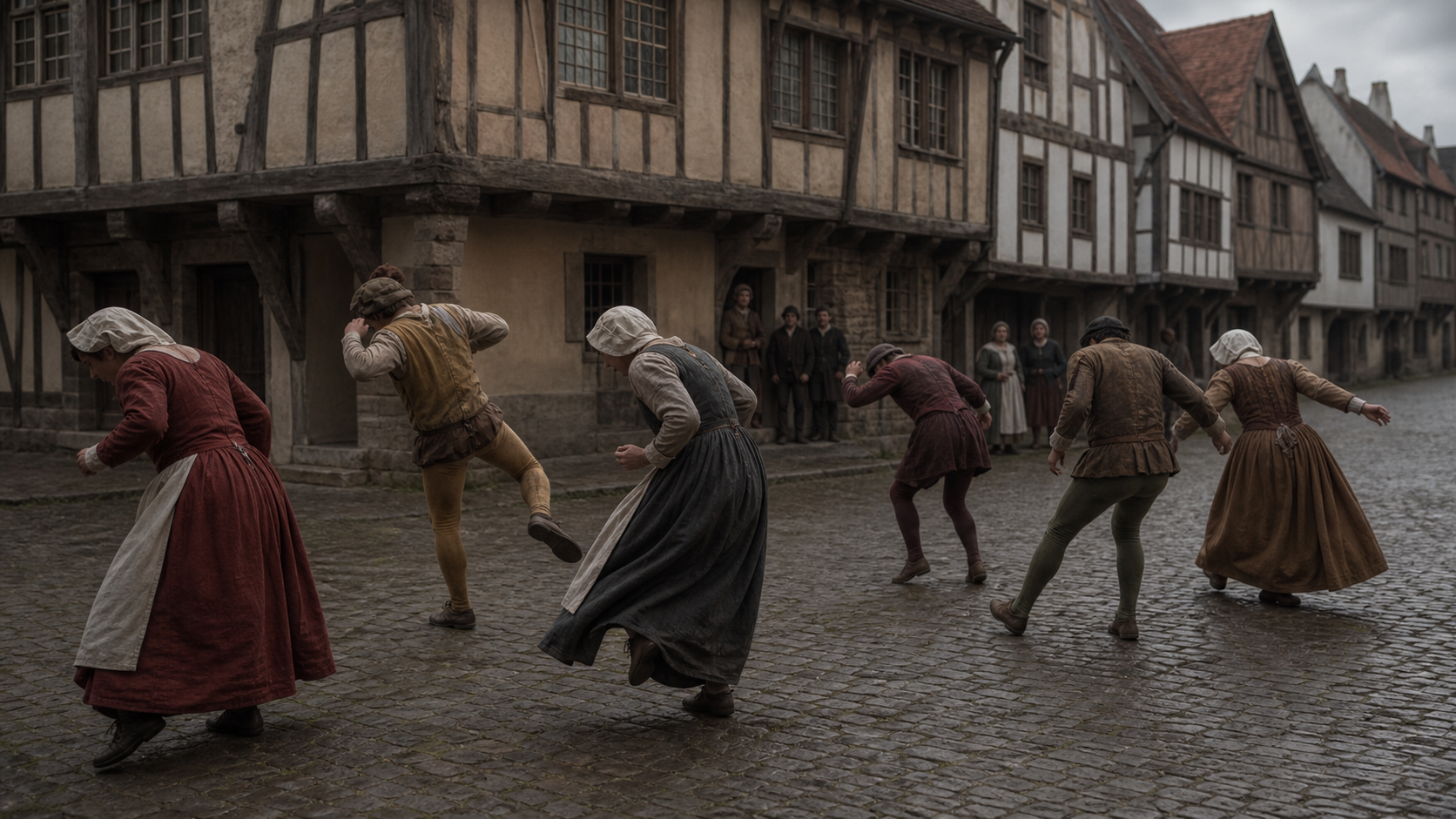
The Dancing Plague of 1518 began with a sight that made no sense. In July, a woman stepped into a Strasbourg street and started moving without music or celebration. She reportedly continued for days. Then other residents joined her. Within weeks, civic authorities were confronting an outbreak of compulsive movement that physicians, priests, and officials could not explain.
The event was real enough to leave traces in chronicles, sermons, medical commentary, and city records. However, its most famous details are less secure. Historians still debate how many people danced, whether anyone died, and what caused the behavior. The likely answer is not a medieval curse or poisoned bread, but an interaction between extreme stress, shared belief, bodily distress, and a city whose attempted cure may have intensified the crisis.
What happened in Strasbourg in 1518?
Strasbourg was then a free city within the Holy Roman Empire, not yet part of modern France. Several chronicles describe a woman, commonly identified as Frau Troffea, beginning to dance in public during July 1518. Her precise identity and the exact date are uncertain, but multiple accounts place a female dancer at the beginning of the episode.
She did not appear to be enjoying herself. Later reconstructions describe relentless, involuntary movement interrupted by exhaustion and brief rest. As days passed, more residents reportedly joined. Estimates vary widely, from several dozen people to hundreds by the outbreak’s peak. That range is a warning: the basic event is documented, while the scale has been enlarged and simplified through centuries of retelling.
| Question | What the historical record supports |
|---|---|
| Where did it happen? | Strasbourg, then a city of the Holy Roman Empire |
| When did it begin? | July 1518, with uncertainty about the exact day |
| Who began dancing? | Several chronicles identify a woman usually called Frau Troffea |
| How many were affected? | Accounts support dozens, while later estimates rise as high as roughly 400 |
| Did people die? | Deaths are repeated in later versions, but contemporary sources do not provide a reliable toll |
| What caused it? | No cause is proven; mass psychogenic illness is a leading modern interpretation |
When the city encouraged the dancers
Local authorities consulted physicians, who interpreted the condition through humoral medicine. They reportedly blamed overheated blood rather than astrology or direct supernatural attack. The proposed remedy was deeply unsettling: allow the afflicted to keep moving until the illness burned itself out.
Officials made space for dancing and hired musicians and healthy dancers to accompany those affected. Instead of ending the outbreak, the public spectacle appears to have attracted attention and reinforced the behavior. A private crisis had become a civic performance, surrounded by rhythm, spectators, expectation, and official permission.

The policy was eventually reversed. Music and public dancing were restricted, and the affected people were taken away from the city’s central spaces. This change shows that Strasbourg’s council did not passively watch an inexplicable event. It tested an accepted medical response, saw the situation worsen, and then turned toward religious intervention.
Saint Vitus and the terror of a dancing curse
People in the Rhine region already knew stories of Saint Vitus and punishments expressed through uncontrollable dancing. Earlier European outbreaks of dancing mania had given the fear a recognizable shape. In that cultural world, a person could interpret sudden movement not merely as illness but as evidence of divine anger or a saint’s curse.
Authorities sent dancers toward a shrine associated with Saint Vitus near Saverne. Rituals reportedly included prayers and the use of symbolic red shoes. The surviving accounts do not show a miracle under controlled observation. They show how treatment followed the meaning a community assigned to the symptoms.

This matters because expectation can shape distress. If residents feared that Saint Vitus could compel sinners to dance, seeing another person move uncontrollably could awaken the same terror in them. The belief did not need to be imaginary or foolish to have physical consequences. It had to be emotionally powerful, socially shared, and connected to a recognizable pattern.
Did hundreds dance until they died?
The darkest version of the story claims that up to 15 people died each day from exhaustion, heart attacks, or stroke. That figure has been copied widely, but the evidence is weak. Contemporary Strasbourg records do not provide a dependable death toll, and some claims of mass fatalities appear in later accounts.
People who moved for prolonged periods in summer heat could certainly have collapsed, become dehydrated, or suffered injury. That medical possibility does not prove a specific number of deaths. Historians must distinguish between what could have happened, what later writers said happened, and what surviving documents actually record.
The same problem shapes many famous mysteries. Repetition can transform an uncertain detail into a familiar fact. Evil’s Eye examined that process in the disputed evidence behind the Borley Rectory haunting and the stories layered over Poveglia Island’s documented history. The Dancing Plague demands the same caution.
Why ergot poisoning is an unlikely answer
One popular theory blames ergot, a fungus that can contaminate rye and produce toxic alkaloids. Ergot poisoning can cause convulsions, hallucinations, burning pain, and restricted blood flow. Because contaminated grain has been proposed for other historical outbreaks, it offers an apparently physical answer to Strasbourg’s mystery.
Yet ergotism does not fit prolonged, socially spreading dancing particularly well. Severe poisoning can leave people desperately ill and physically impaired. It would not be expected to produce an organized pattern that expanded through observation and responded to the community’s beliefs about dancing. Grain contamination also fails to explain why the behavior took the culturally specific form feared in the region.
Ergot cannot be excluded with the certainty of a modern laboratory test because no biological samples survive. Still, most serious modern discussions treat it as less convincing than explanations centered on psychological and social contagion.
The case for mass psychogenic illness
Historian John Waller has argued that the outbreak makes sense as mass psychogenic illness, sometimes loosely called mass hysteria. The term does not mean the dancers knowingly pretended. It describes real symptoms arising and spreading within a group without an identified organic agent sufficient to explain them.
Strasbourg’s residents had endured hunger, disease, economic pressure, and intense religious fear. In such conditions, one person’s visible distress could supply a model for others whose suffering had no safe outlet. Public attention and musicians may then have amplified the pattern. Belief in the curse of Saint Vitus gave the symptoms both a cause and a script.
This interpretation remains retrospective. No modern clinician examined the dancers, and early 16th-century writers did not record symptoms using present diagnostic standards. Mass psychogenic illness explains the cultural pattern better than ergot poisoning, but it should be presented as a strong theory rather than a solved diagnosis.
Claims, theories, and what remains uncertain
| Explanation | Strengths and problems |
|---|---|
| Divine punishment or curse | Matches contemporary belief and ritual response, but offers no independently testable supernatural evidence |
| Ergot poisoning | Can cause severe neurological symptoms, but poorly explains prolonged socially patterned dancing |
| Mass psychogenic illness | Fits stress, social spread, expectation, and regional belief, but remains a retrospective interpretation |
| Deliberate religious ritual | Dancing had ritual meanings, yet sources describe distress and loss of control rather than a voluntary festival |
| Legendary exaggeration | Likely affects the numbers and death claims, but does not erase the documented civic response |
The outbreak was neither wholly invented nor fully recoverable. City measures and multiple written accounts support an extraordinary episode of compulsive dancing. They do not permit precise reconstruction of every movement, injury, participant, or death.
Why the Dancing Plague of 1518 still disturbs us
The Dancing Plague of 1518 is frightening because the body seems to stop belonging to the person inside it. The dancers were not described as celebrating. They were caught in movement that observers could see but could not halt, while the city’s first treatment turned their suffering into a larger spectacle.
The strongest explanation combines physical exhaustion, extreme social stress, shared religious expectation, and psychological contagion. It does not solve every detail, particularly the number affected and whether deaths occurred. What survives is a darker lesson: communities can give distress a form, and authorities can intensify a crisis when the cure repeats the behavior causing harm.
Read next
- Anneliese Michel Exorcism: Illness, Faith, and Trial
- Borley Rectory: Evidence Behind England’s Haunted House
- Paris Catacombs: What Lies Beneath the City of Light