

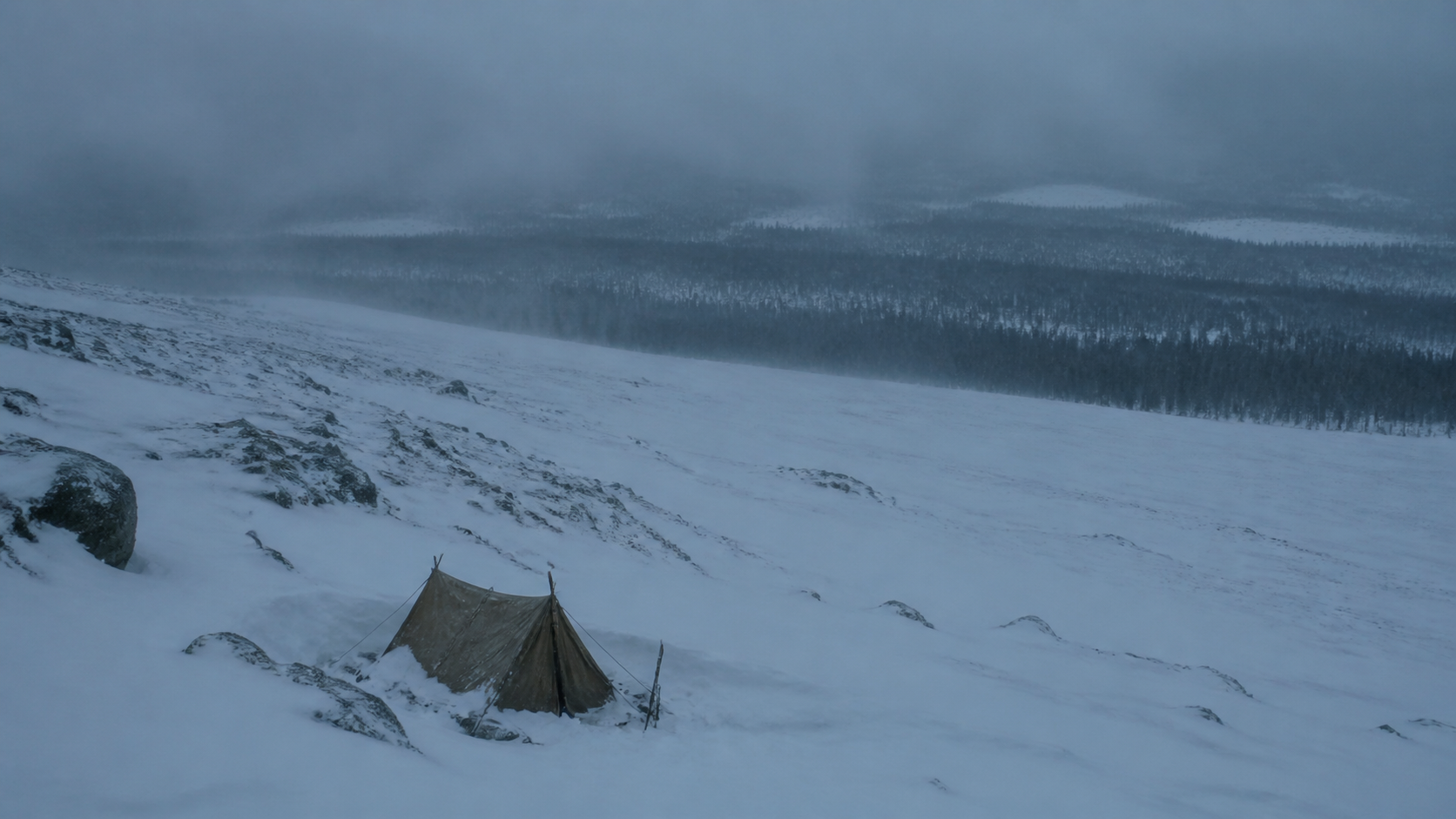
In the first hours of February 1959, nine experienced Soviet hikers left the only shelter they had on a wind-scoured Ural Mountains slope. Their tent was later found cut open from within. Boots, coats, food, and equipment remained inside while a line of tracks descended toward a forest more than a kilometre away. None of the hikers returned.
That sequence turned the Dyatlov Pass incident into one of the twentieth century’s most persistent mysteries. Yet the genuine horror does not require a monster, secret weapon, or invented conspiracy. It lies in a simpler question: what could make a capable group abandon a tent in lethal cold, and why were they unable to climb back?
The expedition before it became a mystery
The journey began as a demanding winter ski trek across the northern Urals. Igor Dyatlov, a 23-year-old engineering student, led a group drawn largely from the Ural Polytechnic Institute. Ten people entered the wilderness, but Yuri Yudin turned back because of illness. That decision made him the expedition’s only survivor.
The remaining nine were Igor Dyatlov, Zinaida Kolmogorova, Lyudmila Dubinina, Rustem Slobodin, Yuri Doroshenko, Georgy Krivonischenko, Alexander Kolevatov, Nikolai Thibeaux-Brignolles, and Semyon Zolotaryov. They were not reckless novices. Their diaries and photographs describe an organised team accustomed to severe conditions, which is one reason the final night still feels so difficult to reconcile with ordinary misjudgment.
On February 1, worsening visibility pushed the group off its intended route. They pitched their tent on the exposed slope of Kholat Syakhl rather than descending to the forest. The choice saved time, but it placed their shelter beneath snow that strong winds could continue loading long after camp had been established.
What searchers found on the mountain
When the group failed to return, a search began. The tent was discovered on February 26. Investigators reported that it had been cut from the inside. Most footwear and warm outer clothing remained there, suggesting that departure was urgent and that the hikers expected the shelter to remain recoverable.
Tracks led downhill toward the tree line. Near a cedar, searchers found Doroshenko and Krivonischenko beside the remains of a small fire. Dyatlov, Kolmogorova, and Slobodin lay between the cedar and the tent, positions commonly interpreted as an attempted return uphill. The final four were not located until May, beneath deep snow in a ravine.
Hypothermia killed several members of the group. Others had serious chest or skull trauma. The disturbing condition of bodies recovered months later encouraged sensational stories, but decomposition and prolonged exposure can explain details often presented online as inexplicable mutilation. The case remains unsettling without stripping those details from their physical context.
Why the Dyatlov Pass incident attracted darker theories
The 1959 investigation ended with an opaque conclusion that a compelling natural force had caused the deaths. In the secrecy of the Soviet era, that phrasing created room for stories about military tests, radiation, glowing objects, and concealed evidence. Later retellings added a Yeti, violent outsiders, and other explanations that travelled further than the underlying records.
Several facts were especially easy to sensationalise. Some clothing showed radioactivity, although at least one hiker had worked in a field where contamination was possible. Reports of unusual lights were never tied conclusively to the group’s final hours. The Mansi people were also unfairly pulled into early suspicion despite an absence of evidence that another person attacked the hikers.
Mystery grows when unusual facts are collected but their limits are removed. That same pattern appears in modern coverage of the claims surrounding Skinwalker Ranch, where testimony, instrumentation, folklore, and speculation must be kept in separate categories. At Dyatlov Pass, the responsible question is not whether every odd detail feels eerie. It is whether one physical sequence can explain most of the evidence with the fewest unsupported assumptions.
A small avalanche, not a roaring wall of snow
In 2020, a new Russian prosecutorial review concluded that an avalanche was the most likely cause of the emergency. Critics had long argued that the visible slope seemed too gentle, that searchers found no obvious avalanche debris, and that an avalanche should have buried the tent. Those objections were reasonable if the proposed event was a large, fast-moving avalanche. A compact snow slab presents a different mechanism.
Researchers Johan Gaume and Alexander Puzrin modelled how the hikers’ cut into the slope, combined with wind-deposited snow and irregular terrain, could have produced a delayed slab release. Their peer-reviewed 2021 study in Communications Earth & Environment found that a relatively small slab could plausibly strike the tent with enough force to cause serious, nonfatal injuries.
The delay matters. The model proposes that katabatic winds continued moving snow above the tent after the hikers settled in. Hours later, the added load could have fractured a weak layer. The danger may not have resembled the cinematic avalanche many readers imagine. A dense block of snow pressing into a low tent could have felt like the beginning of a larger collapse and made evacuation the rational immediate choice.

How a survivable emergency could become fatal
An avalanche explanation does not mean all nine died beneath snow. Instead, it offers a trigger for the rushed exit. If the group believed another release could follow, remaining in or beside the damaged tent would have seemed dangerous. They could descend together toward the forest, use the trees as protection, start a fire, and then return once conditions stabilised.
Darkness, wind, and temperatures below minus 25 degrees Celsius made that plan unforgiving. Snow could erase landmarks within minutes. Injured hikers would move slowly. At the cedar, inadequate clothing and a weak fire offered little protection. Those who attempted to regain the tent faced an exposed uphill journey through a whiteout, while the ravine may have provided shelter at the cost of deep, unstable snow.
This sequence is frightening because each decision can be understandable. Leave a threatened tent. Seek cover. Make a fire. Return for equipment. Find a depression away from the wind. Under severe cold and impaired visibility, a chain of reasonable choices can close every route back to safety.
What the avalanche theory still cannot prove
The snow-slab model establishes plausibility, not a witnessed reconstruction. It cannot tell us precisely when every injury occurred, what each hiker perceived, or how the group divided after reaching the forest. The scene had also changed before investigators arrived, and the last four bodies remained under snow for months.
Follow-up field expeditions later documented that avalanches can occur in the area, strengthening the environmental case. A 2022 follow-up published by the same researchers reported evidence that such events are not exceptional at Dyatlov Pass. However, a plausible trigger does not convert every uncertainty into certainty.
That distinction matters throughout paranormal and unexplained-case reporting. Evil’s Eye approached the legends of Hoia Baciu Forest in the same way: documented landscape and history first, reported experiences second, and extraordinary explanations only where evidence allows them.
Why the mountain still refuses a clean ending
The Dyatlov Pass incident endures because the physical evidence appears to capture an interrupted plan. A stocked tent stood above a forest. Tracks showed a descent but preserved no explanation. Bodies marked fragments of what followed, while weather erased the links between them.
Snow science now offers a coherent answer to the first question. A delayed slab release could have damaged the shelter, injured members of the team, and forced an evacuation. Exposure, trauma, darkness, and separation could explain the deaths that followed. It is less spectacular than the conspiracy theories, but it respects both the terrain and the available evidence.
Still, no model can recover the words spoken inside the tent or identify the exact moment the hikers understood they were in mortal danger. The most defensible conclusion is therefore narrow: an avalanche-related emergency is the strongest supported explanation, while the final human sequence remains partly unresolved. On Kholat Syakhl, that missing sequence is where the coldest part of the story survives.
Sources
- Gaume and Puzrin, “Mechanisms of slab avalanche release and impact in the Dyatlov Pass incident in 1959,” Communications Earth & Environment (2021)
- Puzrin and Gaume, “Follow-up expeditions reveal avalanches at Dyatlov Pass,” Communications Earth & Environment (2022)
- National Geographic, “Has science solved one of history’s greatest adventure mysteries?”