
Samhain turns Halloween’s familiar question inside out. Instead of asking what costume to wear, Irish seasonal folklore asks who might be waiting beyond the door, and whether the dead should be kept outside at all. The festival marks the beginning of winter on November 1, with its eve on October 31 becoming a night of feasting, disguise and uneasy encounters in recorded tradition.
That does not make every modern Halloween custom an unchanged ancient ritual. Samhain’s history reaches us through different kinds of evidence: seasonal calendars, religious observance, collected stories and surviving objects. The most unsettling details are often the smallest ones, a swept hearth, a face cut into a turnip, an ordinary path suddenly treated as unsafe. These are records of belief, not proof that spirits crossed into the living world.
In this story
Samhain begins where the comfortable season ends
For an agricultural community, the approach of winter meant practical decisions before it meant decorative ghosts. The National Folklore Collection’s Halloween resource describes November 1 as a turning point when cattle came down from summer pasture, rents and tributes fell due, and business took place. Samhain was a boundary in the working year.
The same resource presents this shift into the darker season as a moment when people imagined movement between their world and another. That is the useful context for the fear. A familiar landscape did not have to change physically to feel less secure. The calendar supplied a reason to look differently at the route home, the hearth or the edge of a field.
Who came home on Samhain?
The National Museum of Ireland’s account of Halloween customs records an expectation that the souls of the dead would return to their family homes. It also describes fear of harmful spirits and reluctance to travel alone. The returning dead were not a single category of enemy. Some were people a household wanted to remember.
A folklore account from Manorhamilton, County Leitrim, reproduced by Dúchas, describes preparing a bright fire and sweeping the hearth before bed to welcome visitors from beyond ordinary life. Read as testimony about custom, it is intimate rather than theatrical. The disturbing thought is not an attack in the dark, but a family arranging its room for someone whose place has become permanently empty.
This distinction matters when telling Samhain stories. Hospitality and apprehension could occupy the same house. To reduce the whole tradition to demon worship would erase the grief, affection and ordinary domestic care within the record. The hearth could represent welcome while the road outside remained a source of unease.

Before the pumpkin, a face in a turnip
The museum’s Ghost Turnip collection entry gives Halloween’s familiar carved face a precise connection to a place and a collector. In 1943, teacher Rois Ní Braonáin sent a turnip lantern from near Fintown, County Donegal. She said that this type had been made locally around 1900.
The object represented in the collection is a painted plaster-cast model made by museum artist Eileen Barnes. That detail is worth retaining: a preserved representation is not a vegetable that has somehow survived intact for more than a century. The record describes candles inside hollowed turnips, used to frighten people on October 31.
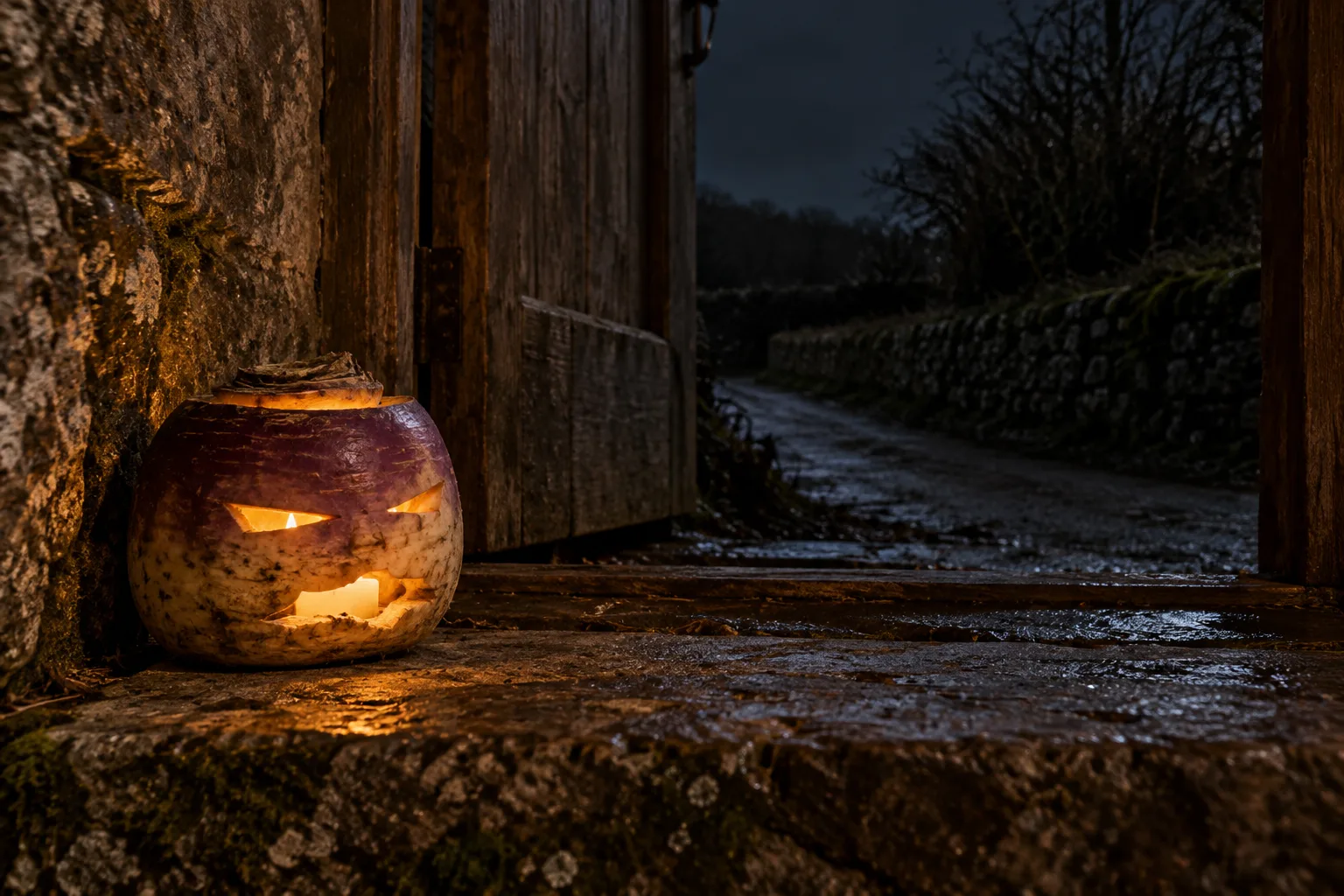
A turnip’s pale, uneven surface gives the face a different character from a bright orange pumpkin. Narrow openings can suggest sunken eyes; a rough mouth becomes more disquieting than an elaborate design. The fear comes from recognisable material made briefly unfamiliar. Our cover interprets that tradition without copying the collection object or pretending to document an ancient Samhain ceremony.
Jack’s punishment was to keep walking
Galway City Museum’s October 2026 account connects the lantern to a folktale about Jack, a blacksmith who repeatedly outwits the Devil. In the version it recounts, his clever bargains save him from being taken to Hell, but do not secure a place in Heaven.
When Jack dies, neither destination accepts him. He receives an ember and places it in a hollowed turnip, carrying a small light through an endless darkness. This is a legend with variants, not a biography or a documented supernatural encounter. Its lasting horror is that winning an argument does not necessarily deliver safety.
The museum also describes lanterns placed on walls and gates or hung from trees to startle passersby. Irish emigrants carried the practice across the Atlantic, where pumpkins offered a more plentiful, easier-to-carve substitute. What changed was the material; the face shining from inside a harvested object remained a compelling image.
The danger at the edge of the familiar
Dublin Castle’s interpretation of old Irish Halloween traditions describes boundaries as dangerous places in supernatural belief: farm divisions, crossing points and river bends. It also recounts stories of a fairy hunt and disguises used as protection. These are elements of folklore, not verified reports of an organised supernatural pursuit.
The geography gives the stories their force. A boundary is neither fully here nor fully there. A person moving through it briefly leaves one secure space without reaching the next. Samhain provides a seasonal equivalent of that uncomfortable interval.
Elsewhere, Black Shuck’s English folklore places danger in an ominous animal and a remembered storm. The connection is not evidence that the traditions share one origin. It is the way a story attaches dread to recognisable surroundings, so that the listener encounters the setting again after the telling has ended.
A false face gave the living room to misbehave
The National Museum’s account of Samhain records ghostly masks used to frighten neighbours and disguised groups visiting and entertaining. Fruit, nuts, games and marriage divination also belonged to the celebration. Fear sat beside amusement, not in a separate, uniformly sinister festival.
Disguise changes the social encounter as well as the face. A neighbour becomes harder to identify, a familiar voice arrives from behind an unfamiliar shape, and a doorstep becomes a small stage. That does not establish an ancient explanation for every costume. It does explain why the mask remains effective: uncertainty begins before anything supernatural has happened.
There is a sharp contrast with the documented history of the Salem witch trials, where supernatural accusations produced real judicial violence. Keeping folklore distinct from evidence protects both stories. A frightening seasonal custom should not become an excuse to caricature a living religious tradition or treat historical victims as Halloween props.

What the surviving history cannot promise
Claims about Samhain become weakest when they turn a layered history into one uninterrupted ceremony. The Library of Congress’s Folklife Today discussion specifically cautions that the idea of Samhain as the beginning of the Celtic year is less certain than popular accounts suggest. It traces the conjecture’s rise and notes that other Irish material points toward Beltaine instead.
The relationship with Christian commemoration also requires care. In an essay for University of California Press, religion historian Kyle Smith challenges the neat claim that November 1 became All Saints’ Day simply to suppress Samhain. He explains that the ninth-century calendar decision recognised observance already present in parts of Europe, and traces separate Christian traditions of remembering saints and souls.
Neither caution empties Halloween of its Irish inheritance. They prevent a later mask, a collected story and an early seasonal festival from becoming interchangeable evidence. A museum record can establish that an object or belief was collected. It cannot establish that a spirit appeared, or that every household practised the custom for the same reason.
Why the doorway still feels wrong after dark
Samhain remains unsettling because its recorded folklore makes ordinary shelter conditional. A fire might welcome someone dead. A lantern could turn a familiar gate into a face. A disguise could make a neighbour temporarily unknowable. The supernatural claim is unproven, but the human uncertainty is easy to recognise.
The strongest way to approach these traditions is neither to mock them nor to convert them into evidence of a haunting. Read them as carefully preserved expressions of memory, mischief and fear at the edge of winter. Behind Halloween’s bright decorations lies a quieter question: when the familiar world grows dark, who do we imagine is still entitled to come home?
Sources and further reading
- Dúchas, National Folklore Collection: Halloween customs and collected accounts
- National Museum of Ireland: Halloween and Samhain customs
- National Museum of Ireland: Ghost Turnip, F1943.350
- Galway City Museum: Turnip Lantern Tradition, October 20, 2026
- Dublin Castle: Halloween in Old Ireland
- Library of Congress, Folklife Today: scholarship and the Celtic New Year question
- Kyle Smith, University of California Press: The Deep History Lurking Behind Halloween