
Port Arthur’s most disturbing story is not an apparition in a window. It is a prison system that tried to control when a person could speak, whom he could see and how his day would pass. At this former convict settlement in Tasmania, enforced silence was a method of punishment, not an accidental quiet left behind when the buildings emptied.
Ghost stories now accompany the ruins and restored interiors. Their existence is documented; the supernatural explanations remain claims. To understand why Port Arthur has such a powerful haunted reputation, it helps to separate three things: the penal settlement’s history, the stories later attached to it, and what a visitor can actually establish from the surviving evidence.
In this story
A place designed to make escape feel distant
The University of Tasmania’s history by Richard Tuffin places the settlement’s beginning in 1830, as a timber station intended for punishment. Port Arthur continued operating until 1877. Its isolation and natural resources helped make it an enduring part of the colony’s penal system.
It was not simply a row of cells. Timber work, shipbuilding, workshops and agriculture made the settlement an industrial landscape as well as a place of confinement. Labour promised useful skills and economic returns, but it took place within a coercive institution. A quiet lawn today can conceal how thoroughly the working day once belonged to someone else.
The wider context matters. UNESCO’s Australian Convict Sites listing identifies forced transportation and convict labour as part of colonial expansion. Port Arthur stands on unceded Aboriginal land, as its operator acknowledges. Treating the landscape as an empty stage awaiting European prisoners would erase a history that precedes the settlement.
Inside Port Arthur’s Separate Prison
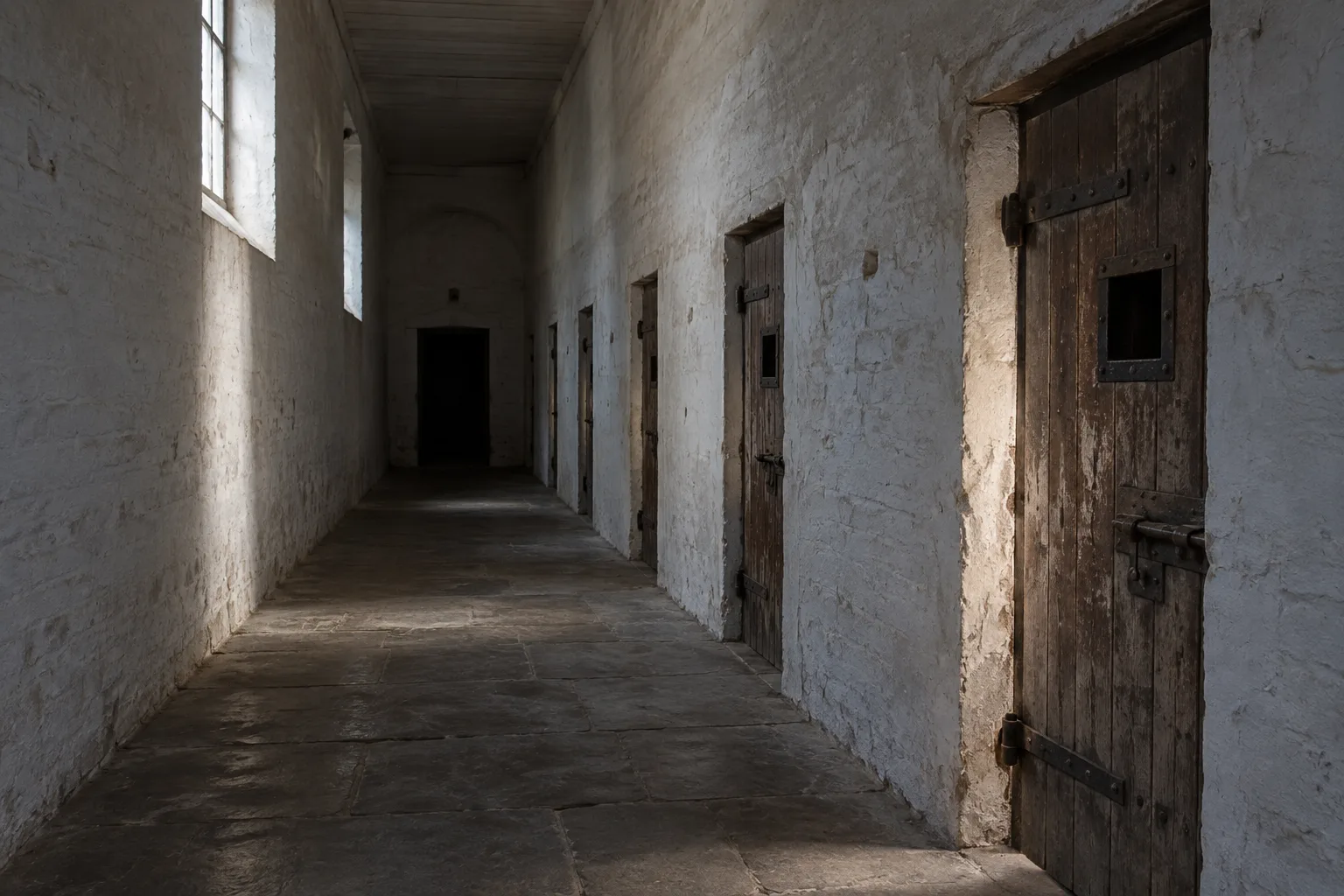
The Separate Prison gave institutional control an especially intimate form. In ABC’s reporting on researcher Honey Dower’s work, men spent about 23 hours a day in individual cells and carried out cell-bound labour. Hoods concealed their faces when they moved outside, and numbers replaced names in the prison’s regime.
The system’s advocates intended separation and religious instruction to encourage reform. That ambition did not make the experience humane. Dower’s research, drawing on conduct records and other documents, examines the damage associated with isolation. The report distinguishes ordinary cells with windows from more severe confinement without light. It is important not to turn every cell into the same invented dungeon.
The disturbing element is the organisation. A man did not merely lose the ability to leave the building. He lost ordinary conversation, spontaneous recognition and much of the daily reassurance people receive from one another. No supernatural event is required to make that a frightening form of confinement.
A bell could replace a human voice
A 2024 archaeological study by Martin Gibbs and Richard Tuffin examines how sound, clocks and visual signals regulated the Tasman Peninsula’s convict landscape. Inside the Separate Prison, the authors describe bells and signals that instructed prisoners while speech remained restricted.
Each cell had a signalling mechanism that raised a numbered plate outside the door and rang a bell to summon a guard. The study also discusses a watch clock used to check whether officers attended their duties. Port Arthur’s regime monitored the watchers as well as the watched.
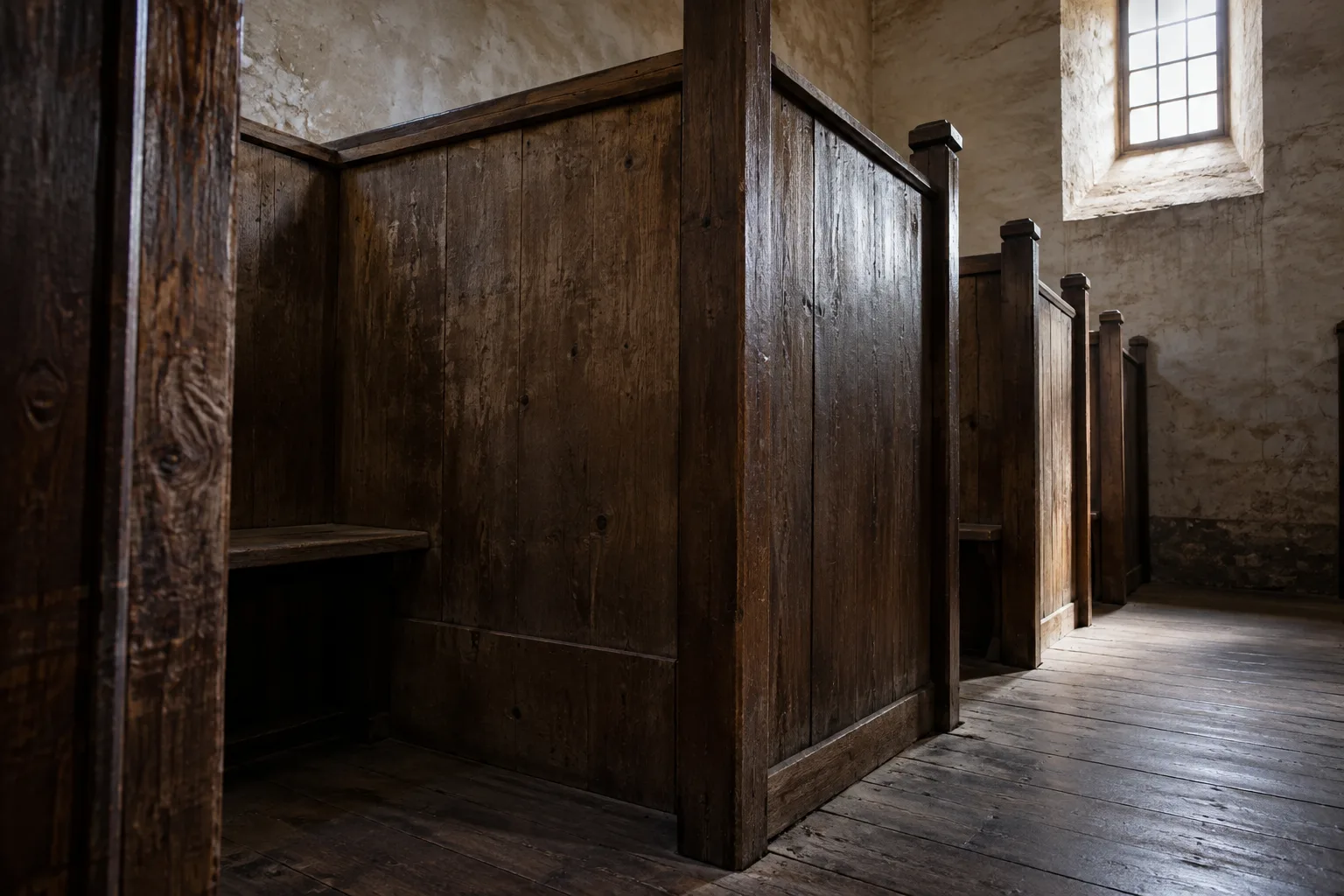
Even religious services preserved separation, as the Australian Convict Sites nomination document explains. The prison chapel’s arrangement screened men from one another rather than allowing the ordinary sociability of a congregation. This makes the interior unsettling in a precise way: the building permitted people to occupy one room without granting them an ordinary shared experience.
Eastern State Penitentiary’s history of isolation and haunting claims offers a useful comparison. The institutions are not interchangeable, but both invite a difficult question about what happens when a promised reform depends on depriving people of contact.
The Parsonage and the stories that outlived the prison
Port Arthur’s ghosts did not appear only with modern publicity. Historian Will Mooney’s University of Tasmania essay on ghost stories identifies the site as an important source of Tasmanian supernatural narrative. It notes that George Cruncel published an account of strange events at the Parsonage in the 1890s.
That is evidence for the age and circulation of a story. It is not independent verification that a dead person occupied the building. A published account can preserve an experience, interpretation or retelling without settling its cause. The distinction becomes more important as a tale acquires new details through repetition.
Mooney situates Tasmania’s ghost traditions within cultural inheritance, oral storytelling and the troubled memory of settlement. This gives the haunted reputation a history of its own. The stories are not simply decorative additions to old buildings; they show how later communities struggled with the past and made it present again.
What an archive can tell us that a haunting cannot
The State Library of New South Wales catalogue for Separate Prison reports describes a volume covering 1867 to 1871. Its pages identify prisoners and record employment, work, conduct and official oversight. The catalogue also explains the prison’s radial arrangement and its emphasis on surveillance, separation and silence.
These are not complete access to a person’s inner life. Administrative records reflect the institution that made them, with its own categories and priorities. Nevertheless, they offer identifiable dates, names and decisions that a researcher can check against other material. That makes them a different kind of evidence from an unnamed visitor’s unexplained sensation.
A careful reading of Port Arthur should keep both limitations in view. A ledger does not tell us everything a prisoner felt. A ghost story does not fill that gap with reliable testimony from the dead. Neither the absence of a simple explanation nor the emotional force of a setting establishes a supernatural cause.
The ruin is not an untouched crime scene
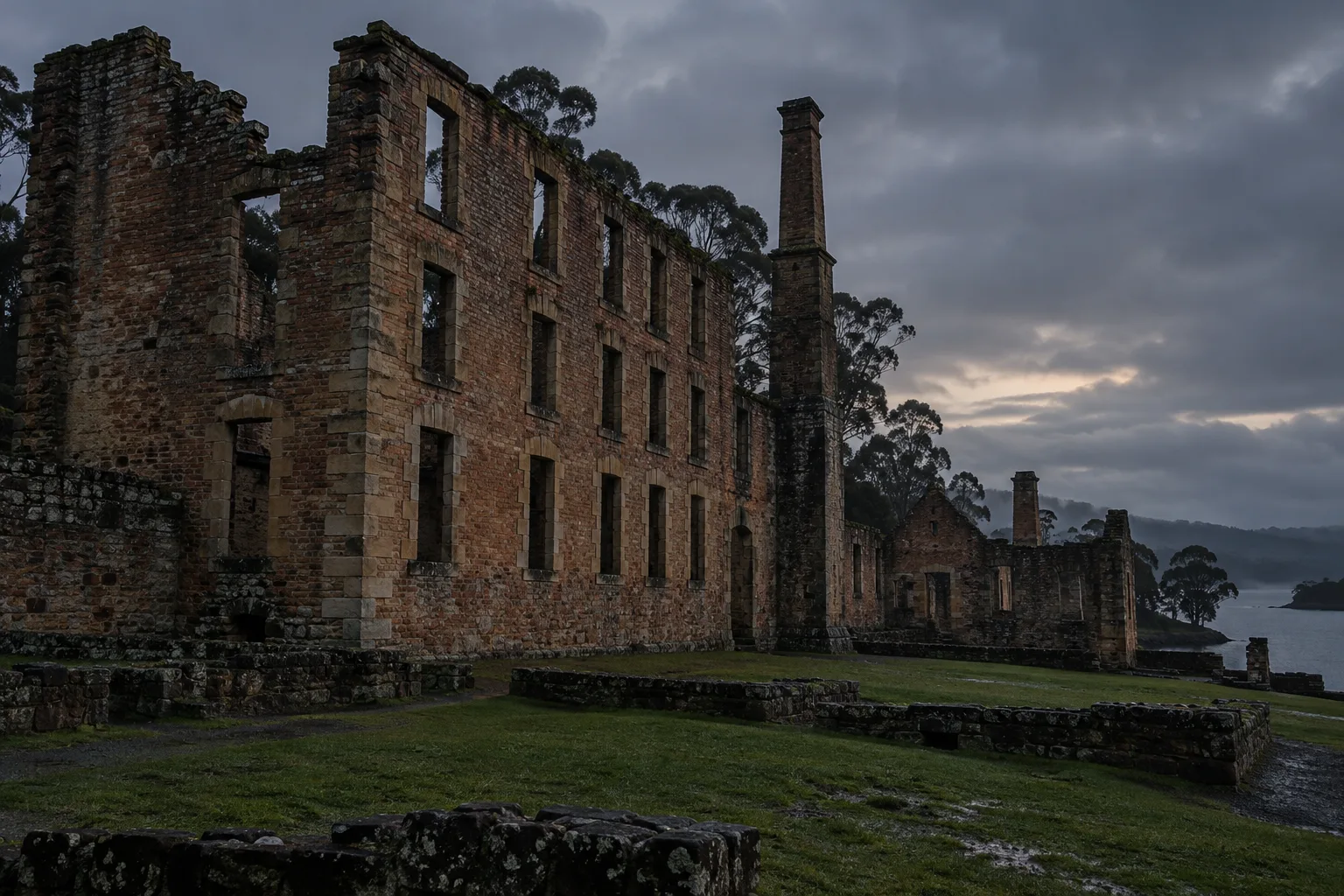
The site’s history of the Penitentiary explains that the building began as a flour mill and granary. It became prisoner accommodation during a conversion between 1854 and 1857. Fire devastated it in 1897, leaving masonry and barred windows, and substantial conservation work has followed.
Those changes matter when interpreting an eerie photograph. An empty opening may reflect fire damage or later conservation rather than a prisoner’s original view. A preserved ruin is a historical source, but not a frozen moment. Our illustrations interpret documented architectural features; they are not photographs of the actual interiors or reconstructions of a witnessed event.
The same caution applies to the stories attached to Edinburgh’s underground vaults. A place can have a documented material history and a much less certain supernatural reputation. Keeping the two distinguishable makes the history richer, not less frightening.
A night visit is not a licence to forget the living
The operator’s current Ghost Tour information describes a guided, lantern-lit walk of approximately 90 minutes over about two kilometres. It explicitly says the route is not wheelchair accessible because of restricted access in heritage buildings. Check the operator’s booking information for the intended date rather than relying on an older departure time or assuming admission arrangements remain unchanged.
A guided account of unexplained events is an interpretation and a visitor experience, not a scientific certification of ghosts. The tour’s atmosphere does not remove the need to ask who reported an event, when it was recorded, and whether ordinary explanations were considered. Curiosity and scepticism can accompany each other through the same doorway.
Port Arthur also holds grief that is neither distant nor appropriate material for a scare. The site’s 2026 remembrance notice describes consultation with survivors, bereaved families, responders and the community about the thirtieth anniversary of the 1996 tragedy. The memorial deserves quiet respect, not an invented connection to ghost sightings.
The history remains when the lantern goes out
Port Arthur does not need a proven haunting to disturb. Its records and architecture describe a system that attempted to reshape people by controlling labour, movement, sight and speech. The most uncomfortable question is not whether someone still walks the corridor, but what it meant to endure that corridor when leaving was impossible.
The ghost stories deserve attention as folklore and as a long part of the site’s public memory. They should not displace the documented lives, turn suffering into anonymous scenery or give certainty where none exists. After the lantern-lit walk ends, the strongest evidence still waits in the buildings, the archives and the history that visitors choose to carry home.
Sources and further reading
- Richard Tuffin, University of Tasmania: Port Arthur Penal Settlement
- UNESCO: Australian Convict Sites
- Georgie Burgess, ABC: research into the Separate Prison
- Gibbs and Tuffin: Carceral Time at Port Arthur (2024), open-access paper
- Will Mooney, University of Tasmania: Ghost Stories
- State Library of NSW: Separate Prison Reports, 1867–1871
- Port Arthur Historic Site: Penitentiary history and conservation
- Port Arthur Historic Site: current Ghost Tour conditions
- Port Arthur Historic Site: 2026 remembrance and respectful reflection
- Australian Government: Convict Sites nomination, separate-system discipline and worship