


Seventeen kilometers west of Jaisalmer, a road enters a village without residents. Sand collects in roofless rooms. Doorways open onto empty courtyards, and rows of golden-stone houses stand beneath the punishing Thar Desert sky. This is Kuldhara village, one of India’s most famous abandoned settlements and the center of a curse story that has grown darker with every retelling.
Popular legend says the entire population fled in a single night in 1825, leaving a warning that nobody would ever live there again. History offers less dramatic but more convincing pressures: oppressive taxation, collapsing trade, political insecurity, and an increasingly fragile water supply. The ruins are real. The sudden vanishing and supernatural curse are much harder to prove.
What was Kuldhara before it became a ghost village?
Kuldhara was established by Paliwal Brahmins, a community known for commerce, agriculture, and sophisticated water management in western Rajasthan. Rajasthan Tourism dates the settlement to 1291. Over several centuries, Kuldhara became part of a network of Paliwal villages around Jaisalmer.
Prosperity in this landscape required careful engineering. Rain was scarce and unreliable, so cultivators used a system called khadeen to capture runoff behind earthen embankments. Moisture retained in the soil then supported crops after the brief monsoon. The technique allowed communities to farm in conditions that appear almost impossible to an unfamiliar visitor.
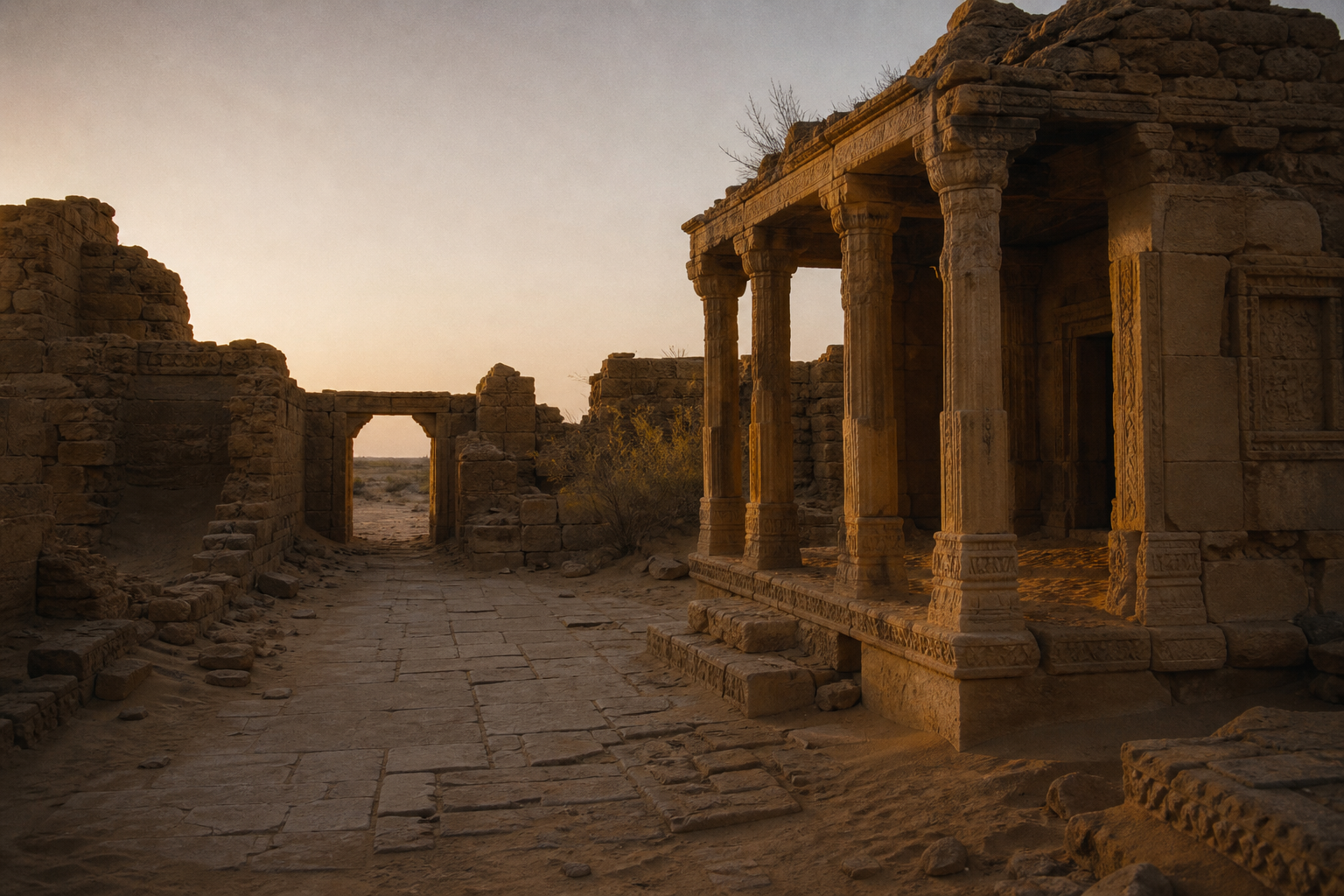
The surviving village plan hints at an organized society rather than a temporary desert camp. Narrow streets connect sandstone homes, wells, courtyards, and a central temple. Its architecture belongs to a living settlement shaped by climate, privacy, and community, even though missing roofs and windblown rooms now make it resemble a stage abandoned between scenes.
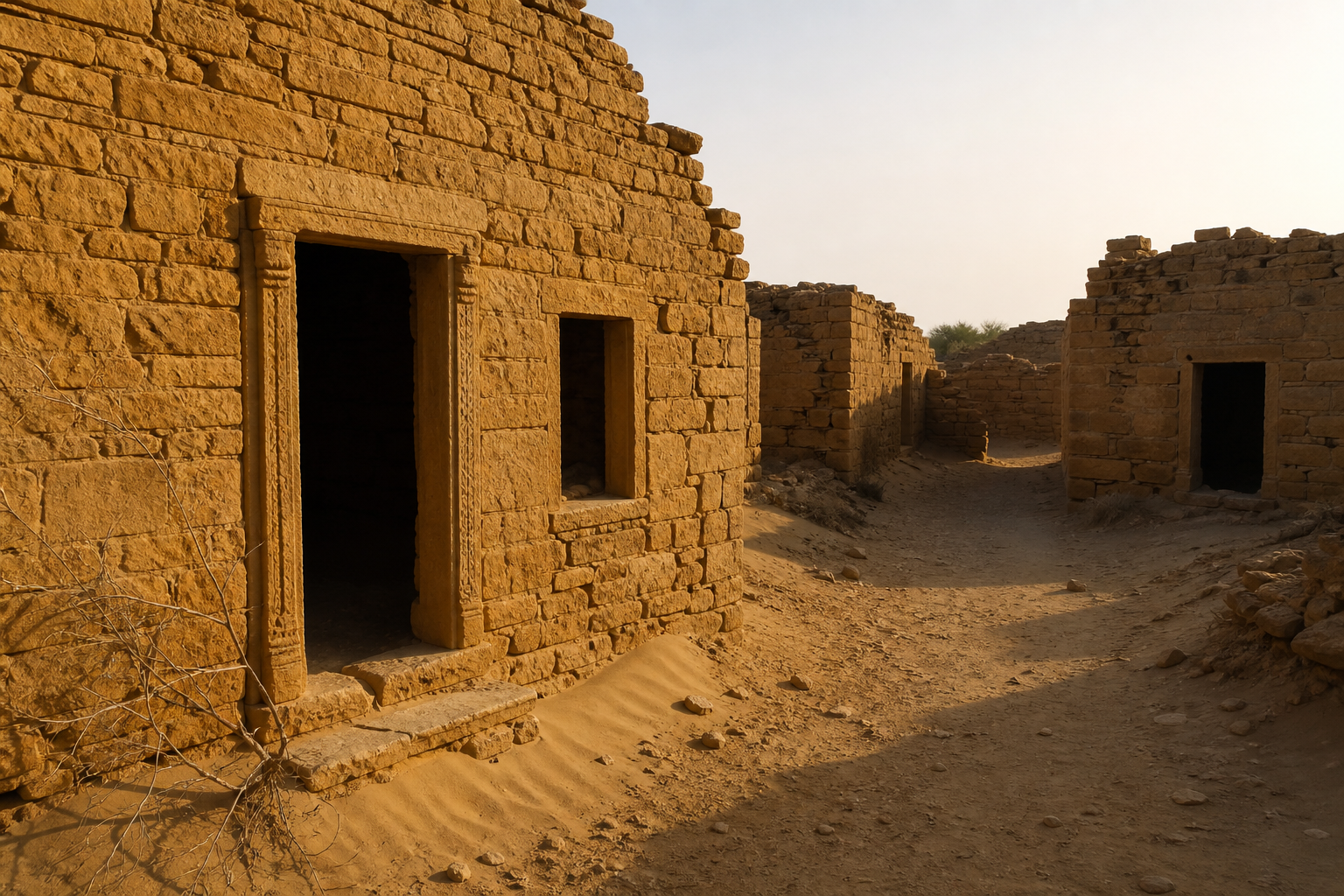
The night the Paliwals allegedly disappeared
The best-known Kuldhara village story centers on Salim Singh, the powerful diwan, or minister, of Jaisalmer. According to folklore, he wanted to marry the daughter of Kuldhara’s village head and threatened the community with severe consequences if it resisted. Some versions describe forced marriage. Others say he promised crushing taxes.
The village council supposedly chose departure over submission. Messengers passed the decision through dozens of neighboring Paliwal settlements. Then, during one night, families left their homes and disappeared into the desert. Before leaving, the story says, they cursed Kuldhara so that anyone attempting to settle there would meet disaster.
Rajasthan Tourism presents 1825 as the year of the exodus and refers to Kuldhara and 83 nearby villages. Other accounts differ on the number of settlements, residents, and the exact sequence. That variation is important. It shows that the episode reaches us largely through oral tradition and later reconstruction rather than a complete contemporary record.
Kuldhara village facts and disputed claims
| Claim | What the record supports |
|---|---|
| Kuldhara was a prosperous Paliwal settlement | Supported by official tourism history, surviving architecture, and accounts of Paliwal farming and trade |
| Everyone vanished during one night in 1825 | A famous tradition, but the precise date, scale, and speed of migration are not securely documented |
| Salim Singh demanded the village head’s daughter | Central to the legend; no surviving contemporary record proves the complete story |
| The departing residents cursed the land | Folklore, not historical or scientific evidence |
| Ghosts prevent anyone from living there | No verified paranormal evidence demonstrates this claim |
Kuldhara is unquestionably abandoned, but abandonment does not establish a supernatural cause. A settlement can empty rapidly when families share kinship, trade, debt, and political pressure. Migration also leaves fewer written traces when a community disperses into related groups rather than moving as one visible caravan.
Water, taxes, and the decline of desert trade
The curse legend condenses a complicated crisis into a single villain and a single night. Historical explanations point toward several pressures operating together. Salim Singh’s tax demands may have become intolerable as the Paliwals’ economic position weakened. A community that once profited from regional trade could have suffered as commercial routes shifted.
Water may have been even more decisive. Kuldhara depended on local wells, runoff harvesting, and a delicate understanding of desert soil. Falling groundwater, prolonged dryness, or a damaged catchment could turn a prosperous village into an expensive place to sustain. Agricultural skill could reduce risk, but it could not create limitless water.
The ruins themselves do not prove that every resident abandoned an intact home during one coordinated night. Buildings decay, stones are reused, roofs collapse, and sand erases gradual change. What now feels like an instantaneous interruption may reflect a migration that unfolded over a longer period and was later compressed into legend.
How a deserted village became haunted
Kuldhara’s haunted reputation draws power from its physical setting. The Thar Desert can shift quickly from glaring brightness to deep shadow. Wind passes through narrow openings and roofless chambers, producing whistles, knocks, and voices that seem to move. Warm stone releases heat after sunset while open spaces cool faster, creating noticeable temperature changes.
Expectation changes perception as well. A visitor who arrives after hearing about curses and missing villagers will interpret an ordinary sound differently from someone studying masonry. Darkness removes visual reference points, while fatigue, dehydration, animals, and blowing sand can make an unfamiliar ruin feel inhabited.
Paranormal groups have reported voices, shadows, touches, electromagnetic fluctuations, and unexplained marks at Kuldhara. These remain claims, not independently verified evidence. In a Gulf News investigation, local conservation figures described spending nights at the site without witnessing paranormal activity, directly challenging the more dramatic accounts.
Does Kuldhara really remain empty because of a curse?
The phrase “nobody could ever settle there” sounds like proof only if modern land use is ignored. Kuldhara is now a protected heritage destination managed for visitors, not an available residential neighborhood. Conservation rules, limited infrastructure, water constraints, tourism, and the value of the ruins all discourage ordinary settlement.
Restrictions on access after dark are also not evidence of ghosts. Heritage sites can close for safety, conservation, staffing, wildlife, and liability reasons. Broken walls, unlit drops, snakes, and extreme desert conditions present tangible hazards. Turning an administrative closing time into official confirmation of a haunting gives the sign a meaning it does not carry.
Even so, the curse performs a cultural function. It transforms displacement into resistance. In the legend, the Paliwals are not helpless victims who quietly lose their homes. They choose exile, deny a powerful official what he wants, and make the land itself refuse every future claimant.
Visiting the Kuldhara ruins responsibly
Rajasthan Tourism places Kuldhara about 17 kilometers west of Jaisalmer and describes it as a protected monument under the State Archaeology Department. Visitors should confirm current opening hours locally, enter only through authorized access points, and leave before the official closing time.
The ruins are fragile. Climbing unstable walls, removing stone, entering closed structures, or attempting an unauthorized overnight visit risks injury and damages the site. It also reduces a displaced community’s history to a paranormal dare.
Kuldhara belongs within a broader landscape of places where abandonment invites supernatural explanation. Our investigation of Bhangarh Fort’s haunted reputation examines another Rajasthani site shaped by curse folklore. Farther away, the empty structures of Poveglia Island show how isolation and restricted access can make uncertain history feel like proof of ghosts.
Why Kuldhara still unsettles visitors
The most honest answer to the Kuldhara village mystery is that no single explanation accounts for every detail. Economic decline, water scarcity, taxation, and political pressure offer a credible foundation for migration. The Salim Singh story preserves a memory of exploitation, but its most cinematic details cannot be independently confirmed.
No reliable evidence proves that spirits patrol the lanes or that a supernatural curse prevents resettlement. Yet the village remains frightening because absence has become visible there. Houses retain their doorways but not their families. A temple faces a street that no longer carries daily footsteps. As sunset drains the color from the sandstone, the ruins do not reveal where everyone went. They preserve only the shape of what was left behind.
Read next
- The curse legends surrounding Bhangarh Fort
- History behind the haunted legend of Poveglia Island
- Why Hoia Baciu Forest became a paranormal landmark