
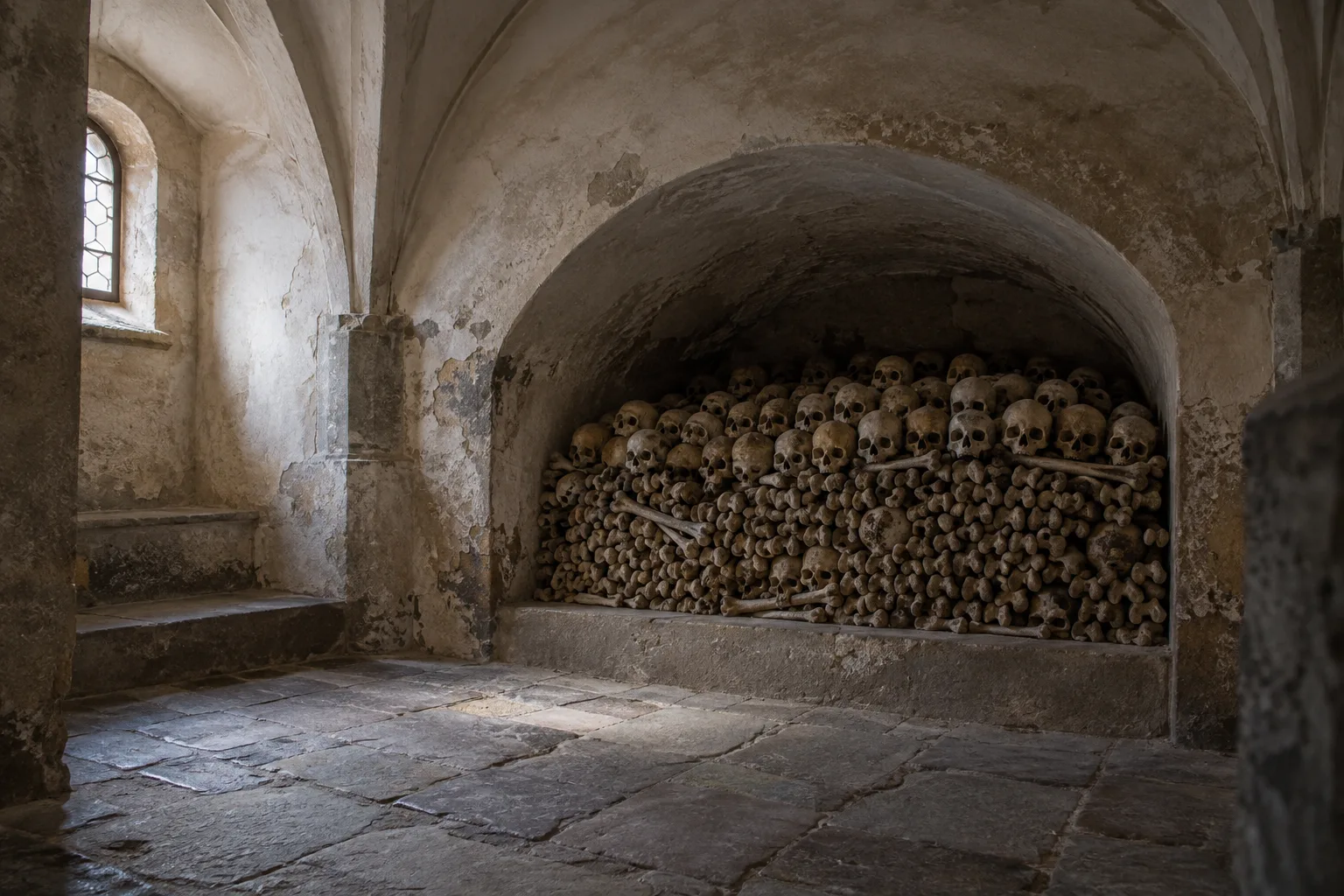
Sedlec Ossuary unsettles because the material is not a theatrical substitute. The skulls and bones belong to people whose remains were moved from graves into the lower chapel of a cemetery church near Kutná Hora, Czechia. What now looks like extraordinary decoration began with burial, limited space and the question of how to care for the dead.
The famous bone church is part of the Cemetery Church of All Saints. Its macabre appearance can encourage the language of curses or haunted attractions, but the documented story is different: a Christian burial place, changing artistic choices and centuries of mortality. No invented apparition is needed to make the setting disturbing. The harder thought is that these remains once belonged to individual lives, most of whose details a visitor cannot recover.
In this story
Why the dead were moved into Sedlec Ossuary
The parish’s history of Sedlec Ossuary explains that the remains came from exhumed graves in the large cemetery on former monastery land. As burial pressures increased and the cemetery later contracted, bones needed a place of respectful storage. The lower chapel served that purpose, while the upper chapel accommodated commemorative worship.
This was not a church built from the bodies of people killed to furnish it. Exhumation and the later arrangement of bones form different stages in its history. Collapsing them into one grisly act obscures both the cemetery’s practical needs and the religious purpose of keeping remains below ground.
The regional tourism authority connects the church with the former Cistercian abbey, founded in 1142. It also records the legend that earth brought from Jerusalem made the cemetery especially desirable. That soil story is a tradition about the site’s holiness, not a finding established by modern archaeological testing.
How Sedlec Ossuary became a bone church
The striking interior was not a single medieval design that remained untouched. VisitCzechia’s account identifies both architect Jan Blažej Santini-Aichel and František Rint in its development. Santini’s work belongs to an earlier phase; Rint’s later intervention helped produce the decorations for which the chapel became widely known.
The parish dates the completion of Rint’s work to 1870 and associates him with the chandelier, hanging garlands and Schwarzenberg coat of arms. Those forms make the room particularly difficult to process: material associated with an individual body becomes ornament, pattern and an object suspended overhead.
Yet visual shock is not the whole history. It matters that Sedlec Ossuary’s arrangements developed within a religious space rather than a modern horror production. Calling them merely grotesque props misses the encounter between devotion, artistic taste and human remains. The discomfort comes partly from not being able to separate those categories neatly.
The cemetery holds more than one catastrophe
A 2025 study in the journal Radiocarbon examined mass graves found near the chapel. Researchers combined archaeological context, radiocarbon dating and statistical modelling to investigate the relationship between burials and the famine of 1318 and plague of 1348 to 1350. Their analysed sample included teeth and bones from 86 individuals.
The paper also explains the limits of that reconstruction. It calls for ancient DNA analysis to help validate the identification of plague in the studied remains. The research concerns excavated graves and a defined sample. It does not identify the cause of death of every person whose bones now appear in the decorative arrangements.
That distinction is more informative than repeating an enormous total as though every skull came from one event. Sedlec Ossuary belongs to a cemetery with a long history, not one frozen instant of disaster. A burial ground can preserve the consequences of repeated crises, ordinary deaths and later changes to how the dead were housed.
Readers interested in a different response to crowded burial grounds can explore the history of the Paris Catacombs. The comparison is about the movement and care of human remains, not a claim that the two places share the same origin or religious meaning.
What memento mori means in a room of bones
Memento mori is a reminder of mortality. The parish describes the earlier Baroque arrangement at Sedlec in terms of death, divine order and hope of resurrection. The image was not simply that death defeats everyone. Within its Christian framework, the remains also belonged to an expectation beyond death.
For a modern viewer, the tension can be uncomfortable. A skull is recognisable as part of a person, but a repeated arrangement encourages the eye to read it as pattern. Recognition keeps interrupting decoration. The object cannot become entirely abstract without the viewer deliberately overlooking what it is.
This is an interpretation of the room’s effect, not a claim about what every visitor feels or what every deceased person believed. It also explains why the site can disturb without a supernatural allegation. A ghost story imagines a presence returning. An ossuary asks the visitor to confront a physical presence that never entirely left.
The work behind an apparently timeless interior
Sedlec Ossuary is not an interior outside time. The parish’s published restoration account describes structural instability and damp as major reasons for intervention. Preserving the building involves supporting masonry, controlling moisture and protecting the fragile material inside it.
The Sedlec Ossuary conservation report for 2025 describes a new internal wooden structure for a bone pyramid, intended to improve stability and ventilation, as well as changes to visitor circulation during construction. These details challenge the impression of an untouched chamber. What survives depends on people making practical decisions about materials, access and care.
A conservation report is therefore useful reading before a visit. It explains why an older photograph may not match the current arrangement or route. This article does not promise that a particular restoration stage or exhibition is complete. Check the parish’s current notices rather than using an undated image as a guide to what is accessible.
A visit governed by the people buried here
The official Sedlec Ossuary visitor guidance requires advance booking for a specific date and time. It identifies the bones as genuine human remains, prohibits touching them and asks for quiet, respectful conduct. Photography is not permitted inside the church.
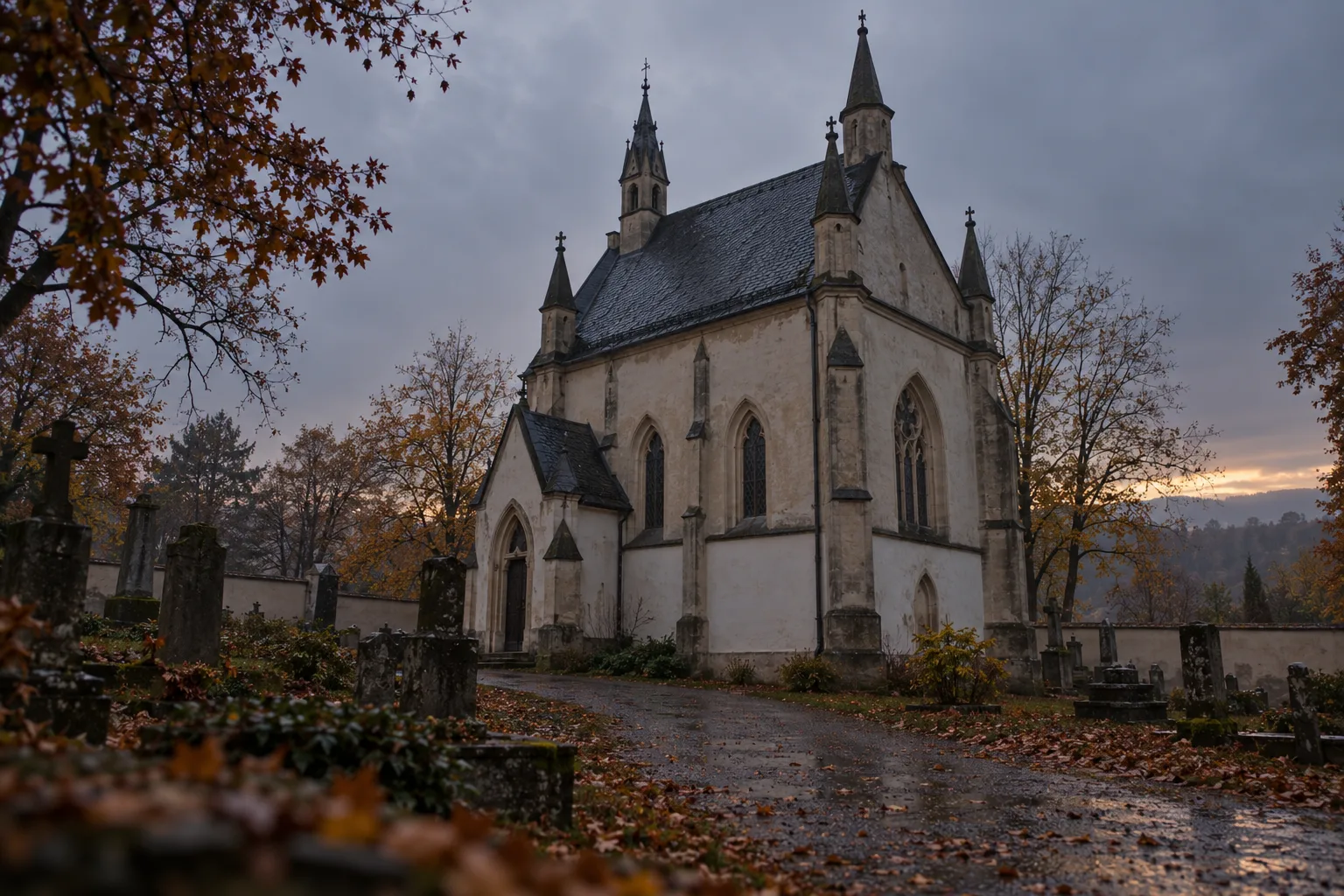
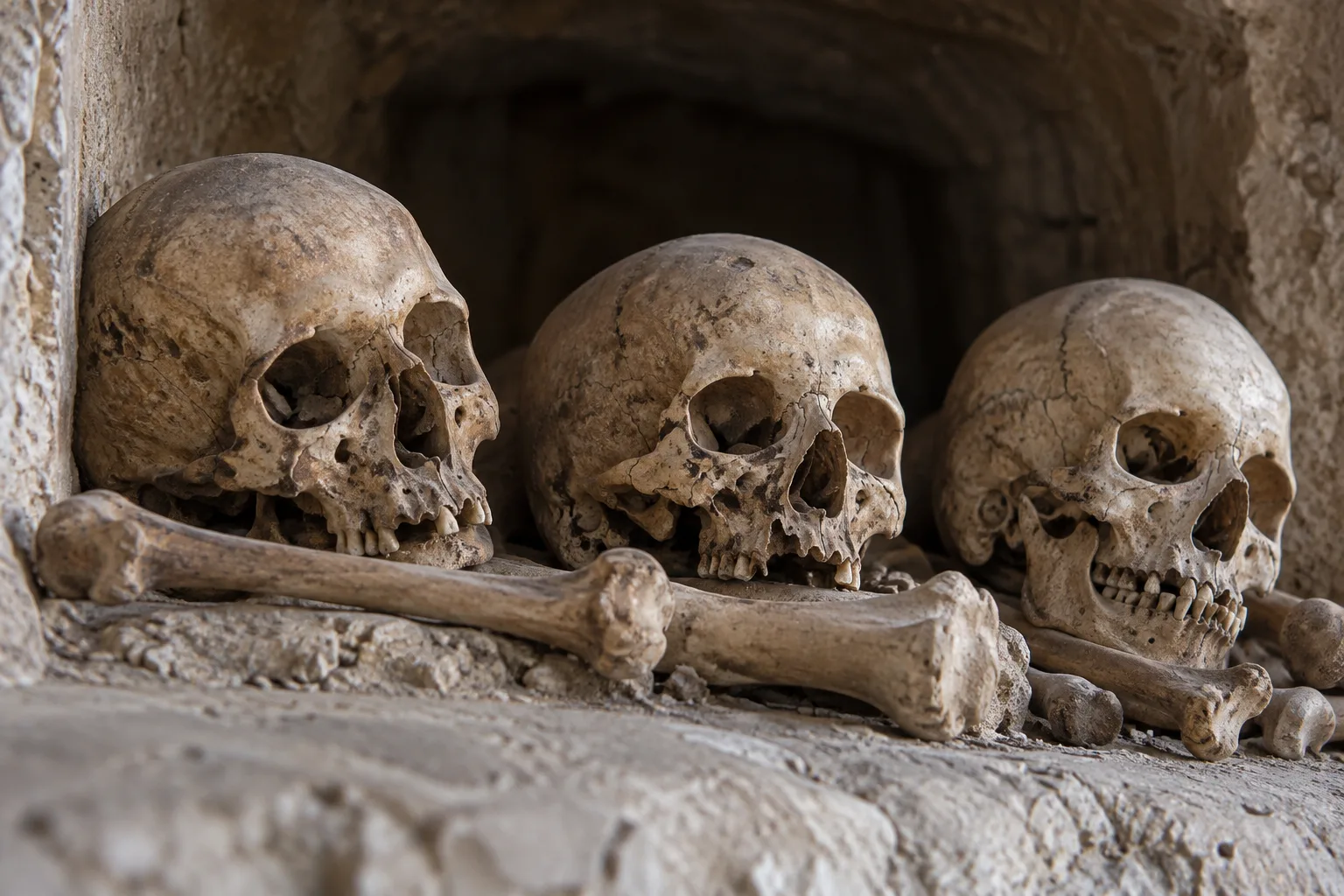
The published visitor rules also prohibit entering restricted areas or walking over graves. This remains a working church and cemetery, not a setting where a visitor’s desire for an eerie image overrides the people commemorated there. The illustrations accompanying this article are original interpretations, not photographs taken inside Sedlec.
Accessibility needs particular attention. The current visitor page warns that construction affects step-free access. Confirm the latest arrangements with the operator before travelling if stairs present a barrier, and check opening conditions and ticket availability through the official site. Do not infer access from another traveller’s older description.
For a contrasting Czech story, Houska Castle’s gateway-to-hell legend shows how a building acquires a supernatural explanation. Sedlec Ossuary offers a different encounter: its most unsettling feature is documented and material, not dependent on proving a portal or an apparition.
More unsettling than an invented haunting
Sedlec Ossuary is frightening in a way that does not require certainty about ghosts. It places the evidence of mortality into forms that invite sustained looking, then makes that looking ethically difficult. The remains are not anonymous stage dressing simply because a visitor cannot attach a name to each one.
The documented history supports a burial place transformed by successive decisions about space, worship, art and preservation. It does not establish a curse or a verified haunting. The most lasting thought is less elaborate than either: each repeated shape belonged to a person, and the room still asks the living how carefully they are willing to remember that.
Sources and further reading
- Sedlec parish: cemetery, ossuary and decoration history
- Regional tourism authority: All Saints cemetery church
- VisitCzechia: Sedlec chapel and its bone decorations
- Sneberger and colleagues: medieval plague and famine graves, Radiocarbon (2025)
- Sedlec parish: conservation and repair reports
- Sedlec parish: current visitor arrangements
- Sedlec parish: visitor rules