
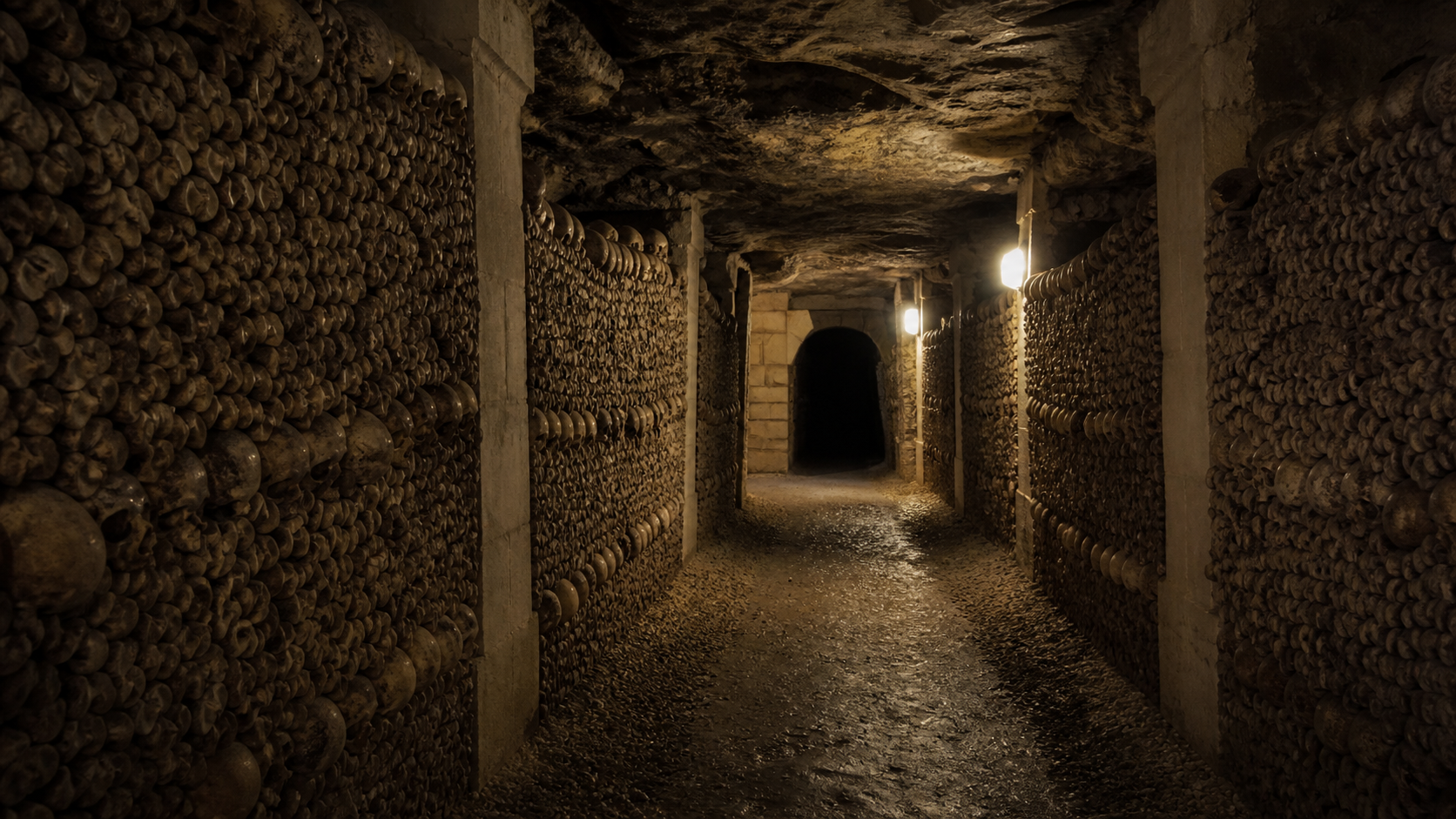
The Paris Catacombs begin with a warning carved above the entrance to the ossuary: “Stop, this is the empire of death.” Beyond it, the corridor narrows and the walls change. Limestone gives way to carefully arranged femurs and skulls, forming a structure that continues farther than the visitor’s light can comfortably reach.
For generations, those underground rooms have attracted stories about whispering voices, lost explorers, secret rituals, and tunnels that rearrange themselves after midnight. The documented history is more disturbing. The Catacombs were created because the living city could no longer contain its dead, while the ground beneath Paris was already collapsing into forgotten quarries.
Reopened on April 8, 2026 after a five-month renovation, the official site now places greater emphasis on conservation and the people represented by the remains. That shift matters. The Paris Catacombs are frightening, but they are not a theatrical dungeon. They are a municipal response to disease, overcrowding, unstable ground, and millions of lives stripped of their individual names.
The city was built above a hollow world
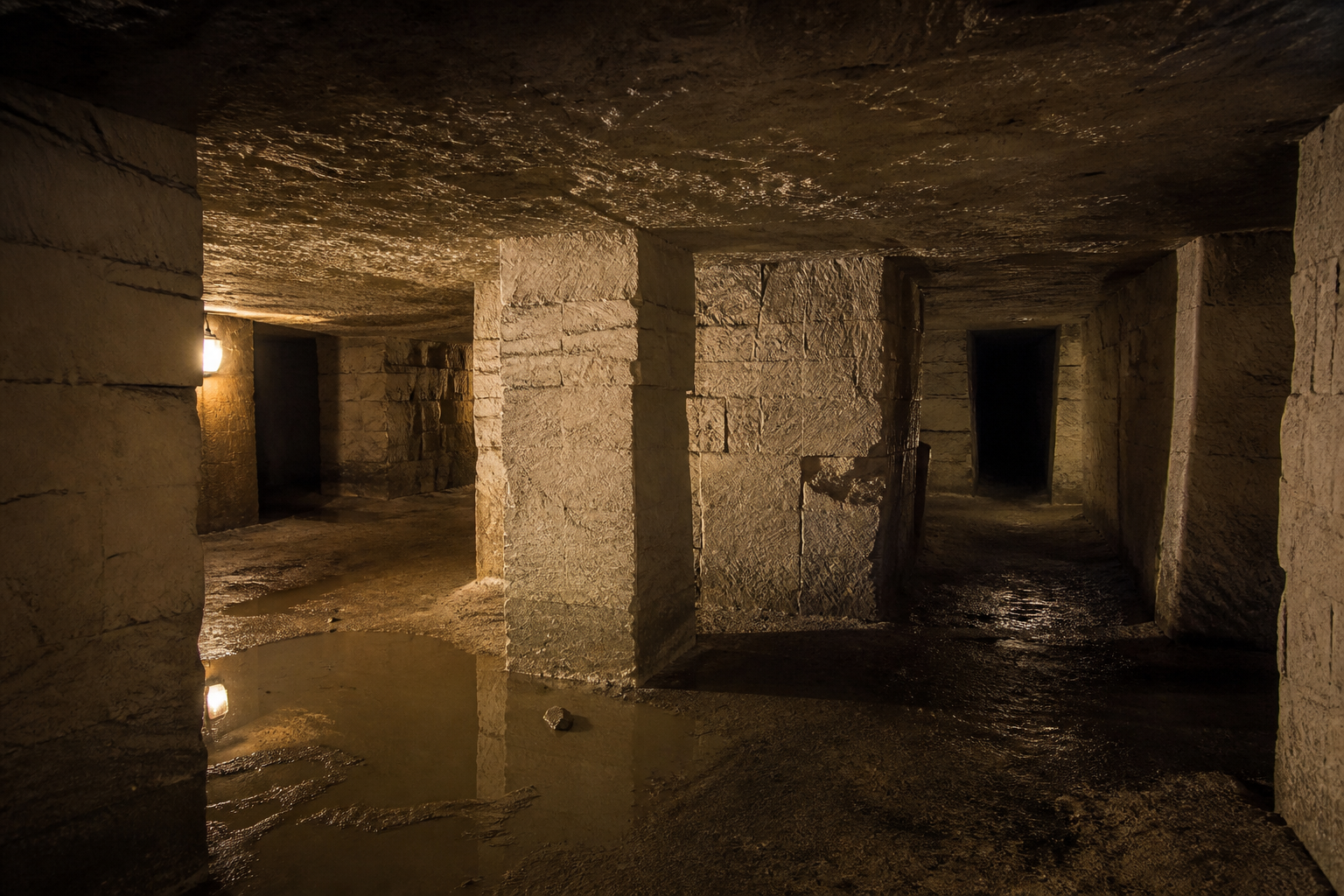
Long before bones entered the tunnels, quarry workers extracted limestone beneath what would become modern Paris. The stone helped construct the city above, leaving chambers, pillars, and passages below. As Paris expanded, many old workings were abandoned or poorly recorded.
By the eighteenth century, the underground voids had become a threat. Serious collapses opened beneath streets and buildings. In 1777, under Louis XVI, authorities created the Inspection Générale des Carrières to survey, reinforce, and manage the former quarries.
This origin is often lost in popular retellings. Most of the underground network is not an ossuary. It is a system of former mines and inspection galleries. The official Paris Catacombs occupy only a defined section that was converted to hold human remains. Calling every tunnel beneath the city a catacomb makes the legend larger while making the history less precise.
When the cemeteries began poisoning Paris
Above ground, the city faced a different crisis. Central burial grounds had accepted generations of dead within increasingly crowded neighborhoods. The Cemetery of the Innocents, used for centuries, became the most notorious example. Graves were repeatedly reopened, remains accumulated in charnel structures, and nearby residents complained of foul conditions.
In 1780, part of a wall bordering the cemetery gave way, allowing decomposing material to enter an adjacent cellar. Authorities closed the burial ground. The question was no longer whether it should continue operating, but where an immense quantity of human remains could be moved.
The abandoned quarries offered space away from ordinary life. Between 1785 and 1787, workers began transferring remains from the Cemetery of the Innocents. Covered carts crossed Paris at night before bones were lowered into quarry shafts near the present ossuary. Further transfers from other cemeteries continued through the revolutionary period and into the nineteenth century.
How an underground storehouse became an empire of death
The first deposits were not arranged as the public sees them now. Bones were placed deeper in the quarry spaces, often without individual identification. In the early nineteenth century, quarry inspector Louis-Étienne Héricart de Thury reorganized the ossuary into a deliberate memorial environment.
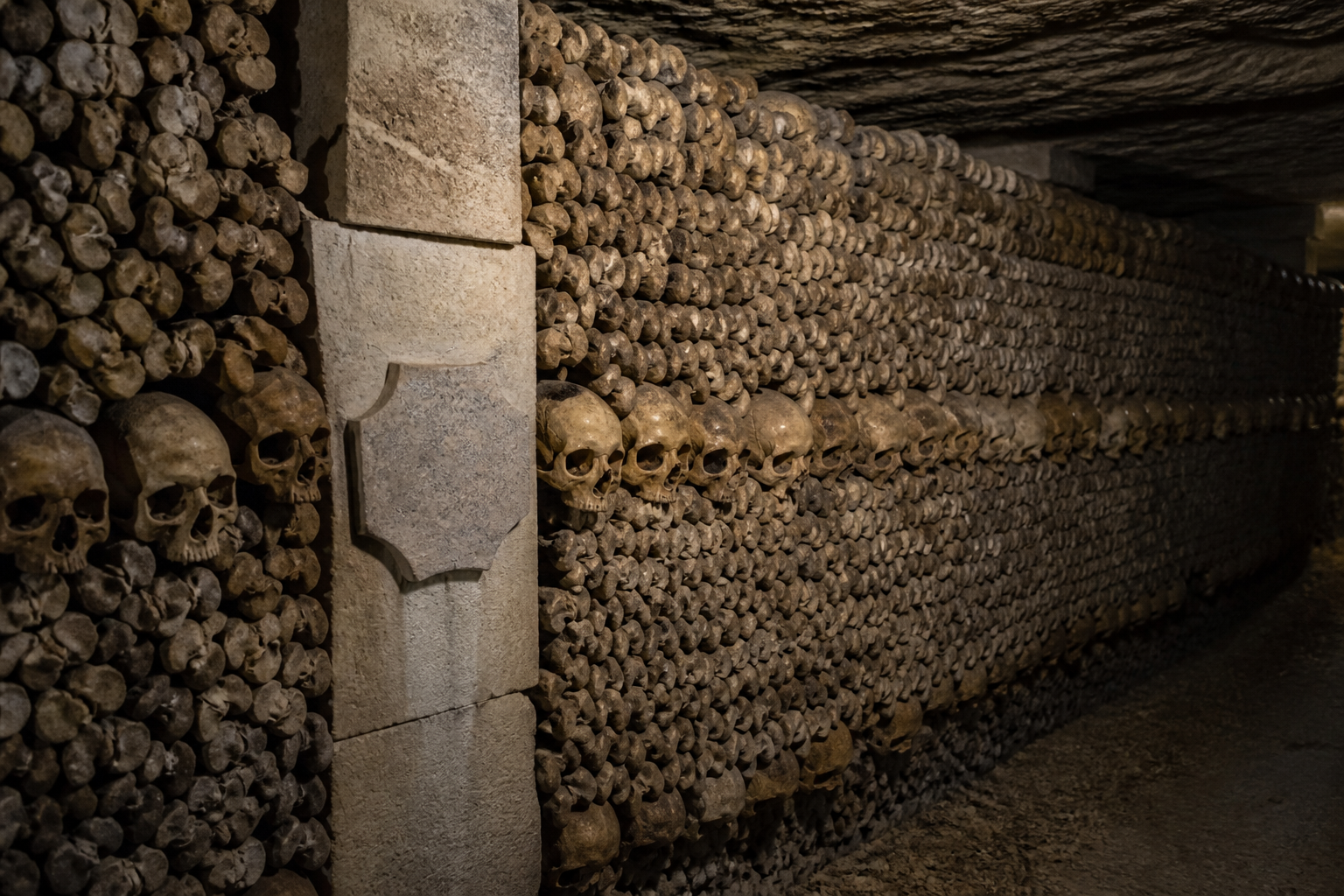
Workers constructed walls known as hagues. Long bones formed dense retaining layers, while skulls created horizontal bands and patterns at the front. Smaller and fragmented remains filled the deeper spaces behind those façades. Cemetery markers and reflective inscriptions turned municipal storage into a carefully staged encounter with mortality.
The result is visually ordered but personally anonymous. The Catacombs contain the remains of several million Parisians, commonly estimated at around six million. They include people from different centuries, social classes, parishes, and burial grounds. The arrangement erased the boundaries that once separated many of them in life.
The public route and the forbidden maze are not the same place
The official visitor route is managed, mapped, monitored, and only a small part of the wider quarry network. Outside it, restricted galleries extend beneath sections of southern Paris. Illegal explorers known as cataphiles enter through concealed or unauthorized access points, navigating spaces that can flood, narrow, collapse, or become disorienting.
Those forbidden areas have developed their own culture. Explorers maintain maps, create rooms, paint murals, hold gatherings, and sometimes protect access information from outsiders. The secrecy encourages a popular belief that nobody knows what lies below Paris. In reality, much of the quarry network has been surveyed, although changing barriers, flooded sections, and unofficial modifications complicate any single map.
The danger is also more practical than paranormal. Darkness removes distance cues. Similar passages encourage wrong turns. Mud, water, unstable stone, low ceilings, poor reception, and a failed light can convert curiosity into an emergency. The maze does not need to move to make someone feel that it has.
Where the Paris Catacombs legends begin
Popular stories describe voices calling explorers by name, clocks stopping at midnight, secret societies, underground creatures, and a damaged video camera recovered after its owner disappeared. These tales circulate widely online, but reliable records rarely support the most dramatic versions.
The setting makes such legends unusually durable. Human remains are present in staggering numbers. The tunnels are real. Unauthorized explorers do become lost. Restricted spaces exist beyond public view. Each documented fact gives an invented detail somewhere solid to attach itself.
Sound behaves strangely underground as well. Speech can travel around corners, water carries vibration, and another group may be closer than it appears. Under stress, the brain tries to organize incomplete sounds into footsteps or words. Once a person expects a voice in the darkness, random noise becomes easier to hear as language.
That does not mean witnesses are lying. It means an experience and its explanation are different questions. Evil’s Eye used the same standard when examining the Queen Mary’s ghost stories, where unusual acoustics, real deaths, sincere reports, and commercial folklore overlap without proving one another.
War, resistance, and the hidden city below Paris
The underground network also entered twentieth-century history. During the Second World War, different quarry spaces were used for shelters, military facilities, and resistance activity. The scale of the network allowed hostile groups to occupy separate areas without controlling the underground as a whole.
These real wartime uses are sometimes blended with exaggerated stories of entire subterranean armies or untouched Nazi chambers. The truth is fragmented. Specific sites had specific functions, while much of the network remained what it had always been: old quarry galleries requiring continual inspection and reinforcement.
That fragmentation is important. “The Catacombs” has become a single imaginative place in horror fiction, but underground Paris is a collection of quarry systems, sewers, service spaces, crypts, shelters, ossuary rooms, and modern infrastructure. Combining them creates a better myth and a worse map.
What changed when the Catacombs reopened in 2026
The official site closed for approximately five months before reopening to visitors on April 8, 2026. The City of Paris announced renewed interpretation designed to help visitors understand the ossuary’s history and spiritual atmosphere. Conservation remains difficult because the underground environment is persistently humid.
The renovation arrived alongside a broader discussion about how museums and heritage institutions care for human remains. The bones are not decorative objects. Most cannot be reconnected to individual identities, but they still represent people whose burial places were dismantled by the needs of a growing city.
Recent scientific study may recover some of what anonymity erased. Researchers have begun examining remains to learn about the health and lives of past Parisians. This work introduces a different kind of voice from the underground, based not on alleged whispers but on physical evidence held in bone.
Are the Paris Catacombs haunted?
No reliable public evidence demonstrates that the Paris Catacombs contain ghosts, supernatural voices, or passages that alter themselves. The most famous paranormal stories are usually weakly sourced, endlessly repeated, and separated from verifiable dates, witnesses, or original records.
What the site does contain is powerful enough. It holds the remains of millions within tunnels carved from the stone that built Paris. It records a time when cemeteries overflowed into homes, when carts carried the dead through sleeping streets, and when officials transformed a quarry into a monument about the brevity of life.
The feeling of being watched may come from skulls arranged at eye level. A distant whisper may come from another corridor. The fear of becoming lost may come from knowing that beyond the managed route lies a far larger restricted network. Natural explanations do not diminish that atmosphere. They reveal how completely the architecture, history, and human mind can create terror together.
Like the unresolved sequence at the Dyatlov Pass incident, the unknown attracts theories because certainty ends before curiosity does. In Paris, however, the central mystery is not whether the dead still walk. It is how a city learned to build beauty above a hidden population it could no longer name.
Sources
- Paris Catacombs official history
- Paris Catacombs official ossuary and conservation overview
- City of Paris, 2026 reopening announcement
- Smithsonian Magazine, “Empire of the Dead”
- Smithsonian Magazine, underground Paris and cataphile culture
- Le Monde, conservation of human remains after the 2026 renovation