
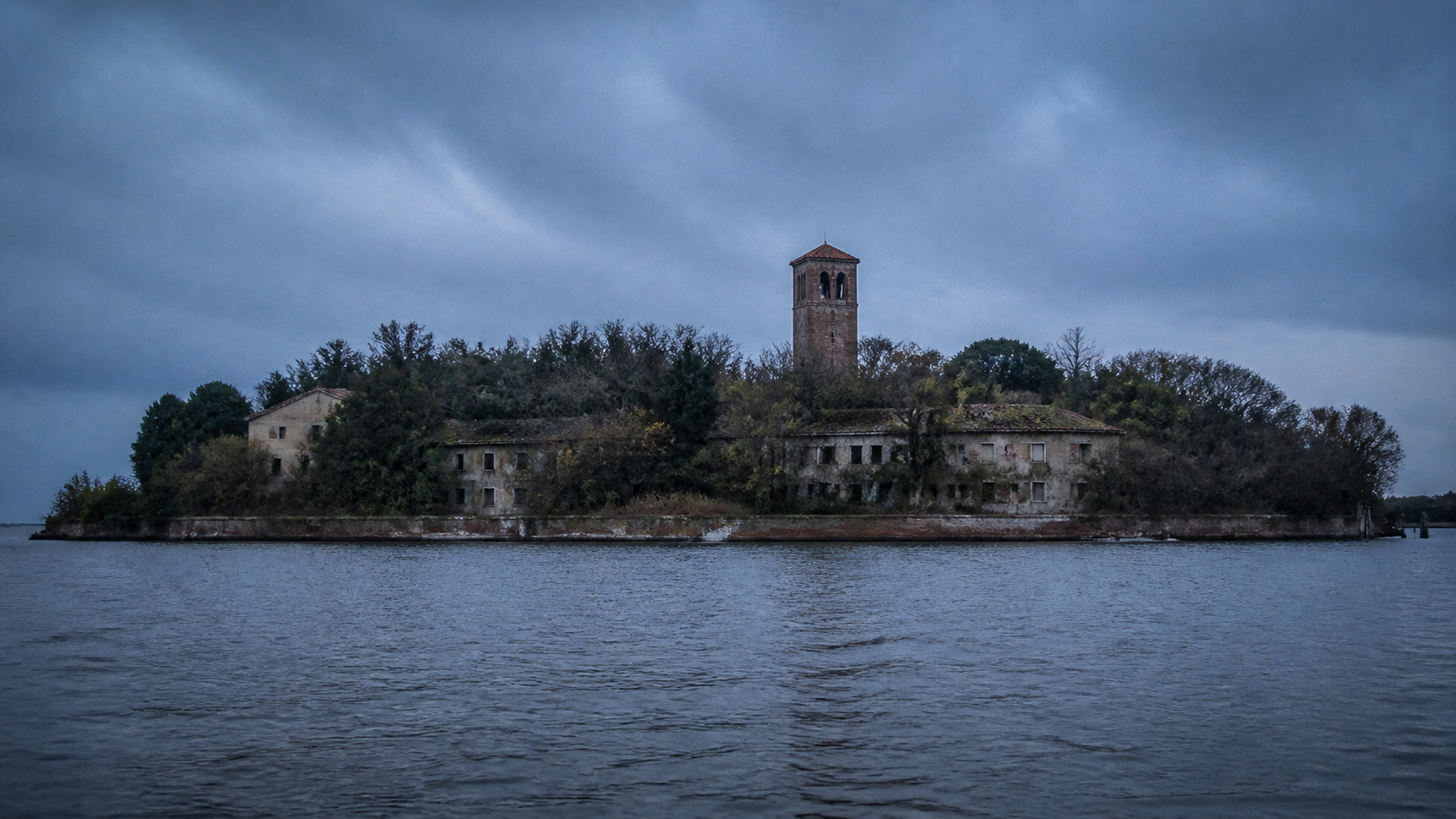
Poveglia Island lies low in the Venetian Lagoon, its brick bell tower rising above trees that have swallowed abandoned healthcare buildings. From a passing boat, the island looks close enough to touch. Yet the built-up section remains closed, the windows are dark, and a century of quarantine history has been compressed into one irresistible claim: this is the most haunted island in the world.
The documented story is unsettling without that label. Poveglia was once a thriving lagoon community, then a strategic outpost, a maritime quarantine station, and a healthcare site. Disease, forced separation, abandonment, and decaying architecture gave later storytellers everything needed to create a modern nightmare.
However, the island’s best-known tales do not all survive scrutiny. Local preservationists reject claims that it is a mass grave or that a murderous asylum doctor performed experiments there. Understanding why Poveglia feels haunted requires separating its real history from the images television and tourism placed over it.
The history of Poveglia Island is therefore more useful than a catalogue of ghost claims. Dates, buildings, public-health records, and local testimony reveal where the haunted legend follows the evidence and where it leaves it behind.
Poveglia Island at a glance
| Detail | Documented information |
|---|---|
| Location | Venetian Lagoon, between Venice and the Lido |
| Approximate area | Seven hectares |
| Historic roles | Settlement, military position, maritime station, quarantine facility, and healthcare site |
| Abandoned | Healthcare use ended in 1968 or 1969, depending on the source |
| Current access | The built-up state-managed island is closed; limited access to the northern green area is arranged separately |
| Paranormal status | Famous modern legend with no verified supernatural evidence |
Before the plague legends
Poveglia was not created as a place of exile. The Italian Ministry of Culture records that people fleeing upheaval on the mainland resettled on the island after the Lombard invasion in the sixth century. It developed into a prosperous community whose families worked in fishing and salt production.
The settlement declined during the War of Chioggia in the late fourteenth century. Residents were evacuated toward Venice, and the conflict left Poveglia devastated. Later attempts to repopulate the island failed. Its location near the shipping route through Malamocco then made it useful for controlling vessels and cargo entering the lagoon.
This earlier history complicates the familiar horror narrative. For centuries, Poveglia was a home and workplace rather than a dumping ground for the unwanted. Its transformation came gradually as Venice developed one of Europe’s most organized systems for confronting epidemic disease.
That transformation gave Poveglia Island a lasting association with departure and uncertainty. People arrived because war or disease had made ordinary life unsafe, then waited beyond the city they hoped to enter.
Quarantine at the edge of Venice
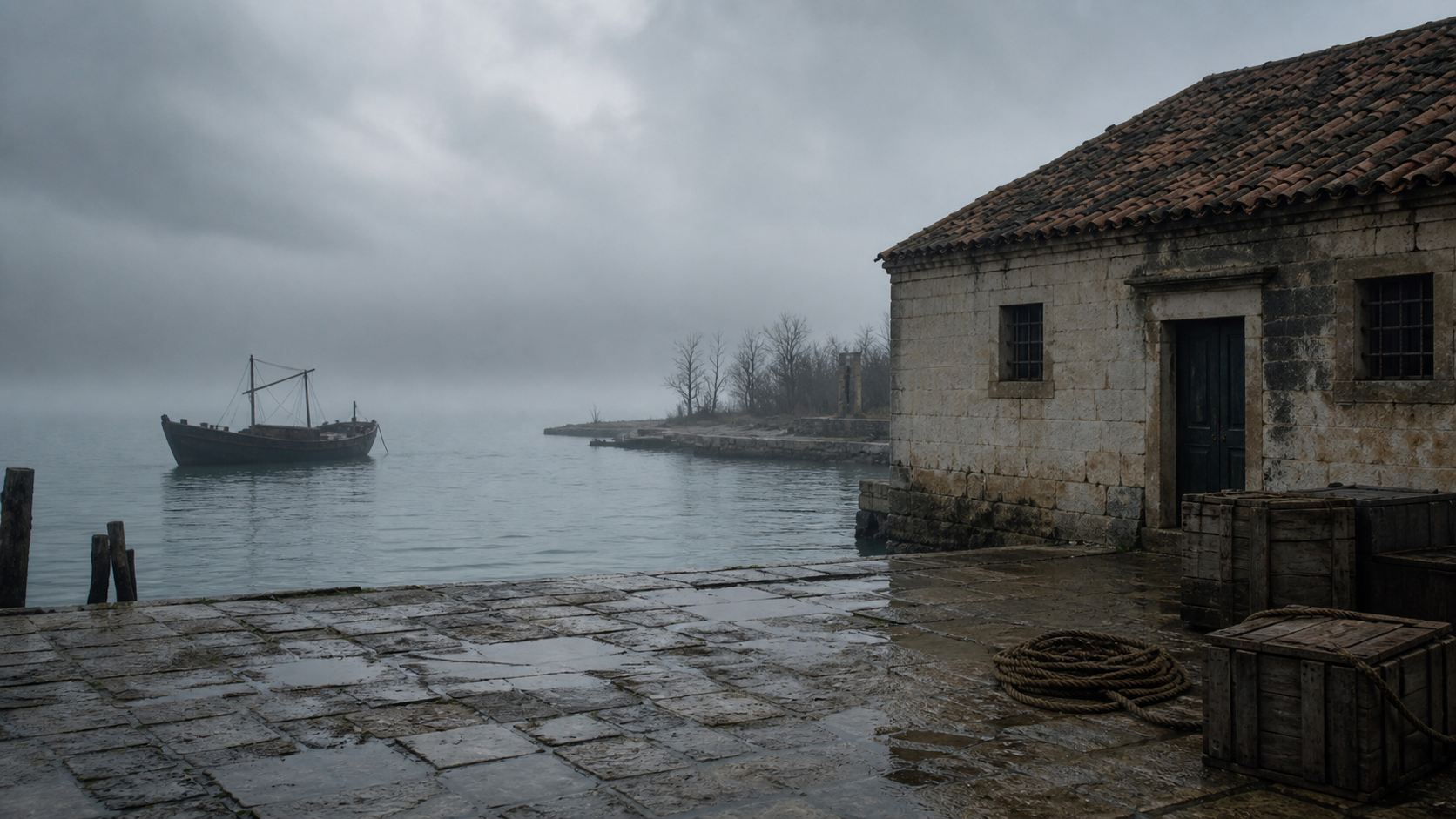
Venice depended on ships, but every arriving vessel could carry infection. The city’s answer was the lazzaretto, an isolated station where passengers, crews, and goods could be observed or disinfected before entering the city. Poveglia was officially designated for quarantine in 1776, according to the Metropolitan City of Venice, and health operations began there during the following years.
The island dealt with vessels suspected of carrying diseases that included plague and cholera. That work involved fear, waiting, and separation. A ship held offshore could not know whether its passengers would be cleared, confined, or transferred. The island became a threshold between the open sea and the crowded city.
Modern accounts often enlarge this history into claims that enormous numbers of plague victims died and were burned on Poveglia. One popular version says human ash forms half of the soil. The local organization Poveglia per tutti directly disputes that story, stating that the island served as a quarantine station for ships but is not a mass grave for plague victims. No reliable excavation or archival total supports the enormous numbers repeated online.
The hospital behind the asylum story
The abandoned healthcare complex is the visual center of Poveglia’s reputation. Empty corridors, broken windows, and vegetation pressing through walls easily resemble a horror-film asylum. Sources disagree over how to describe the institution. Some Italian reporting calls it a psychiatric hospital, while Poveglia per tutti identifies it as a geriatric sanatorium and says the island performed healthcare functions until 1968.
That distinction matters because the most lurid story depends on an asylum. According to the legend, a doctor experimented on patients, conducted lobotomies, then fell or jumped from the bell tower after being tormented by spirits. The tale appears widely in paranormal entertainment, but no confirmed name, medical record, police file, or contemporary report establishes that this doctor existed.
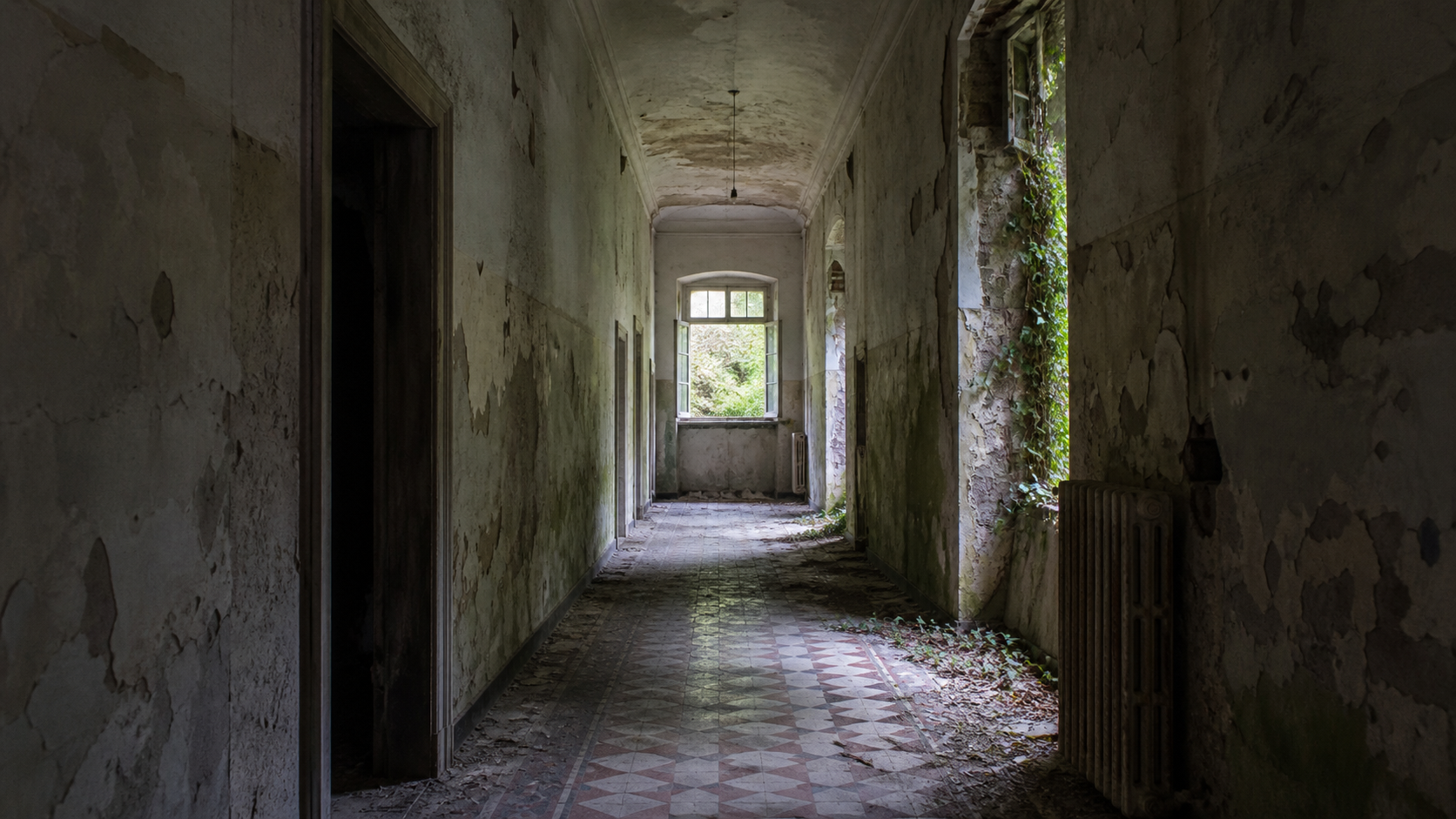
The ruins still deserve sober attention. Institutional abandonment erases individual experiences and invites outsiders to replace them with spectacle. A crumbling corridor can document neglect without proving torture, murder, or a haunting.
How Poveglia became the world’s most haunted island
Poveglia’s international paranormal reputation is surprisingly recent. A 2009 episode of the American program Ghost Adventures presented it as an extreme supernatural location and included a host’s claim that he had been possessed. International articles, videos, and travel sites repeated the program’s imagery, often combining disputed hospital stories with inflated plague-death estimates.
The formula was powerful. Restricted access prevented casual visitors from checking the ruins themselves. Real quarantine history supplied death and isolation. The hospital supplied empty wards. The bell tower supplied a dramatic final scene for the unnamed doctor. Each element made the next claim feel plausible even when documentary support was missing.
As the stories traveled internationally, Poveglia Island became less a specific Venetian place and more a ready-made symbol of forbidden history. Repetition supplied authority that the underlying records did not.
Local memories tell a different story. In reporting on the island’s proposed privatization, Venetian residents described Poveglia as a childhood place for fishing, swimming, picnics, and fruit picking. Preservation campaigners called the ghost stories nonsense and said there was no objective confirmation of experimental lobotomies or wandering spirits.
What is documented and what remains folklore
The evidence does not make Poveglia ordinary. Its documented history includes epidemic control, involuntary isolation, institutional healthcare, war, depopulation, and five decades of decay. Those facts explain why the landscape feels oppressive. They do not verify every story attached to it.
| Claim | Evidence status |
|---|---|
| Poveglia served as a quarantine station | Documented by government and local historical sources |
| The soil contains vast quantities of human ash | Repeated legend without reliable published measurement |
| A doctor tortured patients and died from the bell tower | No verified identity or contemporary record located |
| The ruins were part of a healthcare institution | Documented, although sources differ on its exact classification |
| Visitors have recorded ghosts | Anecdotal paranormal claims, not independently verified evidence |
The careful conclusion resembles the evidence problems surrounding the legends of Hoia Baciu Forest. A disturbing environment can shape expectations, and a famous reputation can influence how ordinary sounds, shadows, and physical sensations are interpreted. That does not prove witnesses are dishonest. It means testimony alone cannot establish a supernatural cause.
No controlled investigation has established that Poveglia Island contains paranormal activity. Audio fragments, personal sensations, and dramatic reactions may be compelling television, but they cannot identify a source or rule out environmental and psychological explanations.
Can visitors go to Poveglia Island?
Poveglia is not a conventional tourist attraction, and there is no public transport service to the island. The preservation association states that landing on the built-up island managed by the State Property Agency is prohibited. Entering unstable abandoned buildings would also create obvious legal and physical risks.
The situation changed in 2025 for the greener northern section. After years of legal and civic campaigning, Poveglia per tutti received a concession for that area beginning August 1, 2025. The group says access uses a temporary pontoon and that transport is organized for selected events. The island has no bars, electricity, water, waste collection, or visitor facilities.
This public project is more important than another unauthorized ghost hunt. It treats Poveglia as part of Venice’s living environment and history rather than a disposable horror set. Anyone hoping to visit should follow current instructions from the association and never attempt to enter the closed ruins.
The island is changing while the legend remains
In 2014, the Italian government sought a 99-year lease for Poveglia. A local movement formed to resist exclusive private redevelopment and raised hundreds of thousands of euros from thousands of supporters. After a long dispute, Rai News reported in 2025 that the State Property Agency had moved toward granting the citizens’ association a concession.
The campaign reveals another version of Poveglia. It is not empty land waiting for a paranormal television crew. It is a contested public place connected to Venetian memory, environmental protection, and resistance to overtourism. The northern concession does not erase the island’s frightening appearance, but it gives the future a purpose beyond decay.
Why Poveglia Island still frightens people
Poveglia Island feels haunted because its landscape exposes several fears at once. Water cuts it off from ordinary streets. Quarantine history recalls the terror of invisible disease. Institutional ruins suggest lives reduced to rooms and records. Prohibition leaves most visitors staring from a boat, unable to resolve what lies beyond the trees.
There is no verified evidence that Poveglia is the world’s most haunted island. There is strong evidence that later media turned fragments of real history into a more profitable nightmare. The truth is quieter and more unsettling: a place once used to protect Venice was abandoned long enough for other people to decide what its silence meant.
Read next
- Explore how documented history and folklore collide in the tunnels of the Paris Catacombs.
- Compare another isolated location in the evidence behind the Haunted Queen Mary.
- Examine how landscape shapes testimony in the Hoia Baciu Forest legends.