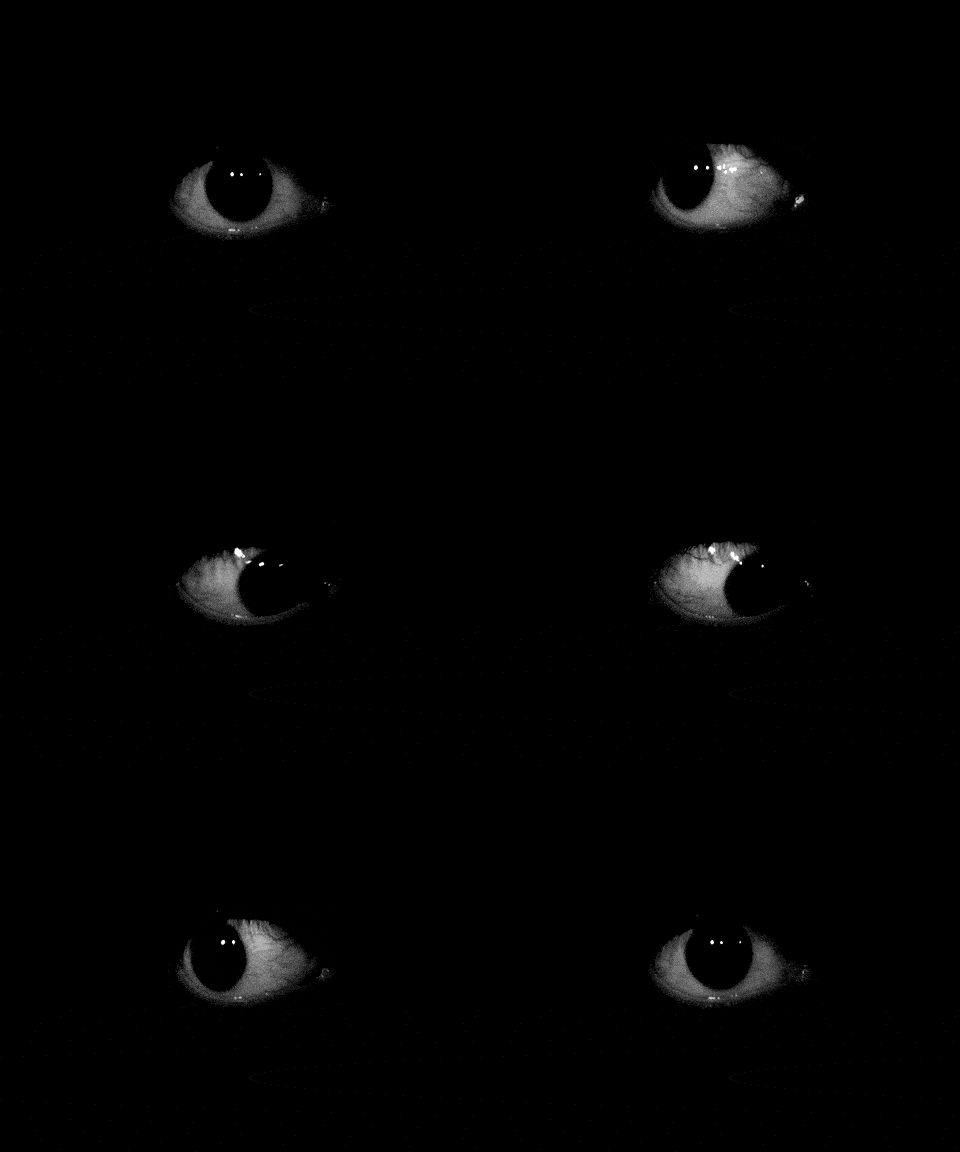


The Anneliese Michel exorcism is often retold as a battle between a young woman and supernatural forces. The documented record is more frightening. In 1970s West Germany, a 23-year-old student with a history of seizures and severe psychological distress underwent repeated Catholic exorcism rites while her physical condition deteriorated. She died on July 1, 1976, after extreme malnutrition and dehydration.
Her death turned a private religious crisis into a criminal case. Two priests and Michel’s parents were later convicted of negligent homicide because the court found that medical intervention should have been obtained. Claims of possession remain part of the case’s religious and cultural legacy, but they were never established as fact. The tragedy is best understood through three separate records: Michel’s documented illness, the beliefs that shaped her treatment, and the legal judgment that followed her death.
Who was Anneliese Michel?
Anna Elisabeth Michel was born in Bavaria in 1952 and grew up in a devout Catholic family. She was a real person whose suffering has often been overshadowed by sensational recordings, lurid retellings, and horror films. Before she became a symbol in debates about possession, she was a student navigating serious health problems.
Michel experienced her first major seizure as a teenager. Medical examinations followed, and physicians treated her for epilepsy. Over time, she also reported frightening visions, voices, aversion to religious objects, and the conviction that she was under demonic influence. Modern summaries frequently describe a combination of epilepsy and psychosis, although no retrospective label can reproduce every detail of her condition with certainty.
| Date | Documented development |
|---|---|
| 1968 | Michel experienced an early major seizure during her teenage years. |
| 1969 onward | Neurological examinations and medical treatment addressed epilepsy and later psychiatric symptoms. |
| 1975 | Bishop Josef Stangl authorized a formal exorcism using the Catholic rite then in force. |
| September 1975 to June 1976 | Priests Arnold Renz and Ernst Alt conducted repeated exorcism sessions. |
| July 1, 1976 | Michel died at age 23 after severe malnutrition and dehydration. |
| April 21, 1978 | Her parents and the two priests were convicted of negligent homicide. |
The medical history behind the exorcism
Medical evidence is central to the case. Michel underwent repeated neurological examinations after her seizures began. She received anticonvulsant medication and later psychiatric treatment. Reports from the criminal proceedings described epilepsy alongside severe psychological symptoms, including religiously focused fear and delusion.
Epilepsy does not make a person violent, evil, or possessed. Some seizure disorders can occur alongside psychiatric symptoms, but the relationship is complex and requires qualified medical care. Michel’s religious environment gave her distress a specific vocabulary. Experiences that clinicians interpreted through neurology and psychiatry were interpreted by Michel and those around her as signs of an external spiritual presence.

Treatment did not bring the relief she and her family sought. That failure appears to have deepened their conviction that medicine could not address the problem. However, unsuccessful treatment does not establish a supernatural cause. It can instead leave a vulnerable person more receptive to an explanation that feels emotionally and culturally complete.
How the Church authorized the rite
Michel and her family repeatedly sought religious help. Priests initially hesitated, as Church practice required signs that could not be adequately explained by ordinary illness. Eventually, Father Ernst Alt supported the view that the situation might be spiritual. In 1975, Würzburg bishop Josef Stangl authorized the use of the major rite of exorcism. Father Arnold Renz performed the ritual with Alt’s involvement.
Published histories state that 67 sessions occurred between September 1975 and June 1976. Many were recorded on audio tape. The voices and prayers heard on those recordings later became the most sensational part of the story, especially during the criminal trial. Yet a recording can document speech and distress without proving the source claimed by participants.
The rites did not occur in a vacuum. Michel, her family, and the priests shared a framework in which demons, sin, sacrifice, and spiritual danger were treated as possible explanations. Repeating the ritual may have reinforced that framework even as her health declined. A responsible account must recognize the sincerity of religious belief without treating sincerity as evidence of possession.
The final months and a preventable death
By the spring of 1976, Michel’s physical condition had become grave. She ate and drank too little, lost substantial weight, and became increasingly weak. Contemporary and later German reporting placed her final weight near 31 kilograms. Whatever participants believed about the spiritual struggle, her body required urgent medical care.
The final exorcism session took place shortly before her death. On July 1, Father Alt informed authorities that Michel had died. An autopsy attributed the death to malnutrition and dehydration. The central legal question was therefore not whether demons exist. It was whether the adults responsible for her care failed to obtain help while a visibly deteriorating young woman was dying.

That distinction protects the victim from becoming a horror prop. Michel’s death was not an unknowable vanishing or an ambiguous paranormal event. It had measurable physical causes. The unresolved questions concern responsibility, belief, treatment, and how a preventable medical emergency was allowed to continue.
What the 1978 trial established
The trial began in Aschaffenburg in 1978. Prosecutors charged Michel’s parents, Anna and Josef, and priests Arnold Renz and Ernst Alt with negligent homicide. The courtroom heard medical testimony and excerpts from the recorded rites. Defense arguments included the defendants’ religious convictions and their belief that Michel had accepted suffering.
On April 21, 1978, the court convicted all four defendants. Each received a six-month custodial sentence suspended for three years. The judgment held them responsible for failing to secure medical assistance. Contemporary trial reporting in The Washington Post described how the tapes and conflicting medical and religious interpretations dominated the proceedings.
| Question | What the record supports |
|---|---|
| Was Michel medically ill? | She had a documented seizure history and received neurological and psychiatric treatment. |
| Did formal exorcisms occur? | Yes. The Church authorized the rite, and repeated sessions were conducted and recorded. |
| Did recordings prove possession? | No. They documented the sessions and Michel’s distress, not a supernatural cause. |
| What caused her death? | The physical causes were severe malnutrition and dehydration. |
| What did the court decide? | Her parents and the priests were guilty of negligent homicide for failing to obtain medical care. |
Medical evidence and possession claims
Believers have continued to interpret aspects of Michel’s behavior as evidence of possession. Some point to her apparent knowledge, changes in voice, aversion to sacred objects, or the intensity of the recorded sessions. These observations came from an environment already organized around the expectation of demons. None provides a controlled test that excludes illness, suggestion, learned religious imagery, or psychological distress.
Medical explanations do not make the case less disturbing. They make it more human. A person can suffer symptoms that feel alien, terrifying, and spiritually meaningful while still needing evidence-based care. The Protestant Centre for Religious and Ideological Issues summarizes the dominant medical interpretation as epilepsy combined with psychosis, while also noting that some religious circles continue to frame her suffering as possession.
The same conflict appears in other famous cases, including the religious interpretation imposed on the Smurl family’s reported haunting. In both stories, extraordinary claims gained power because trusted investigators and clergy supplied a ready explanation before independent evidence could settle the cause.
How cinema changed Anneliese Michel’s story
Michel’s death inspired films including The Exorcism of Emily Rose and Requiem. These productions use fiction, compressed timelines, invented scenes, and dramatic structure. They should not be treated as biographical records. Even films marketed as inspired by true events can shift the central question from medical neglect to supernatural suspense.
That shift has consequences. The more Michel becomes “the real Emily Rose,” the easier it is to forget her individual history and the legal finding that care was withheld. Horror can explore questions of faith and uncertainty, but factual coverage must return her name, illness, and death to the center of the story.
Why the Anneliese Michel exorcism still matters
The Anneliese Michel exorcism remains frightening because conviction did not protect a vulnerable person. Medical treatment had not solved every symptom, religious authorities believed a spiritual danger was possible, and repeated rituals created the impression that action was being taken. Meanwhile, her physical condition became fatal.
The evidence does not establish demonic possession. It establishes illness, prolonged exorcism rites, severe physical decline, death from malnutrition and dehydration, and criminal responsibility for failing to seek care. The case endures as a warning about what can happen when an extraordinary explanation replaces the urgent duty to protect a suffering human being.
Read next
- Deadly Exorcism Cases and the Human Cost of Possession Claims
- The 1986 Pennsylvania Haunting and the Smurl Case
- Borley Rectory: Evidence Behind England’s Haunted House