
The Hope Diamond curse is often told as if a single blue stone carried death from an Indian temple to the palaces of France and the mansions of Washington. The documented history is darker in a more human way. It contains royal power, a spectacular theft, a diamond deliberately cut into a new identity, collapsing fortunes, family grief, and a legend sharpened by people who knew fear could raise a jewel’s price.
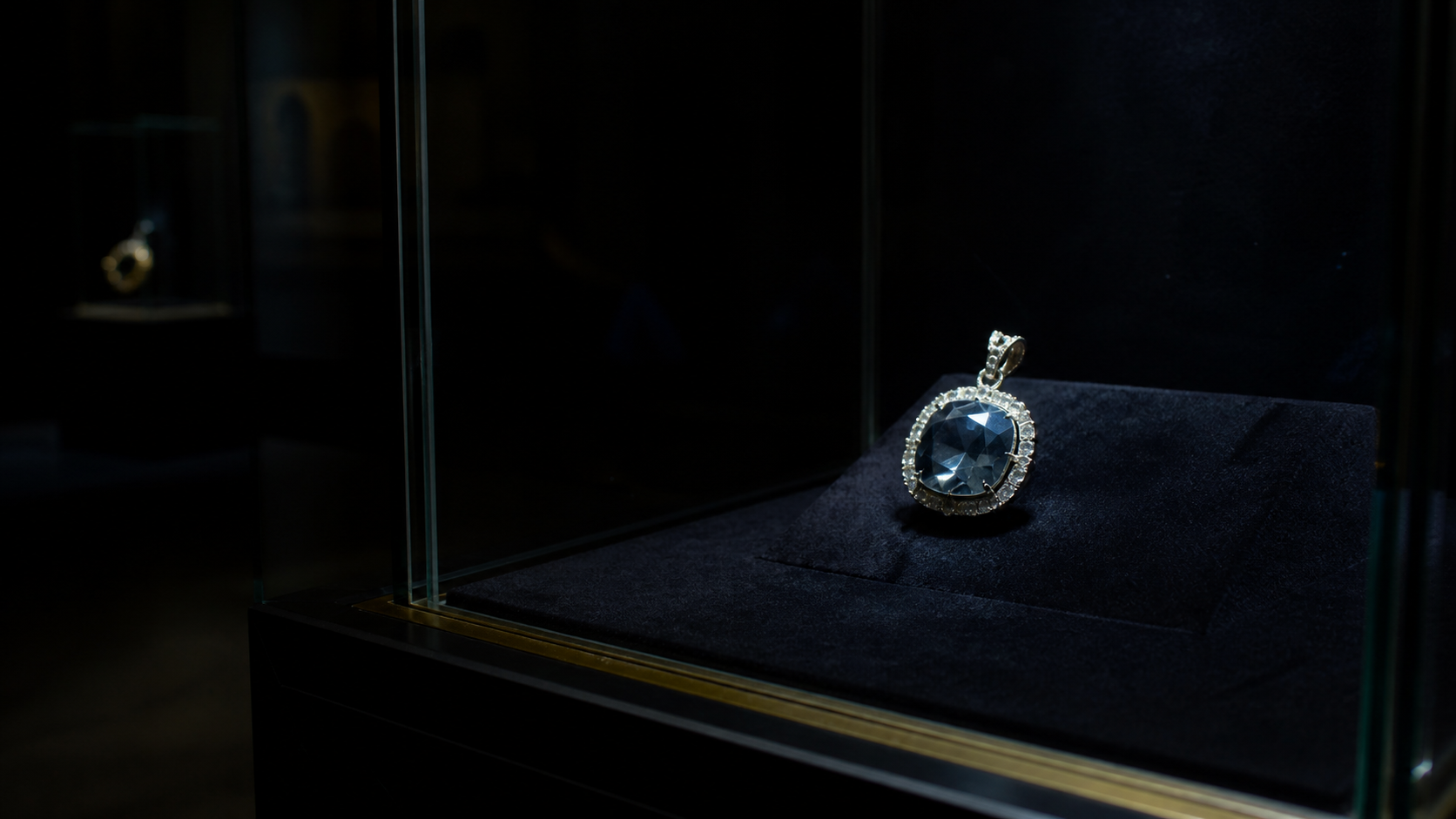
Today, the 45.52-carat diamond turns slowly behind thick glass at the Smithsonian National Museum of Natural History. Its blue facets appear almost black until the light catches them. Millions have stood before that case, yet the question surrounding it has barely changed: did misfortune follow the stone, or did later storytellers arrange unrelated tragedies into a curse?
The surviving records make one conclusion clear. The Hope Diamond has a remarkable and sometimes disturbing past, but the famous curse emerged centuries after the stone left India. What follows is the history that can be documented, the claims that cannot, and the reason the legend still feels so difficult to dismiss.
The Hope Diamond curse asks readers to choose between a supernatural pattern and a history shaped by theft, grief, publicity, and chance. Examining when each part of the story first appeared makes that choice much clearer.
Hope Diamond curse at a glance
| Detail | Documented information |
|---|---|
| Current weight | 45.52 carats |
| Color and type | Natural fancy deep grayish-blue, type IIb diamond |
| Origin | India; the Kollur Mine is considered likely, but the exact mine is not confirmed |
| Early European name | Tavernier’s Diamond, later recut as the French Blue |
| Major disappearance | Stolen with the French Crown Jewels in September 1792 |
| Public home | Smithsonian National Museum of Natural History, Washington, D.C. |
A blue stone before the curse
The stone entered recorded European history through Jean-Baptiste Tavernier, a seventeenth-century French merchant who traveled widely in India and Persia. He sold an unusually large blue diamond to King Louis XIV in 1668 or 1669. Modern estimates place the original gem at about 115 metric carats, more than twice the weight of the Hope Diamond seen today.
India was the world’s only commercial source of diamonds during Tavernier’s lifetime. The Smithsonian’s detailed provenance study identifies the Kollur Mine as a likely source because it produced large and colored stones, while stressing that no record proves the exact mine. That uncertainty matters. Later curse stories claimed Tavernier tore the diamond from a sacred statue and suffered a gruesome punishment. No credible contemporary evidence supports either claim.

Louis XIV ordered the rough Indian-style stone recut according to European taste. The result was an approximately 69-carat heart-shaped gem now called the French Blue. Set against gold, its facets created a sun-like effect that suited the symbolism of the Sun King. It was an object of state power long before anyone described it as cursed.
The theft that gave the diamond a second life
By 1792, the French monarchy had fallen into crisis. The crown jewels were stored in the Garde-Meuble in Paris, where an alarming security failure left windows accessible and the jewel room inadequately guarded. Thieves entered on the night of September 11 and returned repeatedly. By September 17, the French Blue had vanished with the Order of the Golden Fleece.
Nearly twenty years passed before a deep blue diamond appeared in London. On September 19, 1812, jeweler John Francillon recorded a sketch of a 177-grain stone held by diamond merchant Daniel Eliason. The timing was extraordinary. The memo was dated only two days after the twenty-year limitation period for crimes committed during the French Revolution had expired.
That coincidence is not proof of a conspiracy, but the physical connection is now strong. A lead model of the lost French Blue was discovered in Paris in 2007. Computer modeling reported by the Gemological Institute of America showed that the modern Hope Diamond could have been cut from it. The stone had not merely traveled. Someone had removed enough material to conceal one of the most recognizable stolen jewels in Europe.
The documented core of the Hope Diamond curse is therefore a criminal transformation rather than a fatal omen. The stone truly did disappear, lose much of its weight, and return with a different shape and an incomplete past.
How the Hope name replaced the missing past
The blue diamond appeared in an 1839 catalogue of the gem collection of Henry Philip Hope, a wealthy British banker. The catalogue praised its deep sapphire color and fine cut but did not explain where Hope acquired it. The absence of a purchase record left a shadow across the years between Eliason and Hope.
Ownership disputes followed Henry Philip Hope’s death. The gem eventually passed through the family to Lord Francis Hope, whose debts forced him to seek permission to sell it. This financial collapse later became one of the curse legend’s favorite examples. Yet debt is not supernatural evidence, and Lord Francis had expensive habits and serious financial problems that existed within an understandable human history.
The distinction is the same one that surrounds other supposedly dangerous objects, including the real Annabelle doll story and the legend of Robert the Doll. Provenance can be documented. A supernatural chain of cause and effect requires evidence that stories alone cannot provide.
The curse was created in print
The Hope Diamond curse is not an ancient tradition. According to the Smithsonian, its recognizable form arose in the early twentieth century. A 1908 Washington Post article portrayed the stone as a dangerous “hoodoo” and selected episodes of financial loss and death from the lives of previous owners. Later writers repeated the pattern, often adding people who never owned the diamond or deaths that did not occur as described.
One striking example involved Selim Habib, who briefly owned the stone. A newspaper report claimed that Habib had drowned in a shipwreck while carrying the diamond. The report was wrong. Another man with the same name apparently died, while the gem’s former owner was alive and had already sold the stone months earlier.
May Yohé, the former wife of Lord Francis Hope, also helped popularize the legend. She blamed the gem for personal and financial misfortune, then used the tale in a 1921 book and film. By then, the curse had become a self-reinforcing story. Every tragedy could be included, while ordinary years and inaccurate claims disappeared from view.
Pierre Cartier understood the value of fear
Cartier acquired the diamond in 1910, and Pierre Cartier began looking for a buyer. The Smithsonian’s history describes how he presented an embellished curse story to Evalyn Walsh McLean and her husband, Edward “Ned” McLean. Evalyn was not frightened away. She reportedly believed objects considered unlucky for other people could bring her good fortune.
The first setting did not appeal to her, so Cartier reset the gem in a more modern mounting surrounded by colorless diamonds. In 1912, the McLeans bought it for $180,000 and additional jewelry. The transaction reveals an uncomfortable truth at the center of the legend: the curse was not simply whispered by frightened owners. It was also polished by a skilled salesman because a dangerous history made the object more memorable.
The McLean tragedies were real
Evalyn wore the diamond openly at Washington society events and made it part of her public identity. Misfortune nevertheless entered the family. In 1919, her nine-year-old son Vinson was struck by a car and killed. Her marriage deteriorated as Ned drank heavily, had an affair, and was later declared legally insane. In 1946, their daughter Evalyn McLean Reynolds died from a drug overdose at the age of twenty-five.
These deaths should not be reduced to props in a paranormal story. They were devastating events in the lives of real people. The records establish that the tragedies happened, but they do not establish that a diamond caused them. Connecting the two requires selecting the darkest moments from one family and ignoring the absence of a testable mechanism.
For believers, this period remains the emotional center of the Hope Diamond curse. For a careful historical account, it is also where compassion and evidence must take priority over a dramatic coincidence.
That does not make the story emotionally powerless. The gem remained close to Evalyn while wealth failed to protect her family. In photographs, its hard blue surface survives unchanged while the people around it age, suffer, and disappear. The contrast gives the curse its most unsettling image.
What science sees inside the blue
Gemologists classify the Hope as a type IIb diamond. Trace amounts of boron account for its blue color and electrical conductivity. Under ultraviolet light, the stone produces a strong red phosphorescence that can continue for several seconds after the light source is removed. That delayed red glow is unusual, measurable, and entirely natural.
The Gemological Institute of America graded the stone as fancy dark grayish-blue with VS1 clarity in 1988. A later examination described it as natural fancy deep grayish-blue. These physical properties explain why the diamond can look almost black in one moment, then suddenly flare blue as it turns. They do not reveal any force capable of influencing accidents, health, finances, or human behavior.
A scientific explanation for the Hope Diamond curse would require a measurable link between the gem and the events attributed to it. No such link has been demonstrated.
A million-dollar parcel in an empty office
The Hope Diamond curse gained a strangely quiet final chapter when the stone left private ownership.
Jeweler Harry Winston purchased Evalyn McLean’s collection from her estate in 1949. He displayed the Hope Diamond in a traveling Court of Jewels exhibition, then donated it to the Smithsonian in 1958. The transfer lacked the ceremony expected for such an object. Winston sent it by registered United States mail in a plain brown package, insured for one million dollars.
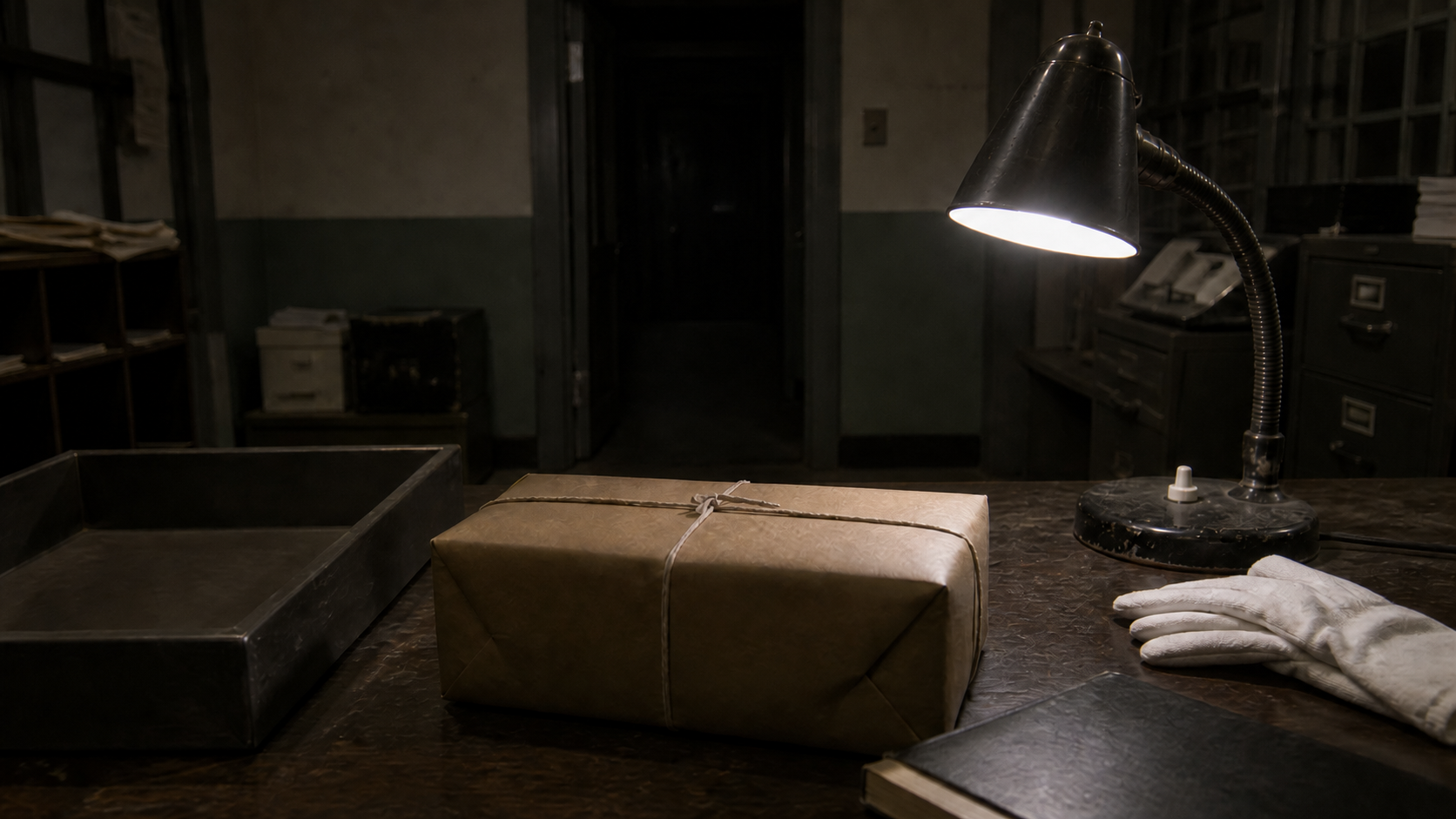
The parcel arrived on November 10, 1958. Since then, more than 100 million visitors have seen the diamond, according to the National Museum of Natural History. The alleged curse did not end with a dramatic ritual. The stone simply entered a public collection, where scientists could study it and visitors could decide what they believed.
Why the Hope Diamond curse still survives
The Hope Diamond curse endures because the documented story already contains the structure of a gothic legend. A jewel emerges from an uncertain past, becomes a symbol of royal excess, disappears during revolution, returns under a new identity, passes through collapsing fortunes, and finally sits behind glass. Little invention is needed to make that sequence feel ominous.
However, the evidence points to a modern legend built from selective reporting, commercial storytelling, factual errors, and genuine family grief. The diamond’s history is extraordinary. Its curse is not proven. The most disturbing part may be how easily tragedy becomes a commodity once a beautiful object gives it a name.