
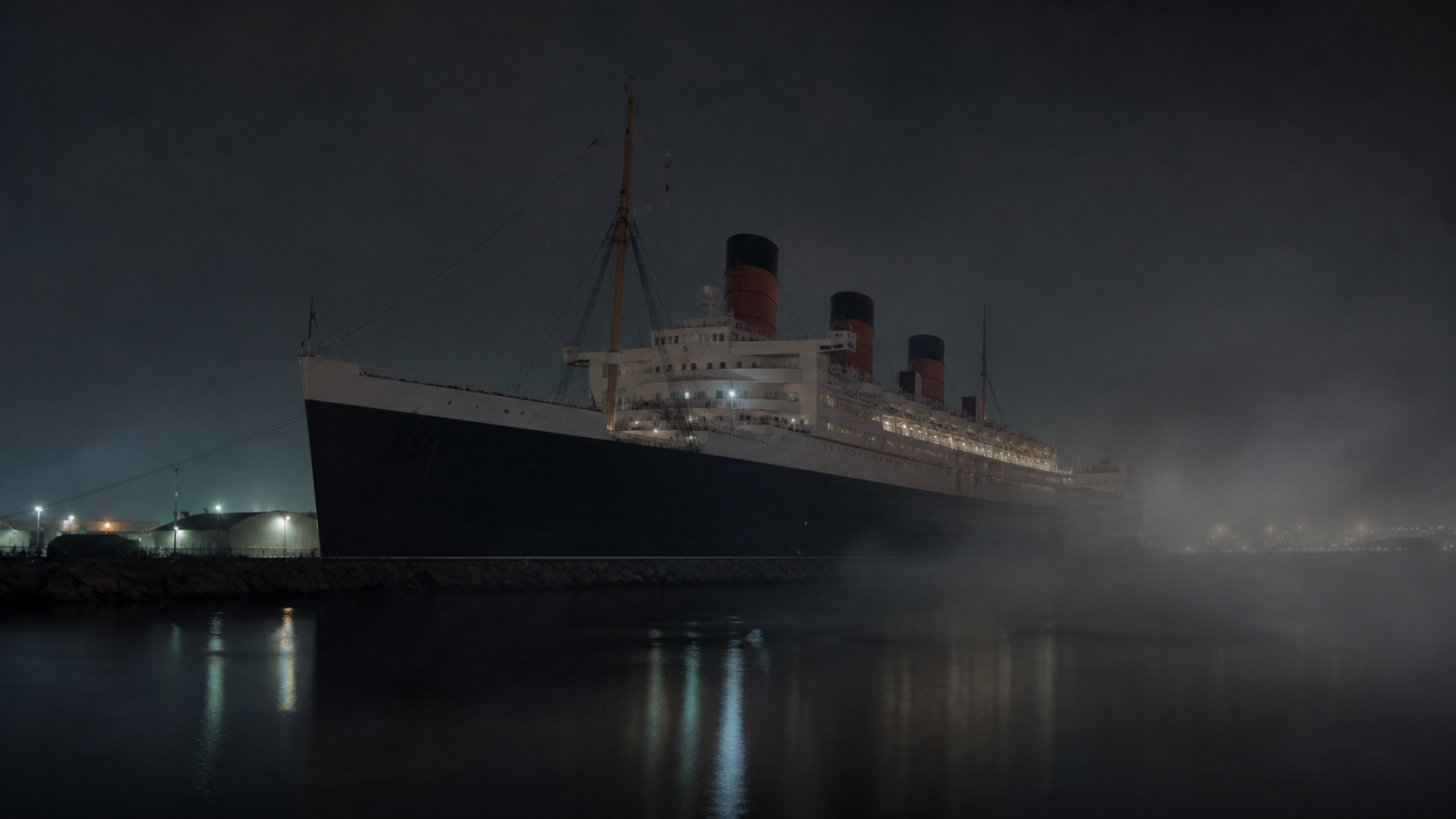
The haunted Queen Mary is easier to believe after midnight. Beyond the polished Art Deco rooms, staircases descend into steel corridors where pipes contract, bulkheads answer the harbor, and a footstep can travel farther than the person who made it. Visitors have reported voices near the drained pool, knocks in the machinery spaces, and disturbances inside one particular cabin. Yet the ship’s real history is darker than many of its ghost stories, and far better documented.
RMS Queen Mary carried celebrities across the Atlantic, transported vast numbers of troops during the Second World War, survived a collision that destroyed a Royal Navy cruiser, and ended her sailing career in 1967. Since becoming a hotel and attraction in Long Beach, California, the liner has also acquired an expanding population of alleged spirits. Some claims are rooted in genuine deaths. Others appear to have grown through tourism, repetition, and the atmosphere of an enormous vessel that never truly becomes silent.
Before the ghosts, there was the Grey Ghost
Built in Scotland and launched in 1934, the Queen Mary entered passenger service in 1936. She was among the defining ocean liners of her era, combining speed with lavish Art Deco interiors. When war began, luxury fittings gave way to troop accommodations, the exterior was painted grey, and the ship earned the nickname “Grey Ghost.”
The transformation was more than cosmetic. The liner moved thousands of service members at a time while relying on speed and evasive movement to reduce the danger from submarines. According to the ship’s official timeline, some wartime voyages carried more than 10,000 people, a scale that made the Queen Mary both invaluable and extraordinarily difficult to maneuver.
On October 2, 1942, the Queen Mary collided with the escorting light cruiser HMS Curacoa north of Ireland. The liner cut through the smaller warship. More than 300 Curacoa sailors died, while the Queen Mary continued because wartime orders and the submarine threat made stopping dangerous. The disaster was concealed from the public until after the war.
The true death behind Door 13
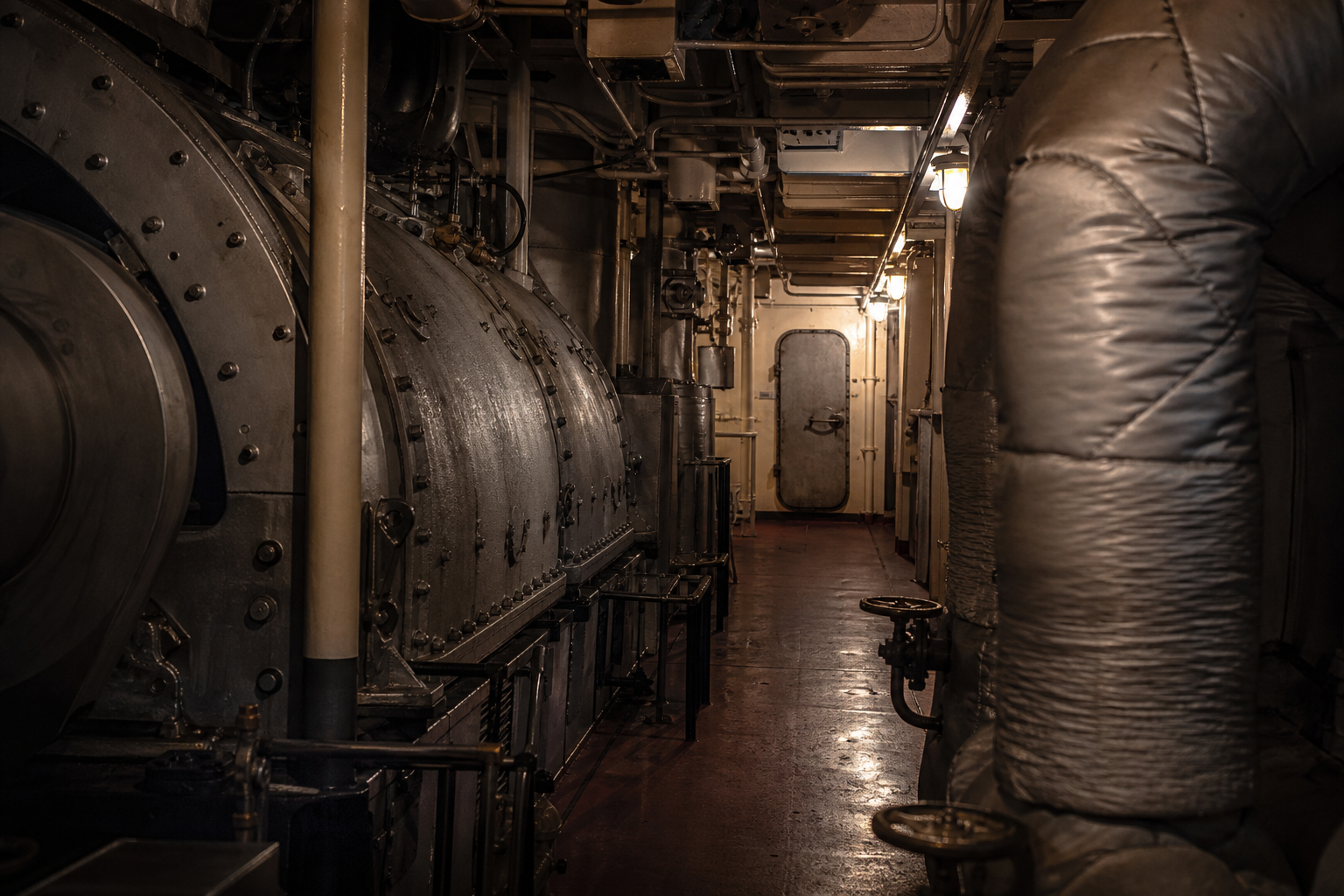
One of the ship’s most repeated hauntings concerns a young crew member killed during a safety drill in 1966. John Pedder was crushed by a watertight door in the machinery spaces. Later accounts describe a figure in work clothes, metallic banging, footsteps, and the sound of tools near the door.
Pedder’s death is documented, but the haunting is not. That distinction is essential. A real tragedy can become an anchor for later experiences without proving that those experiences share a supernatural source. Engine rooms are loud even when their machinery is no longer driving a ship. Pipes move, metal responds to temperature, and sound travels unpredictably through connected compartments.
The story also demonstrates why named ghosts feel persuasive. An unexplained noise becomes more memorable when it is attached to a person, a location, and a death. Over time, the narrative can become so familiar that visitors enter the space already listening for the same wrench, footstep, or shadow.
Why the first-class pool became the ship’s darkest room
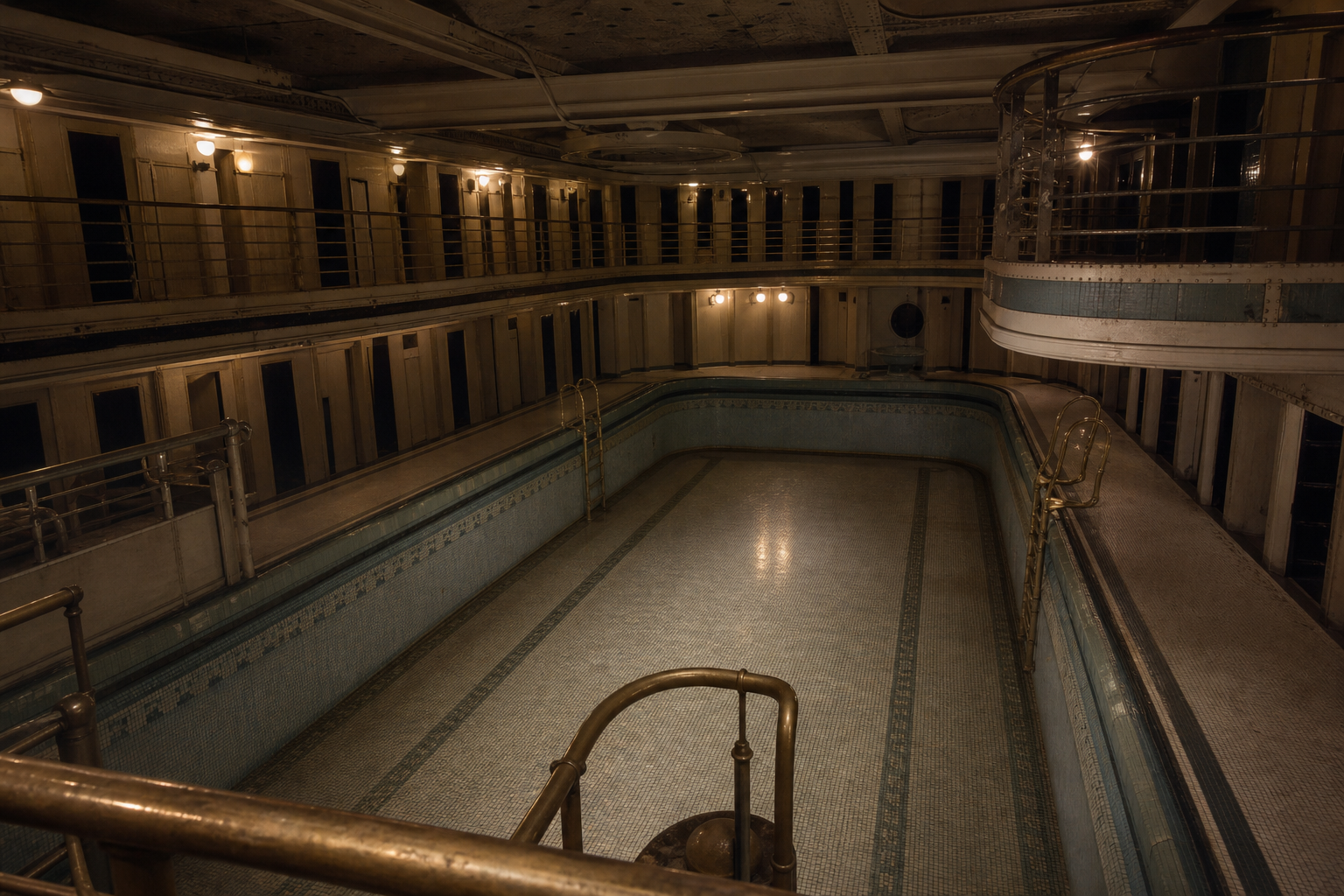
The drained first-class pool has become one of the most famous locations in Queen Mary folklore. Visitors and paranormal investigators report splashing, wet footprints, voices, and the sound of a child. Tour narratives often identify a young spirit called Jackie, although reliable historical evidence connecting that identity to a death in the pool is difficult to establish.
The room itself does much of the work. Tiled surfaces reflect faint sounds. Balconies and changing areas create obstructed sightlines. Empty pools produce unusual echoes because the water that once absorbed sound is gone. Low lighting leaves the brain to complete partial shapes and movements.
None of those factors proves that every witness imagined an experience. They do show why testimony must remain separate from historical documentation. The pool is an authentic preserved space with a powerful atmosphere. Jackie is a repeated legend. Treating those two statements as interchangeable makes the story easier to sell but less accurate.
Room B340 and the problem of a perfect ghost story
Room B340 occupies a special place in the ship’s modern reputation. The Queen Mary’s official exhibit description refers to a vague 1949 log entry recording that a passenger was found dead in a cabin now associated with B340. Later lore supplied the name Walter and attributed disturbed bedding, faucets turning on, knocks, moving objects, and an aggressive presence to him.
The gap between the log entry and the fully formed legend matters. A sparse record does not verify the later name, personality, or list of paranormal behaviors. Those additions may preserve genuine staff and guest reports, but they also make the room function like a self-reinforcing experiment. Visitors know it is supposed to be haunted before they sleep there.
Expectation changes attention. A plumbing noise that would be ignored in an ordinary hotel becomes evidence inside a famous haunted cabin. Sleep disruption, unfamiliar surroundings, vibrations, and the ship’s mechanical acoustics can intensify the effect. The experience may feel entirely real while its cause remains uncertain.
Did the Curacoa disaster leave spirits aboard?
Some Queen Mary ghost stories connect the ship to the sailors killed aboard HMS Curacoa. The historical tragedy deserves remembrance, but the paranormal connection is especially difficult to support. The men died aboard the cruiser and in the Atlantic, not in the Queen Mary’s present rooms and corridors.
Attaching their deaths to anonymous shadows risks turning a wartime disaster into atmospheric decoration. A stronger account preserves the human event on its own terms. The collision reveals the pressure of wartime navigation, the terrible imbalance between the vessels, and the secrecy that followed. It does not require a ghost to remain disturbing.
This is the same discipline Evil’s Eye applies when separating a documented location from the mythology around it. In our investigation of the Hoia Baciu Forest legends, an eerie landscape and sincere testimony were not treated as automatic proof of extraordinary claims.
How haunting became part of the business
Ghost reports did not begin with the latest tours, but the ship’s paranormal identity became more organized after it stopped sailing. Los Angeles Times coverage from the late 1980s and early 1990s shows operators developing tours around reported apparitions, deaths, and previously inaccessible spaces. The stories were no longer just rumors exchanged by staff. They became programmed experiences.
Today, the Queen Mary openly offers haunted encounters and paranormal walks alongside historical exhibits. That does not make every claim false. It does mean the source has a commercial interest in preserving and expanding the legend. The official presentation should therefore be read as tourism material, not independent verification.
Repeated storytelling also produces continuity. A guide tells guests where a figure appears. Visitors watch that location more closely. Ambiguous experiences are reported using the names and details already supplied. Future tours then cite those reports as evidence that the story persists. The legend can grow without anyone deliberately fabricating an encounter.
What could explain the reported activity?
A retired ocean liner is an exceptional environment for misperception. Steel transmits impacts and vibration. Ventilation, elevators, plumbing, hotel activity, harbor movement, and maintenance create noises with no obvious visible source. Long corridors distort distance, while mirrors, polished metal, and glass introduce reflections at the edge of vision.
Fatigue matters as well. Guests exploring late at night may be primed by frightening stories, unfamiliar with the layout, and alert to every sound. The brain is skilled at turning incomplete sensory information into familiar patterns, especially voices, footsteps, and human silhouettes.
Yet a conventional explanation should not become a claim that witnesses are dishonest. Most people who report paranormal events appear to be describing something they genuinely experienced. The question is whether the experience establishes its cause. The distinction also guides our coverage of allegedly haunted objects such as the real Annabelle doll, where testimony, promotion, and verifiable history overlap without becoming the same thing.
What the haunted Queen Mary evidence supports
The haunted Queen Mary contains several different stories occupying one ship. There is the documented liner, built for luxury and remade by war. There are real deaths, including John Pedder’s fatal accident and the enormous loss aboard HMS Curacoa. There are sincere reports from guests and employees. Finally, there is a commercial mythology designed to turn those ingredients into a coherent population of ghosts.
No publicly available evidence proves that the pool, Room B340, or the engine spaces contain spirits. Natural acoustics, expectation, sleep disturbance, and decades of rehearsed storytelling offer plausible explanations for much of the activity. At the same time, the ship’s scale makes certainty difficult. A sound can cross several compartments before anyone hears it, leaving even a careful witness without an obvious source.
The fairest conclusion is not that the Queen Mary is certainly haunted or certainly empty. It is that the vessel preserves real human history beneath a profitable supernatural identity. When the deck lights fade and the harbor disappears into fog, the legend becomes easy to feel. The evidence remains harder to hold.
Sources
- The Queen Mary official historical timeline
- The Queen Mary official exhibits, including B340, the pool, and engine-room lore
- Los Angeles Times, early reporting on Queen Mary ghost tourism
- Los Angeles Times, reported hauntings and the John Pedder story
- Visit Long Beach, Queen Mary history and preservation overview
- UK Parliament, postwar record concerning the Curacoa collision