
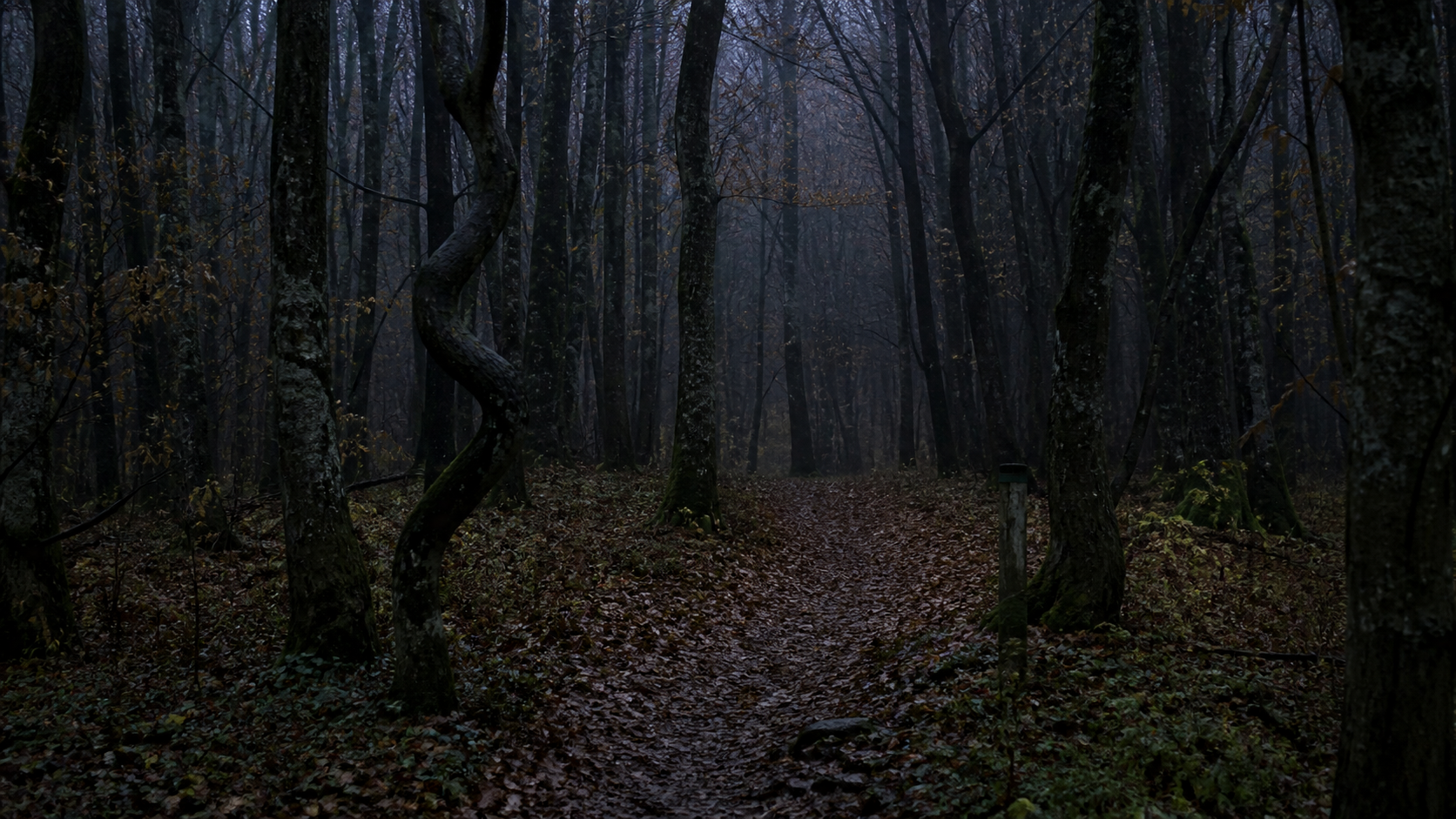
Hoia Baciu Forest begins at the edge of Cluj-Napoca, close enough to Romania’s second-largest city for ordinary walkers to reach its paths. Yet after the light thins beneath the canopy, the woodland can feel much farther away. Bent trunks interrupt the sightlines. Muddy tracks vanish behind walls of wet leaves. Every sound seems to come from a place the eye cannot hold.
For decades, stories have described unexplained lights, missing time, illness, ghostly figures, and a clearing unlike the surrounding forest. Those claims earned Hoia Baciu the nickname “the Bermuda Triangle of Transylvania.” The reputation is real. Proof of a haunting is not. This investigation separates documented history from legend.
Hoia Baciu Forest at a Glance
| Detail | Documented information |
|---|---|
| Location | West of Cluj-Napoca in Cluj County, Romania |
| Landscape | Deciduous woodland, trails, irregular trees, and open clearings |
| Reputation | Haunted forest and paranormal-tourism destination |
| Major turning point | A widely reported 1968 photograph of an unidentified aerial object |
| Best-known site | The open area commonly called Poiana Rotundă, or the Round Clearing |
| Evidence status | No controlled scientific evidence establishes paranormal activity |
1. The Real Forest Beyond the Legend
Hoia Baciu Forest lies immediately west of Cluj-Napoca, near inhabited districts, roads, and the open-air section of the Ethnographic Museum of Transylvania. Cluj’s official tourism information also places the Baciului Gorge nature reserve just north of the forest. This is not an unmapped wilderness cut off from human life.
That closeness makes the fear more effective. A visitor can leave a busy city and quickly enter woodland where dense trunks conceal the horizon. As paths divide and evening removes detail from the undergrowth, darkness turns incomplete information into threat.
2. The 1968 Photograph Changed Everything
The most important documented date in the Hoia Baciu Forest story is 1968. The Cluj County Library’s local-history archive records that the Romanian news agency AGERPRES reported a photographed unidentified flying object over the forest. The images circulated through international news channels and became a classic case within Romanian ufology.
A photograph of something unidentified is not proof of an extraterrestrial craft. Distance, lens behavior, film artifacts, aircraft, weather, and the absence of complete original data all complicate interpretation. Nevertheless, the report gave the forest a modern origin story. Older rural unease could now merge with Cold War fascination about objects in the sky.
The episode also changed how later visitors read their own photographs. Once the forest had a paranormal identity, every ambiguous shape arrived with a ready-made explanation.
3. Alexandru Sift and the Search for a Pattern
Biologist Alexandru Sift spent years studying unusual reports associated with the forest. The same local-history archive states that much of his documentary collection was destroyed after his death in 1993. That loss makes independent review of the full record difficult and has itself become another layer of the mystery.
Later writing by chemistry professor Adrian Pătruț attempted to classify reports involving lights, photographic anomalies, and other irregular observations. Even within that paranormal research tradition, caution appears. The library summary attributes to Pătruț the estimate that only about five percent of reported cases deserved investigation, while the rest were optical illusions produced by people hoping to see something.
That detail leaves uncertainty while showing how expectation can overwhelm observation. A frightened witness does not need to lie. In darkness, the brain can build coherent danger from disconnected fragments.
4. The Round Clearing Became a Portal in Folklore
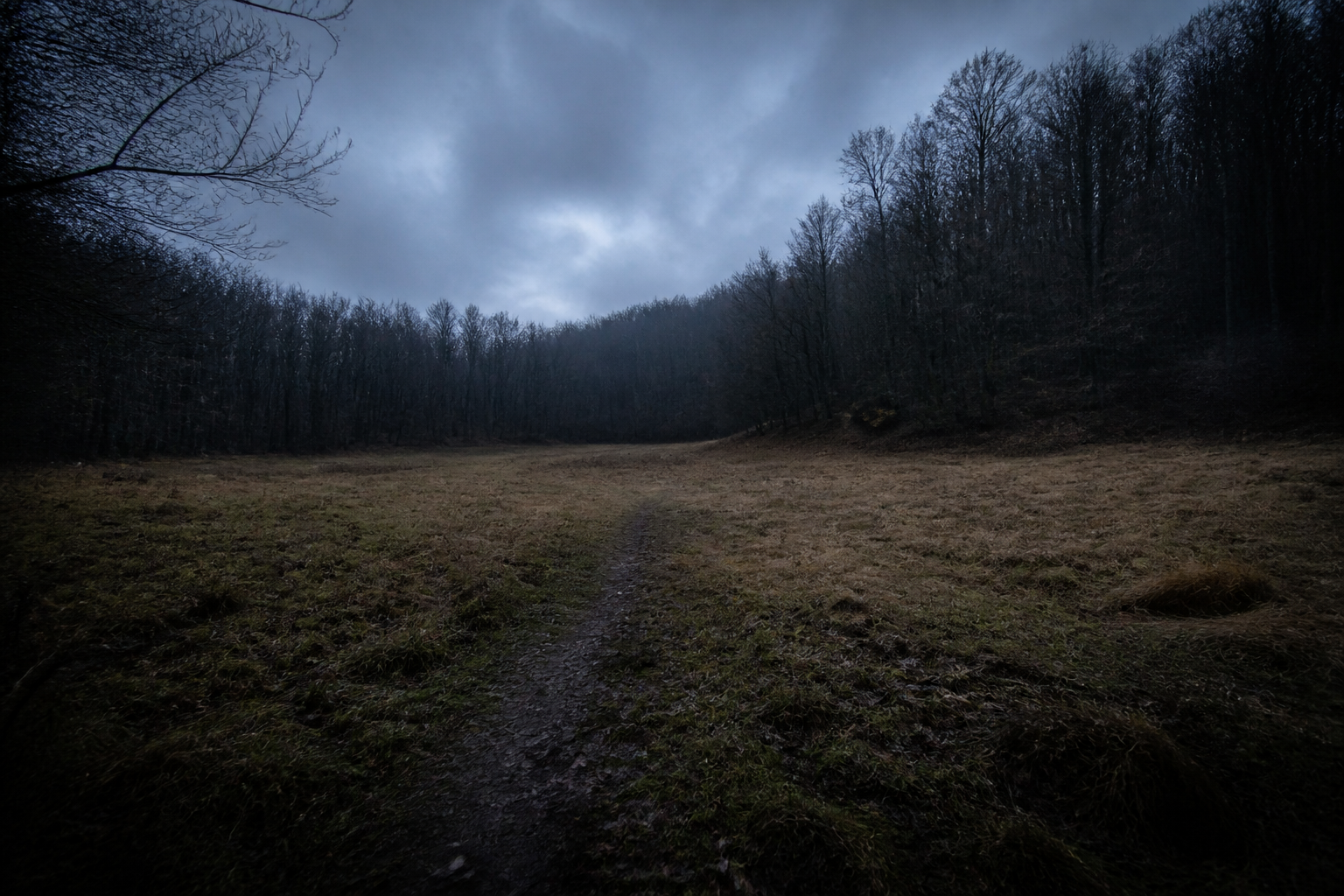
Poiana Rotundă, usually translated as the Round Clearing, is the visual center of many Hoia Baciu Forest legends. Popular retellings often describe a perfect barren circle where vegetation cannot grow. That version is too absolute. Photographs and visitor accounts show an open, grassy area whose appearance changes with season, weather, land use, and camera angle.
The clearing’s exposed shape still creates a powerful effect. Open ground should feel safer. Instead, anyone at its center is visible from the tree line while unable to see deeply into the forest.
Tourism research published in 2025 documents the legends that frame Hoia Baciu as a boundary between worlds. Stories include portals, disappearances, and a girl who allegedly returned years after vanishing without aging. The researchers examined these narratives as dark-tourism culture, drawing on tourist reviews, blogs, and news reports. Their appearance in an academic paper records the folklore; it does not verify the events.
5. The Twisted Trees Look Like Warnings
Images of curved trunks helped give the forest a body. Trees bend across paths, lean into one another, and grow around old damage. In the right light, knots resemble eyes and broken limbs appear to reach through the understory. The effect is frightening because the material is alive, familiar, and almost recognizable.
However, unusual growth does not require unusual energy. Trees respond to competition for sunlight, wind exposure, snow weight, soil movement, injuries, disease, human interference, and the collapse of neighboring vegetation. One trunk can preserve decades of pressure in a single curve.
Online articles frequently mislabel photographs from Poland’s Crooked Forest as Hoia Baciu. Authentic Romanian imagery contains irregular trees, but not an endless army of uniformly bent pines.

6. Why Visitors Feel Watched
Reported experiences include anxiety, headaches, nausea, unseen footsteps, voices, equipment failure, and the feeling of being followed. These accounts are part of the forest’s reputation, but they remain anecdotal. There is no reliable public dataset showing that such symptoms occur more often here than in other woods visited at night by people expecting a haunting.
Forests naturally disrupt perception. Leaves scatter sound, trunks block the source of movement, uneven ground changes balance, and low light removes color and depth. Fear increases attention while reducing the ability to interpret ambiguous stimuli calmly. A branch moving behind the listener can sound like a step approaching from ahead.
Expectation adds pressure. Someone entering “the world’s most haunted forest” monitors every sensation. A cold patch, fading battery, or moment of disorientation becomes meaningful before it can become ordinary.
7. Television Turned Local Woodland Into Dark Tourism
Hoia Baciu’s international reputation expanded through paranormal television, online lists, guided night walks, and social media. Academic tourism research from Babeș-Bolyai University found a revealing divide: foreign visitors increasingly approached the area as a haunted destination, while many local residents still treated it as ordinary woodland for walking and recreation.
That difference shows how stories change landscapes. A local path becomes a threshold once enough visitors arrive carrying the same expectation. Ambiguous photographs then inspire more stories, making the reputation appear self-confirming.
Evil’s Eye has examined a similar tension between documentation and belief at Skinwalker Ranch, where decades of extraordinary claims have also outpaced publicly available evidence. For a historical haunting shaped by generations of retelling, read the investigation into the Bell Witch legend.
Documented Facts Versus Unverified Claims
| Claim | Evidence assessment |
|---|---|
| The forest exists beside Cluj-Napoca | Documented geography |
| An unidentified object was photographed in 1968 | Documented report; the object’s nature remains disputed |
| A shepherd vanished with 200 sheep | Repeated legend without a verified historical record |
| The clearing is a dimensional portal | Folklore with no controlled supporting evidence |
| Visitors experience illness or missing time | Anecdotal reports without a reliable comparative dataset |
| Every twisted tree is scientifically unexplained | Misleading; multiple natural growth processes can bend trees |
Visiting Hoia Baciu Forest Safely
The most immediate risks are ordinary woodland hazards: darkness, uncertain routes, mud, falling branches, insects, weather, and poor phone reception. Visitors should use current maps, check local guidance and forecasts, carry water and a charged light, remain on recognized paths, and avoid entering alone after dark.
Respect also matters. The forest is not a horror attraction constructed for visitors. It is a living landscape beside local communities and protected natural areas. Do not damage trees, leave ritual objects, light fires, or trespass to manufacture a frightening photograph.
Verdict: Is Hoia Baciu Forest Really Haunted?
Hoia Baciu Forest has a documented paranormal reputation, a genuine 1968 media history, decades of investigation, and a landscape capable of producing intense fear. It also has no controlled evidence proving ghosts, portals, alien craft, or impossible disappearances.
The forest remains disturbing because certainty breaks down beneath its canopy. Natural shapes resemble intention. Sounds lose their direction. Old photographs refuse simple interpretation, and folklore waits to explain whatever the darkness withholds. Hoia Baciu does not need a verified ghost to feel haunted. Human expectation has been walking its paths for more than half a century.
Sources
- Cluj County Library, local history of the Hoia Baciu phenomena
- Babeș-Bolyai University researchers, Hoia Baciu and niche paranormal tourism
- Tourism Recreation Research, fright and dark tourism in Hoia Baciu Forest
- Cluj Tourism, Baciului Gorge and the forest’s verified location
- Visit Romania, Hoia Baciu visitor overview and practical guidance