
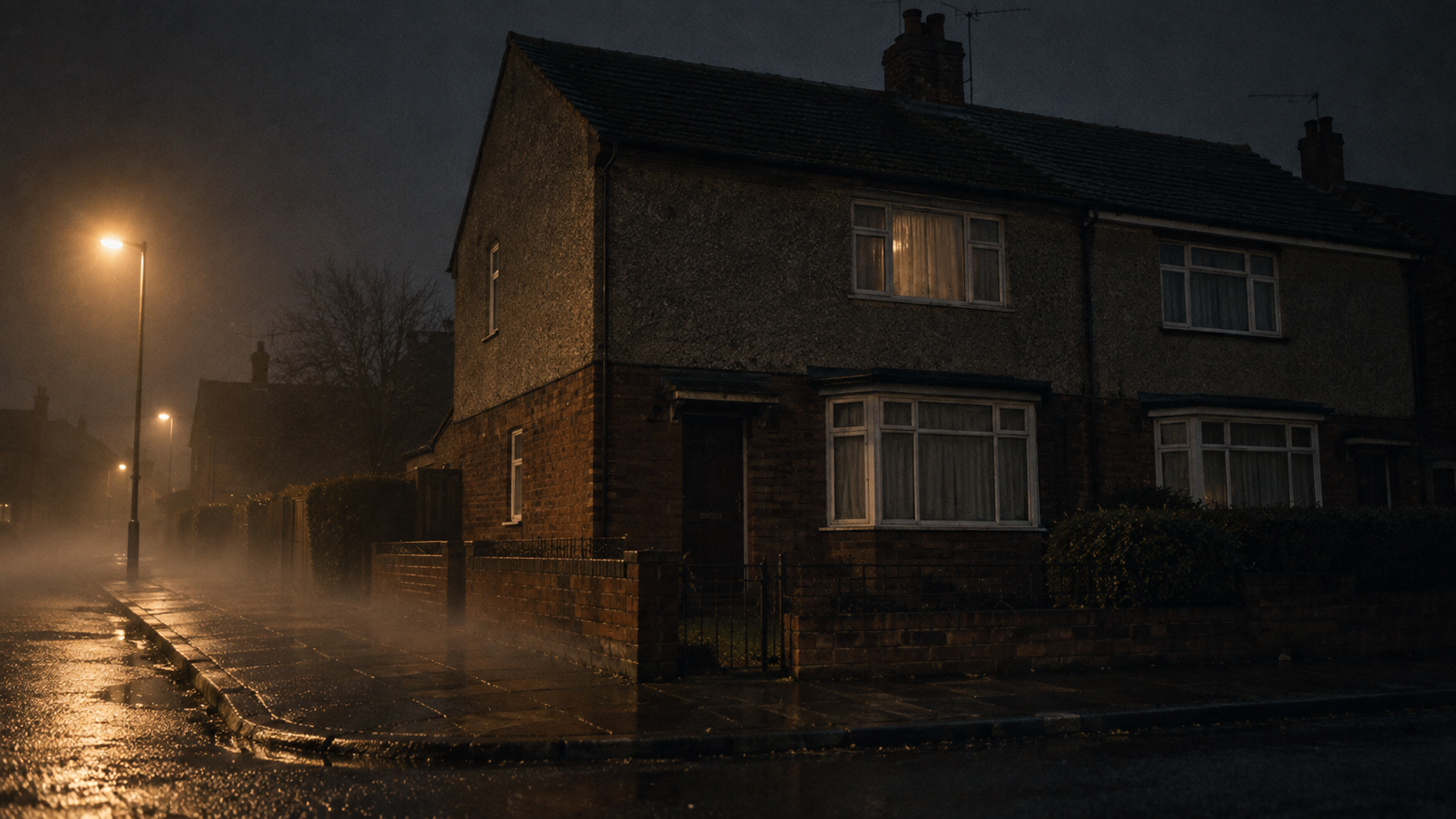
At 30 East Drive in Pontefract, the horror reportedly began with water. In August 1966, the Pritchard family returned to their ordinary council house and found a fine pool spreading across the kitchen floor. It had no obvious source. White powder then appeared to fall from above, although the ceiling showed no opening. Those small disturbances became the first chapter of the Black Monk of Pontefract, one of Britain’s most violent and disputed poltergeist stories.
Over the following years, the family described objects moving, lights failing, doors slamming and a dark figure appearing inside the home. The most alarming claims involved their teenage daughter, Diane. Yet the famous identity of the supposed spirit emerged later, and the historical evidence for a murdered, black-robed monk is remarkably thin. The case is frightening not because every claim can be proved, but because an unremarkable house became the stage for a story that still refuses to stay quiet.
An ordinary home on East Drive
Joe and Jean Pritchard lived at the semi-detached property with their children, Philip and Diane. The Chequerfield estate did not resemble the traditional setting of a ghost story. There were no ruined towers, sealed crypts or centuries-old corridors. There was a narrow staircase, small bedrooms and neighbouring homes close enough for ordinary sounds to travel through walls.
According to later family accounts, the disturbances escalated after the unexplained water and powder. Crockery rattled or flew from cupboards. A heavy chest was said to move. Green foam appeared from a tap. Doors reportedly opened and closed without visible hands, while lights flickered and objects vanished before reappearing somewhere else.
The family called the unseen presence Fred or Mr Nobody. The playful name did not make the atmosphere safer. What began as domestic disruption allegedly became aggressive, particularly when Diane was inside the house.
| Period | Reported development |
|---|---|
| August 1966 | Water and falling white powder reportedly appear inside 30 East Drive. |
| Late 1960s | The family describes moving objects, noises, damaged furniture and electrical disturbances. |
| Later incidents | Diane allegedly suffers physical attacks, and witnesses report a hooded figure. |
| Around 1980 | Researcher Tom Cunliff reconstructs the case from interviews and newspaper coverage. |
When the activity turned violent
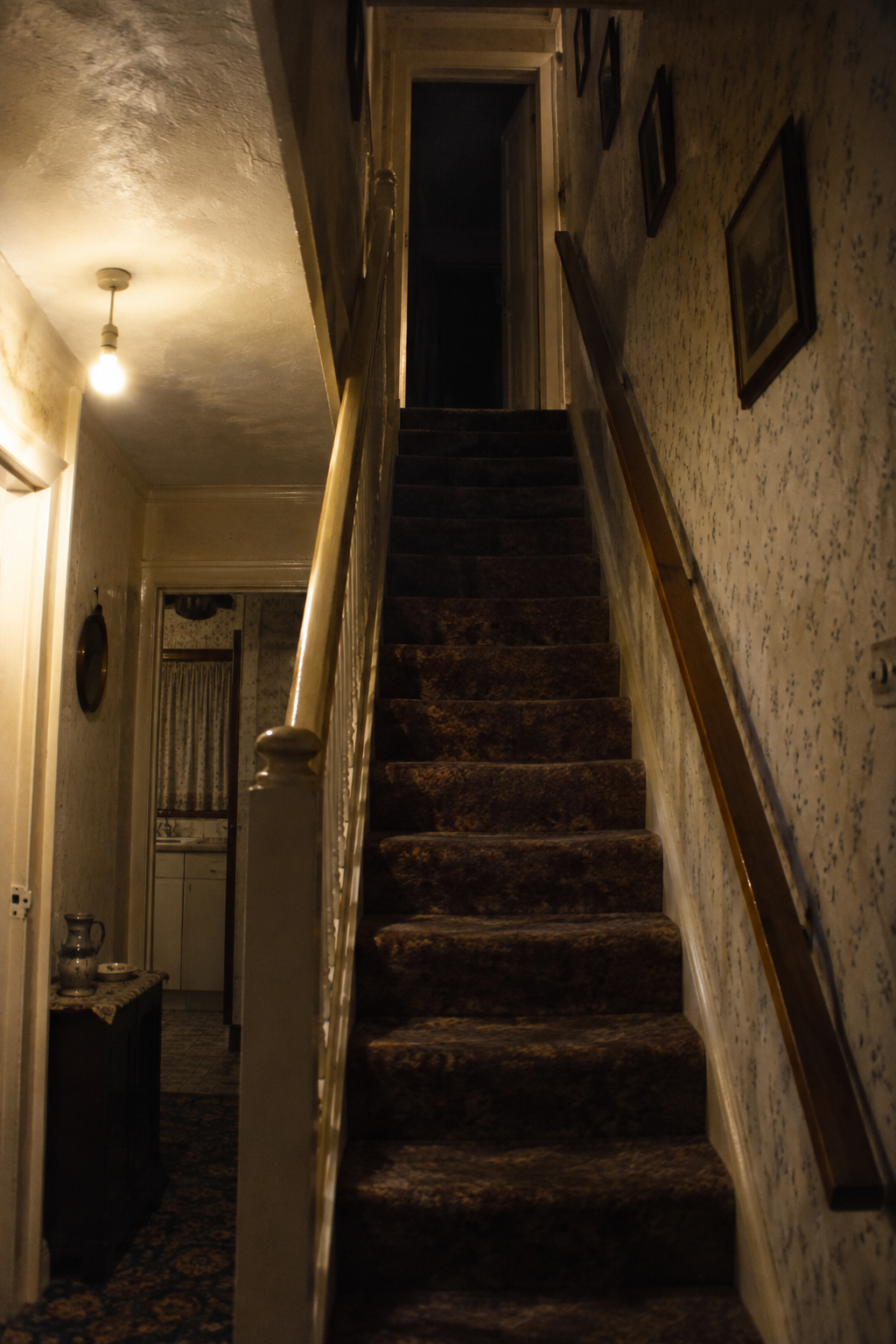
The most disturbing stories focus on Diane. Relatives later claimed that an unseen force pulled her hair, dragged her and once left marks around her throat. One account describes her being pulled toward the staircase. These claims made the Pontefract case notorious, but they were not recorded through controlled observation or supported by medical documentation that publicly established a paranormal cause.
Other incidents were reportedly witnessed by visitors, neighbours, police, clergy and local officials. A councillor allegedly watched a heavy wardrobe shake. A neighbour described drumming sounds. The family’s relatives said objects moved in front of them. The number of reported witnesses gives the story weight, although most surviving versions were assembled years later from memory and press reports.
The figure at the bedroom door
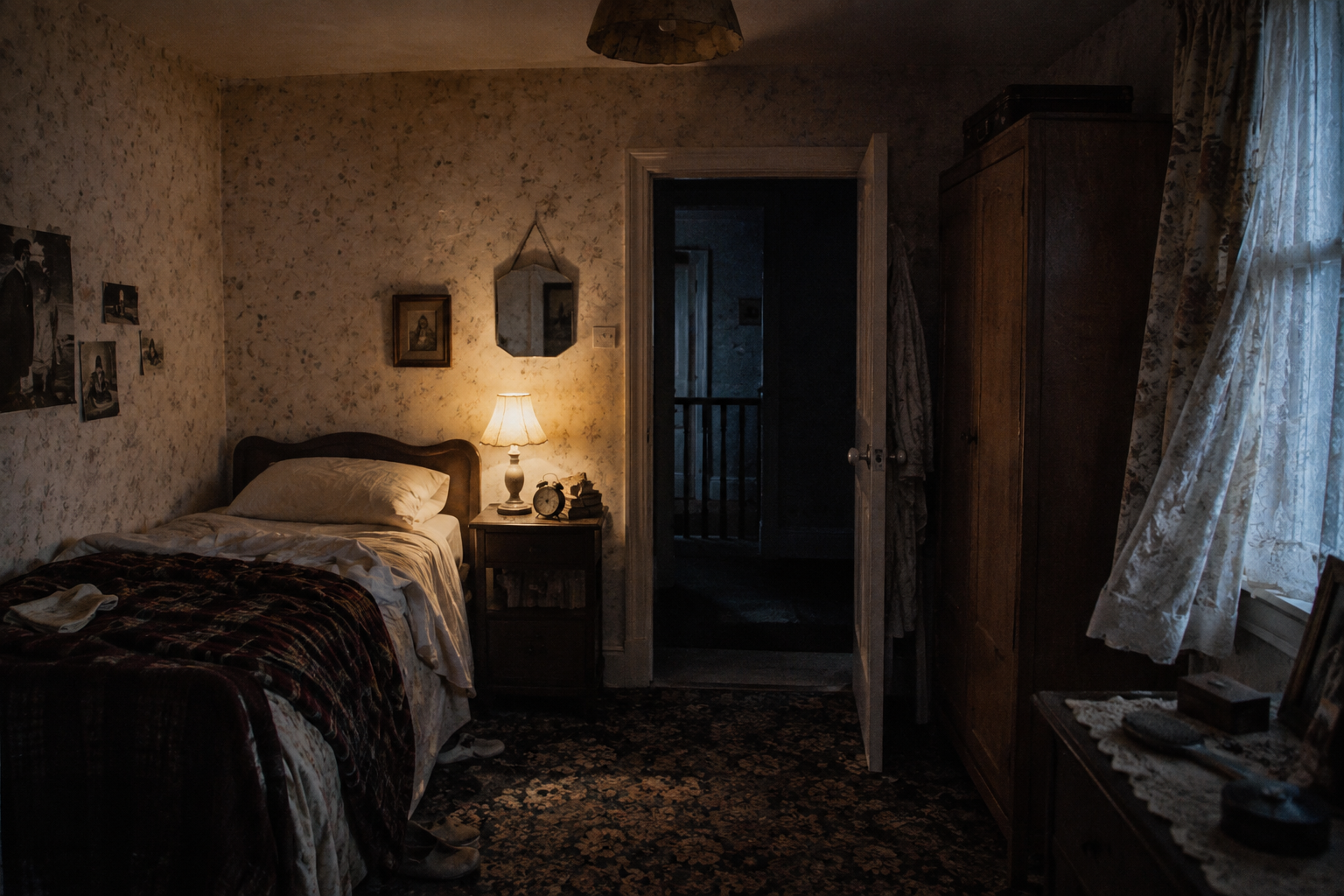
The case changed when witnesses began describing a tall, hooded form. Jean and Joe were said to have seen it, while Diane and Philip reportedly encountered a similar figure near the kitchen. A neighbour later recalled a dark, robed shape standing behind her. The face inside the hood was indistinct or completely hidden.
That image gave the haunting a body. A nameless disturbance could now be imagined waiting on the landing or bending beneath a low doorway. However, a visual resemblance to a monk does not prove the apparition’s identity. Darkness, expectation and later retellings can turn an uncertain silhouette into a recognizable figure.
The Society for Psychical Research notes that Pontefract began as a poltergeist case before developing into a recurring ghost story. That distinction matters. Early reports centred on movement, noises and household disruption. The specific Black Monk narrative came later.
Was there really a Black Monk of Pontefract?
The popular explanation claims that the figure was a Cluniac monk executed near the property during the reign of Henry VIII. Some versions accuse him of rape or murder and place a gallows close to the future estate. The story is vivid, specific and repeated so often that it can sound like documented history.
Researchers have not found a reliable historical record proving that this monk existed or died as the legend describes. Even a long feature preserved by the current 30 East Drive archive acknowledges that an extensive search failed to confirm the execution story. The monk may therefore be an identity constructed after witnesses reported a hooded shape.
Pontefract does have genuine monastic history. Its medieval priory and the violent past of the surrounding area supplied convincing scenery for a legend. Still, historical atmosphere is not evidence that a particular dead man returned to a twentieth-century council house.
Why the evidence remains difficult
The Pontefract haunting was not investigated continuously while its most dramatic events were happening. Much of the detailed narrative comes from researcher Tom Cunliff, who examined newspaper accounts and interviewed witnesses roughly a decade later. Colin Wilson subsequently popularized the case in his writing on poltergeists.
This delay creates serious problems. Human memory changes, especially when witnesses repeatedly discuss a frightening event. Newspaper reports select dramatic details. Later books often combine separate incidents into a smooth chronology, even when the original record is incomplete.
There is also no widely available film, photograph or physical sample that demonstrates an unknown force at work. Current visitors continue to report sounds, shadows and uncomfortable sensations, but a property operating as a paranormal destination creates strong expectations before anyone enters. These experiences may be sincere without proving that a supernatural entity caused them.
A haunting shaped by the house itself
The setting explains part of the story’s power. At night, a narrow postwar home can compress every sound. Pipes tick behind walls. Floorboards answer footsteps from another room. Headlights sweep across ceilings, and a person standing at the bottom of the stairs cannot see what waits beyond an open door.
None of these ordinary effects individually accounts for every reported event. Together, however, they show why a domestic haunting can become more oppressive than a ruined castle. The threat is not safely distant. It shares the kitchen, watches the staircase and enters the bedroom. That same invasion of private space makes the Enfield Poltergeist case so disturbing, although Enfield produced a much larger contemporary archive.
What the Black Monk story can support
It is reasonable to conclude that the Pritchard family and several visitors reported frightening disturbances at 30 East Drive. It is also clear that the house became one of Britain’s most recognizable paranormal locations. What cannot be established is that a monk caused those incidents, that the alleged figure corresponded to a real executed person, or that today’s experiences continue the same phenomenon.
The strongest interpretation is therefore not a neat verdict. Pontefract contains a core of family testimony surrounded by later investigation, local folklore, commercial attention and increasingly dramatic retellings. The absence of early controlled evidence keeps the paranormal claim unproven. The consistency of the family’s fear keeps the story from feeling disposable.
Why 30 East Drive still terrifies
The Black Monk of Pontefract endures because its most frightening element is brutally simple: the family could not shut the disturbance outside. It was already in the rooms where they ate and slept. Whether the cause was environmental, psychological, fabricated, misunderstood or genuinely unexplained, the story turned a safe domestic space into a trap.
Other hauntings leave grand ruins behind. This one leaves a front door on an ordinary street and a staircase disappearing into darkness. That contrast is the real source of its dread. Like the disputed events at Borley Rectory, the case survives at the exact point where testimony becomes legend and the missing evidence leaves room for something colder to enter.
Read next
- Compare Pontefract with the recordings and disputed photographs from the Enfield Poltergeist investigation.
- Examine another British haunting through the evidence behind Borley Rectory.
- Explore a very different haunted landmark in the history of the Queen Mary ghost stories.