
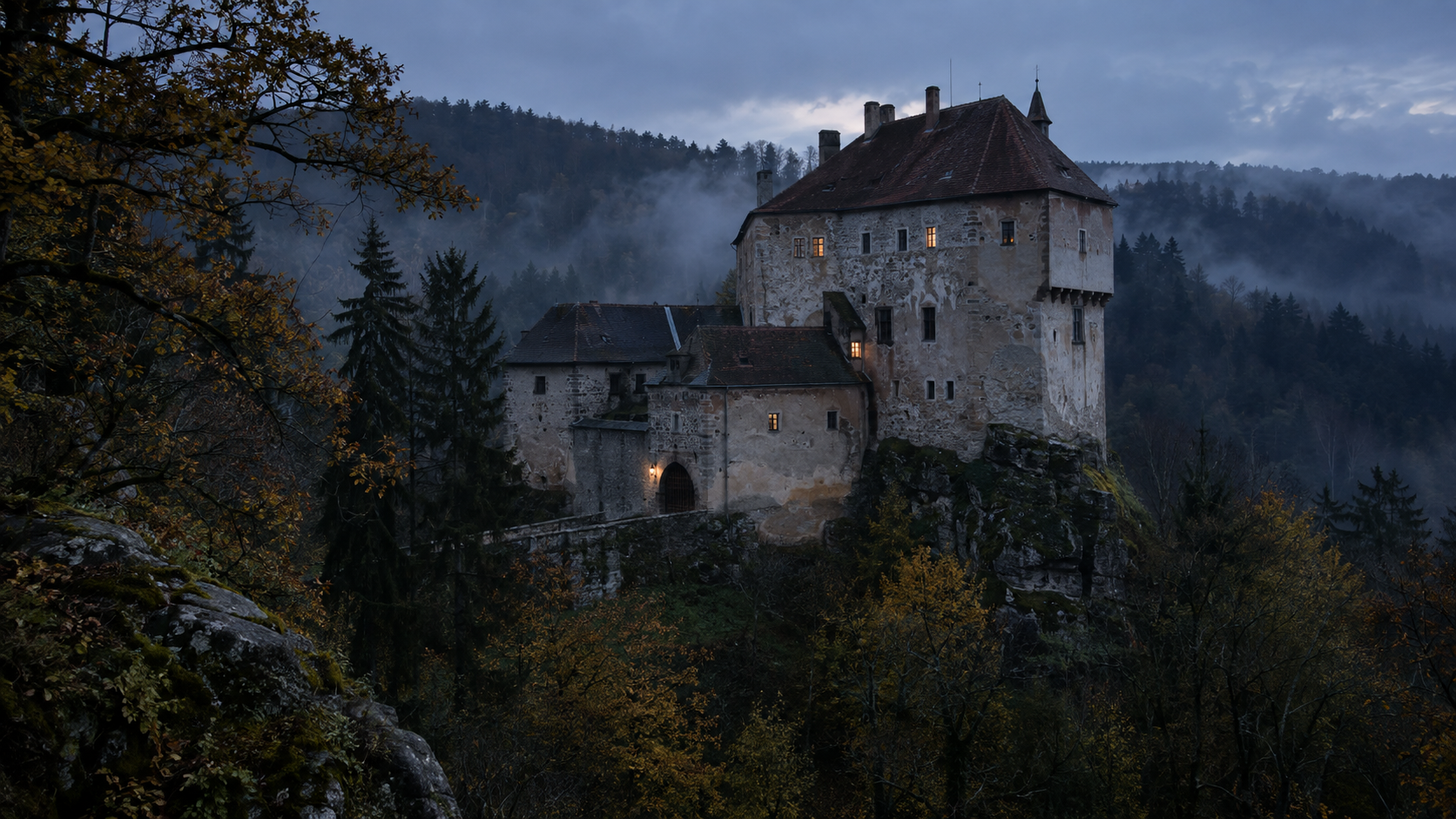
Deep in the wooded landscape of Central Bohemia stands a castle with a terrifying reputation. According to folklore, Houska Castle was not built to keep enemies out. It was built to seal something beneath its chapel: a bottomless fissure said to open into Hell.
The legend describes malformed creatures crawling from the darkness, prisoners lowered into the hole and a faceless monk guarding the grounds. The documented castle is no less atmospheric, but its real history tells a more complicated story. Houska is a genuine 13th-century fortress, altered during the Renaissance and occupied across centuries of political upheaval. The infernal gateway belongs to folklore, not proven archaeology. Yet the building’s unusual rock, remote setting and shadowed chapel give the story a physical place to survive.
A castle hidden in the Bohemian forest
Houska Castle lies in the Kokořín forests, roughly 47 kilometres north of Prague. Archaeological research cited by the castle dates its foundation to the first half of the 13th century, during the reign of Přemysl Otakar II. An earlier wooden and later stone stronghold may have occupied the site.
The surviving building combines an early Gothic core with extensive Renaissance alterations. Its enclosed courtyard, thick masonry and narrow openings create the impression of a structure turned inward. Modern retellings claim that its defenses face the centre rather than an approaching army, although architectural history shows that Houska once possessed substantial external fortifications.
| Period | Documented history |
|---|---|
| Early 13th century | The Gothic castle is founded under the Přemyslid rulers. |
| 1584 to 1590 | The medieval core is transformed into a Renaissance residence. |
| 1658 | Parts of the fortifications and the Gothic tower are demolished after the Thirty Years’ War. |
| 1939 to 1945 | The German military uses the property during the occupation. |
| 1999 | The restored castle opens to the general public. |
The legend of the bottomless pit
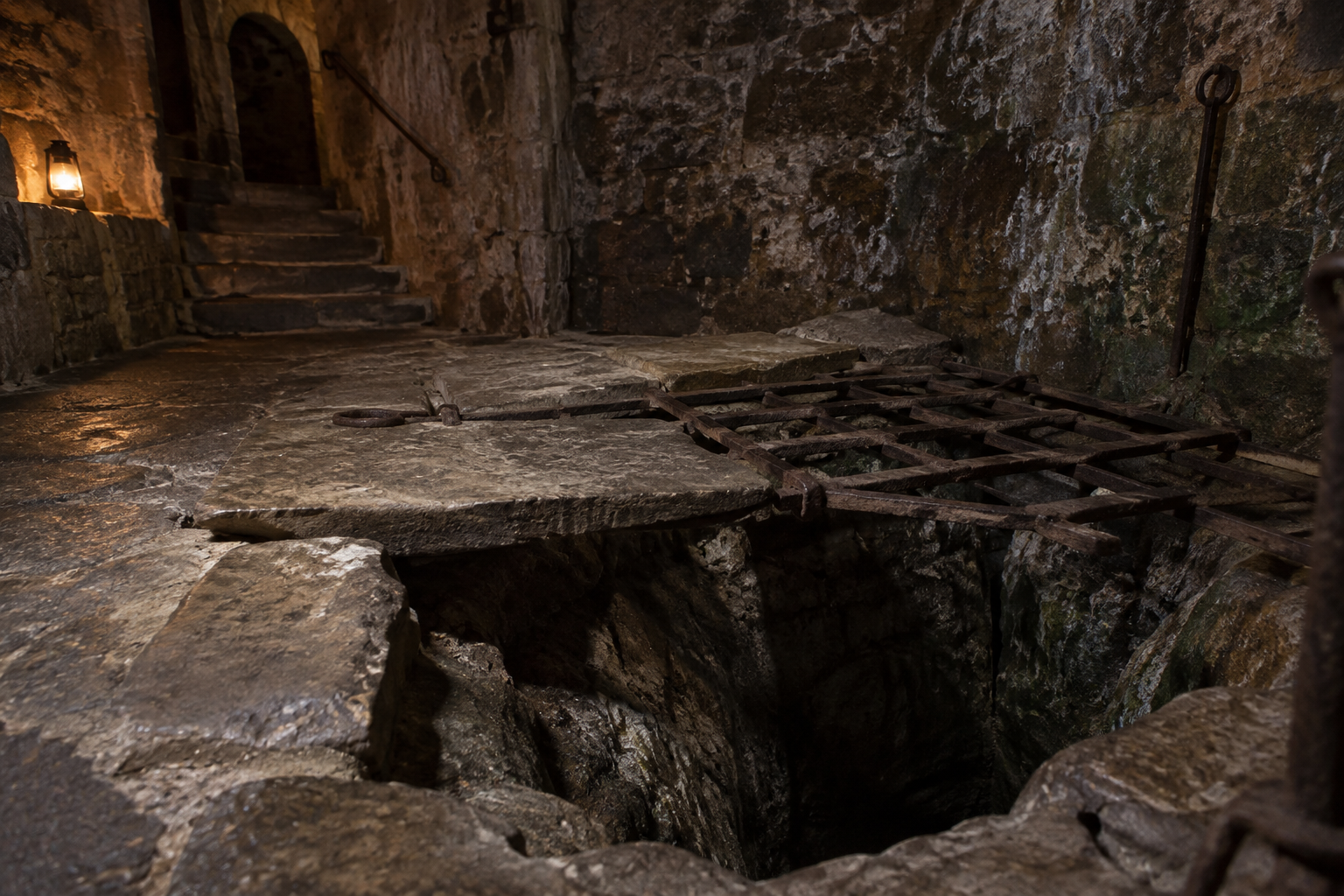
The most famous Houska Castle legend begins before the stone walls existed. Local folklore describes a crack in the rock so deep that no one could see its end. Strange beings allegedly emerged after dark. Some versions say local rulers offered pardons to prisoners willing to descend by rope and report what they found.
In the story, the first prisoner returned screaming, his hair suddenly white and his face aged by terror. Other versions claim he died soon afterward. No contemporary medieval record confirms this experiment. The episode functions like a classic warning tale: knowledge lies below, but looking into it destroys the witness.
The official Czech tourism account calls the alleged opening a gateway to Hell while clearly presenting it as legend. Its precise location also shifts between versions. Some place it beneath the chapel. Others move it to the castle well. That instability is important because a documented physical entrance has never been established.
Why the chapel became the centre of fear
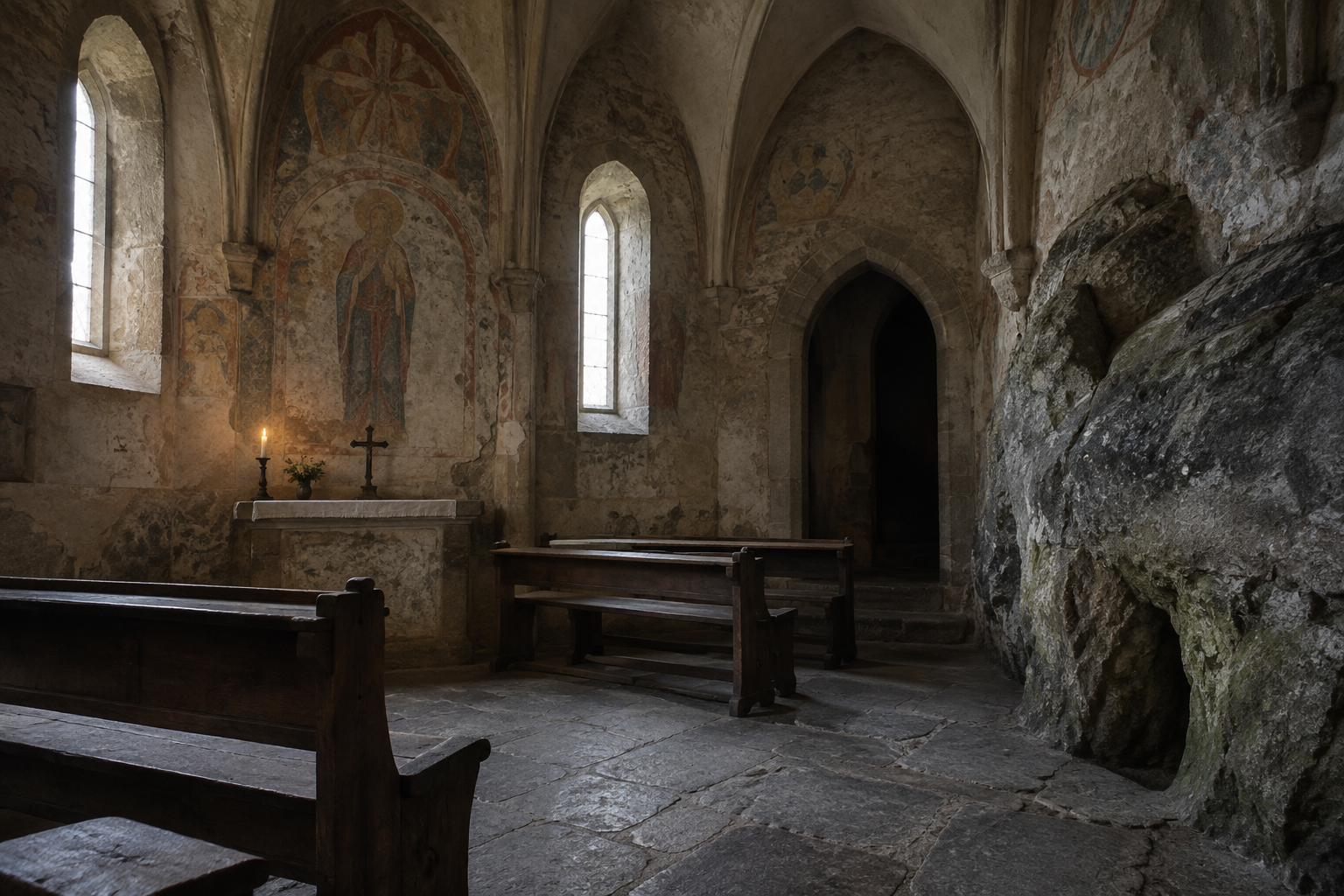
The castle chapel stands over natural rock incorporated into the building. Its surviving medieval paintings date from around the turn of the 13th and 14th centuries, making the room historically valuable even without the supernatural claims. In the dim interior, faded sacred figures stare across worn stone while the structure appears to grow directly from the crag.
Folklore treats the chapel as a spiritual lid. The builders supposedly placed consecrated ground over the fissure and constructed the holy space to contain whatever moved below. This interpretation gains force from the visible rock, but it remains a story applied to real architecture. Medieval chapels were normal features of castles, and building around exposed bedrock was hardly evidence of an infernal purpose.
Still, the placement creates an unforgettable image. Worship takes place above darkness. Paintings of angels, saints and hybrid figures become guardians. Every footstep on the chapel floor seems to land on a boundary that the legend insists must not break.
The faceless monk and other Houska Castle legends
A second legend places a black-robed monk around the castle. Witness stories describe a hood with no visible face, watching visitors who remain after dark. The castle’s own account includes the figure as part of its folklore, but no reliable historical identity connects the apparition to a particular monk.
Other stories add winged creatures, animal-human shapes, moving shadows and cries beneath the floor. Their details vary widely. They are best understood as layers of folklore rather than a single continuous body of testimony. Once a location becomes known as a gateway to Hell, almost any unexplained sound can be absorbed into the central myth.
The faceless monk also resembles figures found in many European haunting traditions. A hood conceals identity and expression, allowing the listener to imagine what the darkness refuses to show. The recurring image says more about religious fear and medieval memory than it proves about an actual apparition.
What history confirms about the castle
The official history of Houska Castle describes a defensible Gothic structure that later became a Renaissance residence. The Association of Castle and Chateau Owners records a first written mention in 1316, later fortifications and the partial demolition ordered after the Thirty Years’ War.
These details complicate the popular claim that the building had no defensive or residential function. Houska may be remote from major modern routes, but it served political, administrative and domestic purposes. Its architecture changed as weapons, ownership and fashion changed.
During the Second World War, the German military used the castle from 1939 until 1945. Later stories sometimes turn that occupation into claims about occult experiments or forbidden archives. The occupation is documented; the sensational supernatural additions are not supported by equivalent public evidence. After the war, Houska housed State Library archives, was eventually restored to its former owners and opened to visitors in 1999.
Could the gateway have been a natural fissure?
The rock passing through the castle is real and visible within the complex. Central Bohemia also contains caves, sandstone formations and fractured ground capable of inspiring stories about hidden depths. A dangerous natural opening could have been filled, covered or incorporated into later construction without leading anywhere supernatural.
However, publicly available archaeological information does not confirm the legendary bottomless shaft or the prisoners said to have entered it. The absence of evidence does not reveal exactly how the story began. It simply means the most dramatic claims cannot be presented as documented medieval events.
This distinction resembles the problem surrounding the curse of Kuldhara Village. A real place and a genuine historical abandonment can support a later supernatural explanation, even when the evidence for the curse remains uncertain.
Why Houska feels built for the legend
Houska’s atmosphere does not depend on proving Hell beneath the floor. The forest limits the horizon. Ancient walls close around a small courtyard. Natural rock interrupts the chapel, and centuries of reconstruction make it difficult for an untrained visitor to know where one age ends and another begins.
That physical uncertainty gives folklore somewhere to hide. At Poveglia Island, isolation transformed layers of real history into an extreme haunted reputation. At Houska, the same process descends vertically. The terrifying idea is not that the castle contains a ghost. It is that the entire building may be a lock.
What remains beneath Houska Castle?
No credible evidence proves that Houska Castle covers a gateway to Hell, that prisoners were lowered into an endless pit or that creatures emerged from the rock. The documented building was a medieval stronghold, a Renaissance residence, a wartime military property and, eventually, a restored cultural monument.
Yet the legend persists because it reverses the purpose of a castle. Instead of protecting its occupants from the world outside, Houska supposedly protects the world from what is inside. Stand in the cold chapel and that idea becomes difficult to shake. The stones do not prove the story, but they make the question feel dangerously close: if the builders sealed the opening, what convinced later generations that it should never be uncovered?
Read next
- Explore another isolated place where history became horror in the haunted legend of Poveglia Island.
- Examine the evidence behind Kuldhara Village and its famous curse.
- Enter a more modern domestic nightmare in the Black Monk of Pontefract case.