
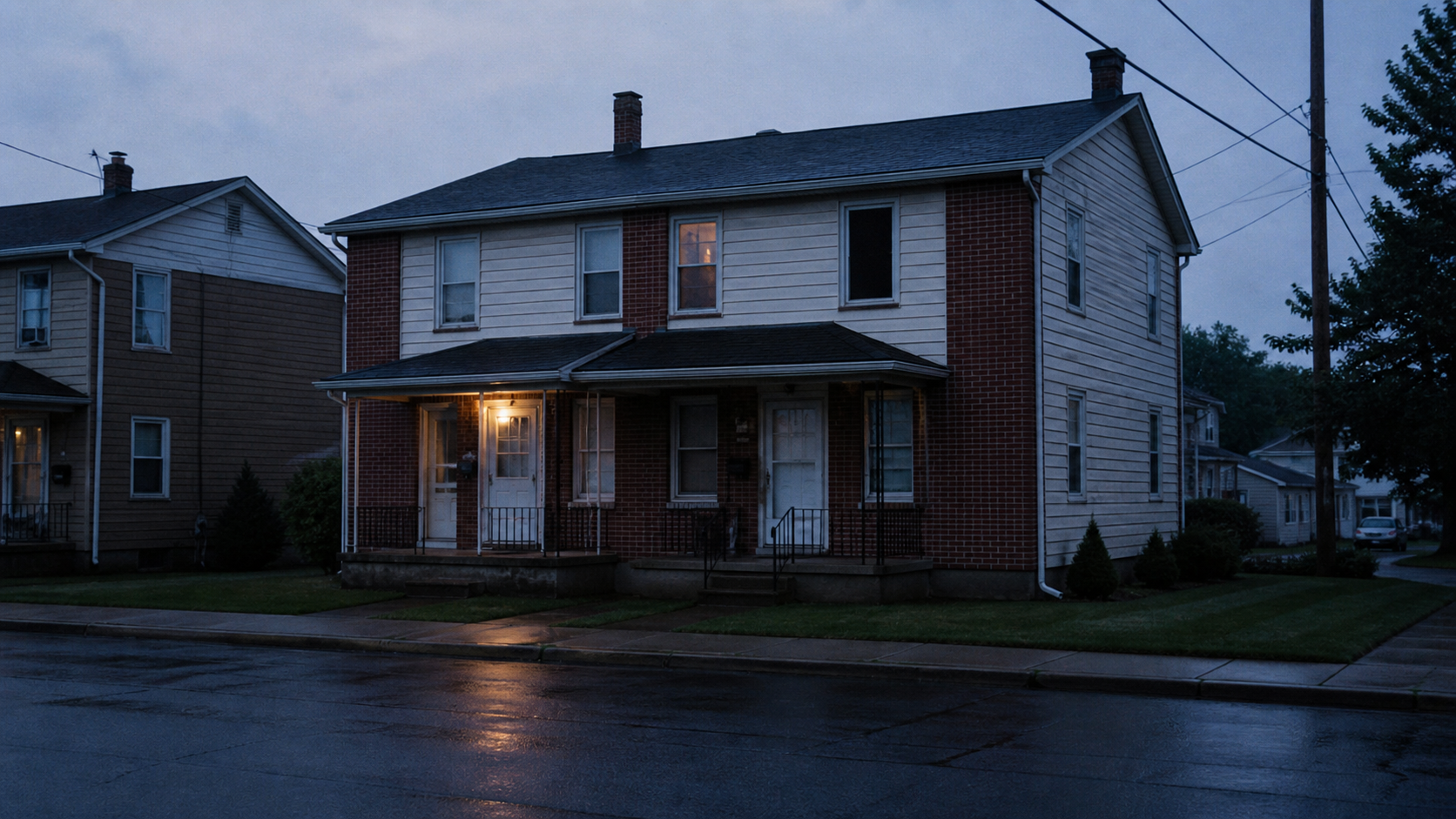
The 1986 Pennsylvania haunting that surrounded the Smurl family did not begin in a ruined mansion or an isolated farmhouse. It unfolded inside a modest duplex on Chase Street in West Pittston, a small borough near Scranton. In August 1986, Jack and Janet Smurl publicly claimed that years of unexplained disturbances had escalated into violent attacks. Reporters arrived, neighbors watched, clergy responded cautiously, and paranormal investigators Ed and Lorraine Warren declared the house demonic.
The 1986 Smurl case became one of Pennsylvania’s most famous haunting stories, but its surviving record contains sharp contradictions. The family described terrifying experiences. The Warrens offered a supernatural diagnosis. Skeptical investigators said they were denied the access needed to test those claims independently. Later books and screen adaptations made the story even more dramatic. What remains is not proof of a demon, but a disturbing study of testimony, belief, publicity, and evidence that was never secured under controlled conditions.
The Smurl family and the West Pittston duplex
Jack and Janet Smurl lived with their children in one side of a double-block home, while Jack’s parents occupied the other. The family later said unusual activity began years before the case reached newspapers. Their accounts included foul odors, unexplained noises, cold areas, moving objects, shadowy figures, and physical contact they attributed to unseen forces.
Those claims grew more severe over time. Family members said beds shook, people were scratched or pulled, and disturbing animal-like sounds moved through the house. These details came primarily from the Smurls, the Warrens, interviews, and later retellings. They are allegations and reported experiences, not independently established events.
| Case detail | Documented information |
|---|---|
| Location | A duplex on Chase Street in West Pittston, Pennsylvania |
| Family | Jack and Janet Smurl, their children, and Jack’s parents |
| Public attention | The story became a national media event in August 1986 |
| Paranormal investigators | Ed and Lorraine Warren |
| Skeptical response | Paul Kurtz and investigators associated with CSICOP challenged the claims |
| Church response | The Diocese of Scranton examined the situation but did not publicly verify a demonic cause |
| Later legacy | Books, a 1991 television film, and later horror cinema adapted the case |
Why the 1986 Pennsylvania haunting became national news
The haunting became national news after the Smurls went public in August 1986. Contemporary reporting described a crowded residential street, intense public curiosity, and a family appealing for help. The details were perfectly shaped for television: an ordinary American home, frightened parents, unseen attackers, religious language, and two already famous investigators.
By this point, the Warrens were closely associated with the case. They interpreted the disturbances through a demonology framework and acted as spokespeople for the family. Their conclusion gave the story a clear villain, but it did not come from a controlled scientific investigation. A diagnosis of demonic activity depends on religious interpretation and the investigators’ own methods.

The public story also compressed time. Reports often treated the case as a single eruption in 1986, although the family said the disturbances developed across years. That distinction matters. A long sequence reconstructed from memory is harder to verify than an event recorded immediately with consistent notes, independent witnesses, and physical documentation.
What the Smurls said happened
The family’s allegations ranged from unsettling household incidents to claims of serious assault. They described unexplained knocking, bad smells, sudden cold, damaged objects, apparitions, and physical attacks. Jack Smurl also made an intensely personal claim of sexual assault by an unseen entity. Responsible reporting should neither mock that account nor repeat it as established supernatural fact.
Some events were said to have witnesses beyond the immediate family, including the Warrens and visiting clergy. However, the most sensational claims were not captured in a form that allowed neutral experts to examine them. Audio recordings of knocks or voices, even when genuine recordings, cannot identify a supernatural cause without reliable control over the environment.
The family’s sincerity and the cause of the experiences are separate questions. People can honestly report fear, sounds, smells, sleep disruption, or a sense of presence while disagreeing about what produced them. Plumbing, pests, neighboring activity, building movement, expectation, stress, sleep phenomena, and deliberate interference are among the ordinary possibilities investigators must exclude before reaching an extraordinary conclusion.
The Warrens, clergy, and claims of exorcism
Ed and Lorraine Warren reportedly visited in January 1986 and later described multiple entities in the duplex, including a demon. Their involvement brought experience in publicity and paranormal cases, but it also made independent verification more important. They entered the house with a spiritual framework already in place.
The Catholic response was more guarded than many popular retellings suggest. Contemporary coverage indicated that the Diocese of Scranton looked into the family’s situation while remaining uncertain about its cause. Reports of prayers or clergy visits should not automatically be described as the Church confirming a possession or authorizing a formal exorcism. Those are different claims requiring different evidence.
In late October 1986, the family said the disturbances had stopped and credited prayer. A contemporaneous United Press International report recorded that statement. The cessation did not demonstrate what caused the events, but it became a significant ending to the most public phase of the story.
Why skeptics disputed the 1986 Smurl case
Paul Kurtz, then chairman of the Committee for the Scientific Investigation of Claims of the Paranormal, approached the case from a skeptical position. His team sought access after press coverage exploded. According to the organization’s published account, independent investigators were not given the unrestricted opportunity they wanted to examine the house and claims.
That access dispute is central. A haunting cannot be tested adequately through secondhand interviews alone. Investigators would need to inspect the building, document mechanical and environmental conditions, control entry, identify every observer, record events continuously, and preserve original evidence. When access is controlled by people already committed to a demonic interpretation, confidence in the conclusion falls.

Kurtz proposed non-paranormal possibilities, including suggestion, misinterpretation, household tensions, and publicity. Mentalist Kreskin later demonstrated for journalists how apparently strange effects could be produced without supernatural forces and predicted that reported activity would decline as attention faded. That demonstration did not prove how every Smurl incident occurred, but it showed why observation and interpretation must be separated.
Claims, records, and unresolved gaps
| Claim | Evidence status |
|---|---|
| The duplex contained a demon | A conclusion attributed to the Warrens, not an independently verified finding |
| Family members suffered physical attacks | Reported by the family, with no surviving controlled documentation proving an unseen cause |
| Recordings captured paranormal sounds | Recordings were claimed, but a sound alone cannot establish its source without environmental controls |
| The Church confirmed the haunting | Clergy responded, but public statements did not establish a verified demonic cause |
| Skeptics disproved every event | Skeptics offered alternatives and criticized access, but limited access also prevented a complete reconstruction |
The strongest documented fact is the media event itself. The Smurls made specific claims, reporters covered them, the Warrens promoted a demonic interpretation, skeptics objected, and the neighborhood became a spectacle. The weakest part of the record is the bridge between reported experience and supernatural cause.
How books and films changed the haunting
Robert Curran’s book The Haunted expanded the family’s story into a dramatic narrative. A 1991 television film carried that version to a wider audience, and later screen adaptations renewed interest in the case. These works are part of the Smurl haunting’s cultural history, but they are not substitutes for contemporaneous records.
Dramatization creates dialogue, compresses timelines, combines incidents, and gives uncertain events a decisive shape. Readers looking for the 1986 Pennsylvania haunting should therefore distinguish between what newspapers reported in 1986, what investigators later argued, what the family remembered, and what entertainment reconstructed. Evil’s Eye applies the same separation when examining the Amityville Horror claims and the evidence debate surrounding Borley Rectory.
What the evidence allows us to conclude
The 1986 Smurl case documents a family who said they were frightened in their own home and sought religious and paranormal help. It also documents a rapid escalation into national publicity. What it does not provide is independently controlled evidence that identifies a ghost or demon as the cause.
The case remains unsettling because the ordinary setting makes the allegations intimate. Yet the more terrifying the claim, the more careful the evidence must be. The 1986 Pennsylvania haunting survives as an unresolved cultural case, not a proven supernatural event. Its legacy rests between sincere testimony, disputed investigation, and a media story that became larger than the duplex where it began.
Read next
- Borley Rectory: Evidence Behind England’s Haunted House
- Amityville Horror: The Tragedy and Haunted-House Claims
- The Haunted Queen Mary: History Beneath the Ghost Stories