
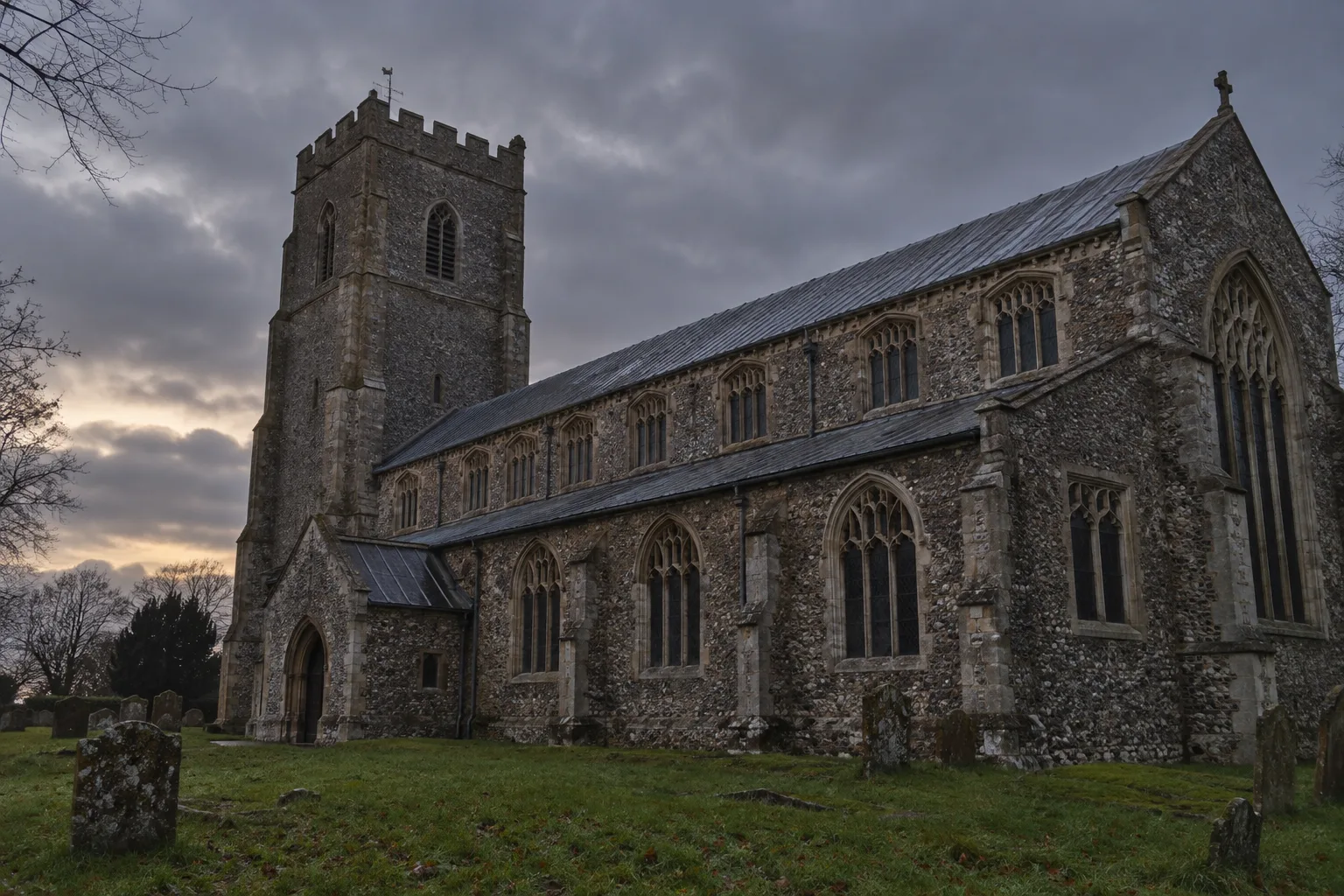
Black Shuck is often imagined on an empty East Anglian road: a huge dark dog keeping pace where no animal should be. Yet the legend’s most disturbing historical episode takes place among a congregation, in daylight. On 4 August 1577, a violent storm struck Bungay in Suffolk. A published account described a black dog moving through the church as people died or suffered injuries.
The storm belongs to history. The claim that a supernatural hound caused the deaths belongs to the story told about it. Between those two statements lies a more unsettling investigation than a simple monster sighting: who recorded the event, what they wanted readers to believe, and how later generations attached the account to buildings that still stand.
In this investigation
The Sunday storm behind Black Shuck
Abraham Fleming’s 1577 pamphlet, preserved in an EEBO Text Creation Partnership transcription, places the Bungay storm between nine and ten on Sunday morning. His account describes rain, thunder, lightning and a church plunged into darkness. Within that confusion, he reports a dog-shaped black presence and two people killed while kneeling.
The narrative then turns to Blythburgh, where a similar thing allegedly entered the church, appeared on a beam and caused further deaths and injuries. The transcription retains early modern spelling; readers should distinguish the original report from modern paraphrases. These are claims in Fleming’s account. They are not a modern forensic reconstruction, and the pamphlet does not establish the presence of an actual demonic animal.
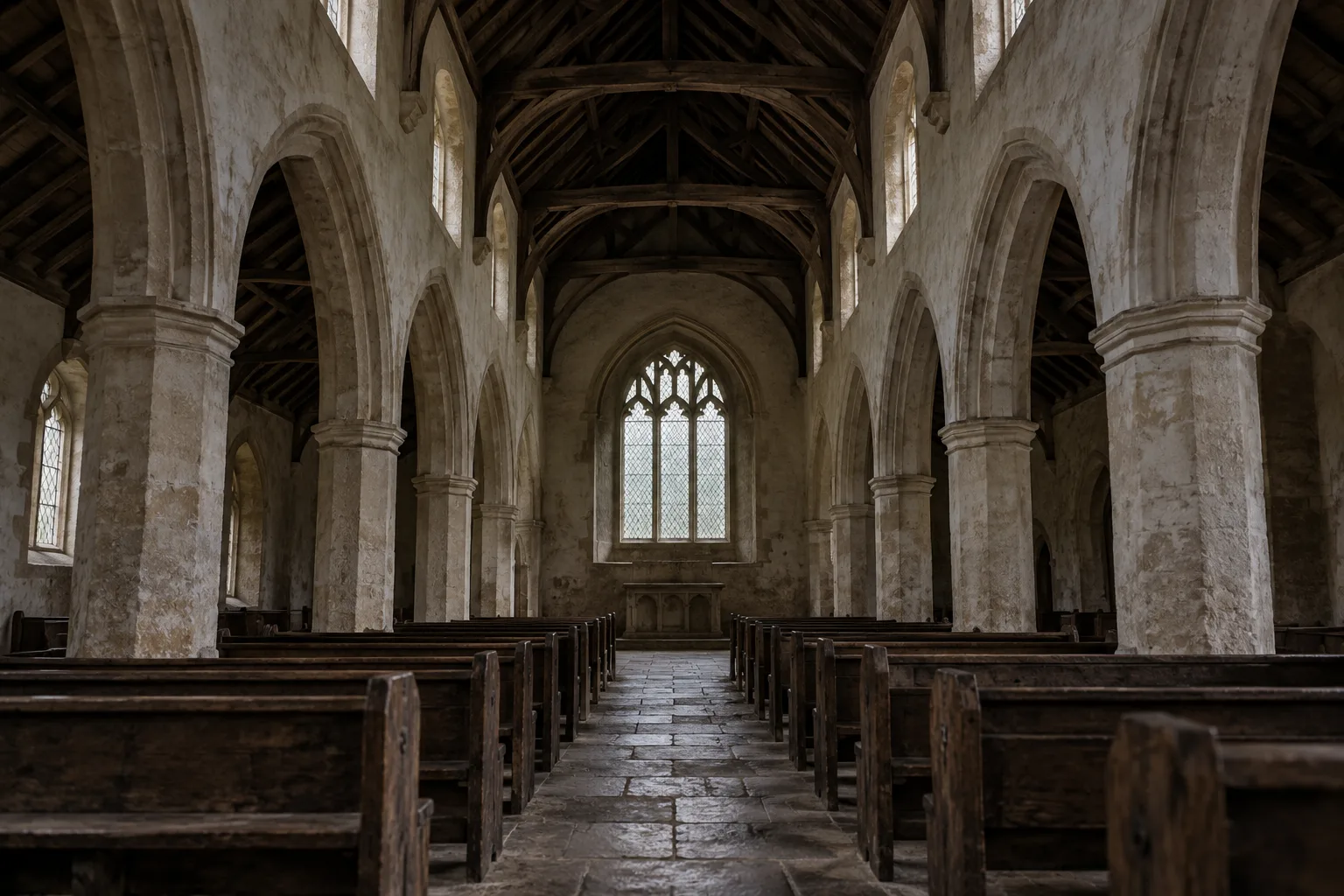
That distinction does not make the setting less frightening. The congregation had gathered for worship, not an expedition into an unfamiliar place. In the story, the threat crosses a boundary that should have held. The church becomes terrifying because its promise of shelter fails at the very moment people need it.
A warning pamphlet, not a neutral witness statement
Fleming says he committed the sequence to paper as he received it, and the title refers to a written copy. Calling him the eyewitness priest who watched Black Shuck attack therefore goes beyond what this source supports. The Blythburgh parish council’s historical discussion also notes that he did not become an ordained clergyman until 1588.
The Black Shuck account was a religious warning. The council explains how Fleming used the frightening creature to turn a natural disaster into a message about sin and divine judgement. He was not simply collecting unusual observations and leaving readers to decide what they meant.
This changes how the account should be read. A near-contemporary publication can be valuable without being impartial or complete. It tells us that a particular version circulated close to the event; it does not remove the distance between an occurrence, someone’s report of it and the moral meaning an author imposed.
The door marks do not tell one simple story
Black Shuck’s supposed claw marks are among the legend’s most memorable details. The Churches Conservation Trust’s account of church folklore describes the tradition that the beast scratched Blythburgh’s door. That is a record of the local legend, not a scientific identification of the marks’ cause.
There is an important complication. Fleming does mention torn church stonework and a door as apparent evidence, but that passage comes in his Bungay account. His later Blythburgh passage does not specifically identify today’s north-door marks. The parish council likewise questions the familiar Blythburgh attribution.
It would therefore be misleading either to say that Fleming never mentioned marks anywhere, or to treat his words as proof of the origin of a mark visible now at a different church. Identifying a physical trace requires a secure chain connecting the object, its age and its cause. A compelling resemblance cannot supply that chain by itself.
Fear had already divided the parish
Historian Christian Owen’s study of religious conflict in Bungay puts the episode inside the tensions of the Elizabethan Reformation. Drawing on churchwardens’ accounts, he describes disputes over religious practice and the treatment of church furnishings. The community was not a single harmonious body suddenly frightened by something from outside.
Owen argues that the storm acquired its diabolical meaning within that atmosphere of division. Fleming’s polemical writing made the reported disaster into a warning about moral and religious failure. This is a historical interpretation grounded in parish records, not a claim that modern readers can recover every witness’s private thoughts.
The result is a different kind of dread. The threat was not only death during a storm. It was the possibility that catastrophe would be understood as judgement on the community itself. A terrifying event could become an argument about neighbours, obedience and the direction their church should take.
Black Shuck beyond the church doors
The Norfolk Record Office’s discussion of Black Shuck presents the familiar folkloric image of a large dark hound beside hedgerows and lonely travellers. It also explores stories attached to Blickling Hall. Those traditions show how far the figure ranges beyond the two Suffolk churches.
Regional Black Shuck folklore is not a single case file. A description attached to a lonely traveller is not automatically a detail witnessed in a church in 1577. The dates and circumstances of each version matter, particularly when a modern retelling combines them into one creature.
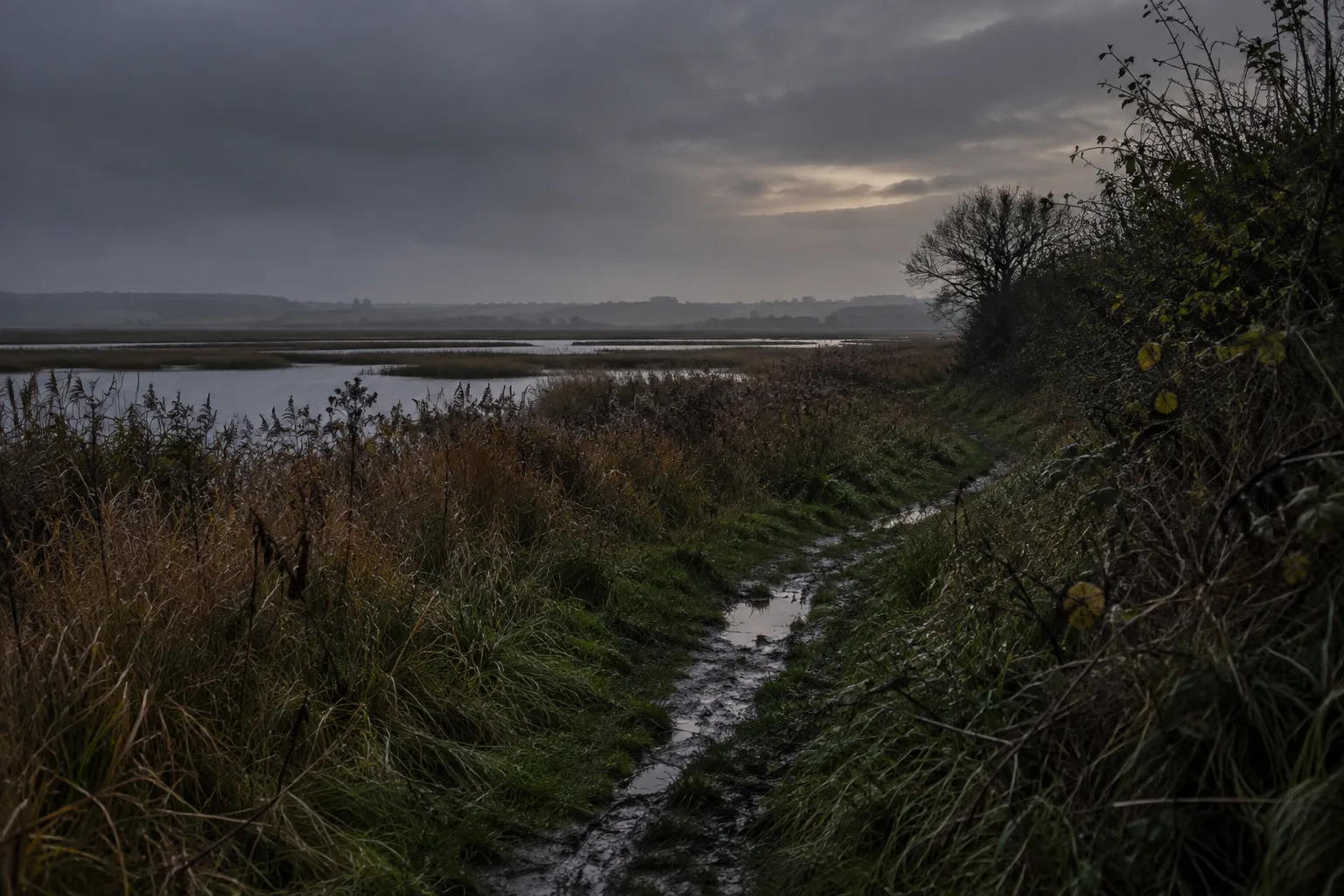
The roadside version works through restricted vision. A hedgerow conceals movement; a bend hides what lies ahead. In that setting, the thought of a companion that cannot be clearly seen makes an ordinary journey feel occupied. This is an interpretation of the story’s effect, not a report of an encounter made for this article.
What survives when the legend is tested
The Norfolk Record Office points toward lightning as a more plausible explanation for the fire and destruction than a hellhound. The historical storm need not be denied in order to question the supernatural cause. Equally, acknowledging danger and confusion does not let us reconstruct every injury with certainty centuries later.
| Material | What it can establish | What it cannot establish alone |
|---|---|---|
| Fleming’s pamphlet | An early printed account and its religious explanation. | That a supernatural dog caused the deaths. |
| Parish records studied by Owen | Local conflict and the setting in which the event gained meaning. | Exactly what every person saw during the storm. |
| Marks associated with the legend | A physical feature around which a story is told. | Its date or cause without further evidence. |
Readers can apply the same separation of testimony and interpretation to the disputed haunting at Borley Rectory and the Black Monk of Pontefract claims. These are different English cases, not further sightings of Black Shuck. Their value as related reading lies in asking how a frightening reputation acquires apparent evidence.
These are living places, not abandoned sets
Holy Trinity at Blythburgh is a Grade I listed parish church. Historic England’s architectural record describes its flint walls, stone dressings, west tower and medieval fabric. Its wooden roof and carved details deserve attention independently of any ghost story.
The church’s own website describes a worshipping community, concerts and other village activities. Check its current visitor information before travelling, respect services and private prayer, and do not treat a folklore association as permission to enter outside opening hours.
At Bungay, the Churches Conservation Trust records St Mary’s involvement in the inaugural Black Shuck Festival in August 2023. It presents the legend as a way for storytelling, heritage and creative work to bring people together. A community can preserve a frightening tale without endorsing the existence of the creature at its centre.
Why the storm still has a name
Black Shuck endures because the legend gives disaster an outline that can be imagined: something dark entering a place of safety. The surviving sources support a real storm, an influential account and a long cultural afterlife. They do not demonstrate that a demonic hound moved between Suffolk churches.
The more revealing story is how those layers meet. A damaged building invites a question. An old pamphlet offers an explanation. A later telling supplies eyes, size and a familiar name. Keeping the layers separate does not empty the church of atmosphere. It lets the historical fear remain visible without mistaking the shape of a story for proof.
Sources and further reading
- Abraham Fleming, 1577: EEBO-TCP transcription, A00943
- Christian Owen: The Black Dog of Bungay (2024)
- Blythburgh parish council: the thunderstorm and Fleming
- Norfolk Record Office: regional Black Shuck traditions
- Churches Conservation Trust: myths and church heritage
- Historic England: Holy Trinity Church, Blythburgh
- Holy Trinity Blythburgh: official church information