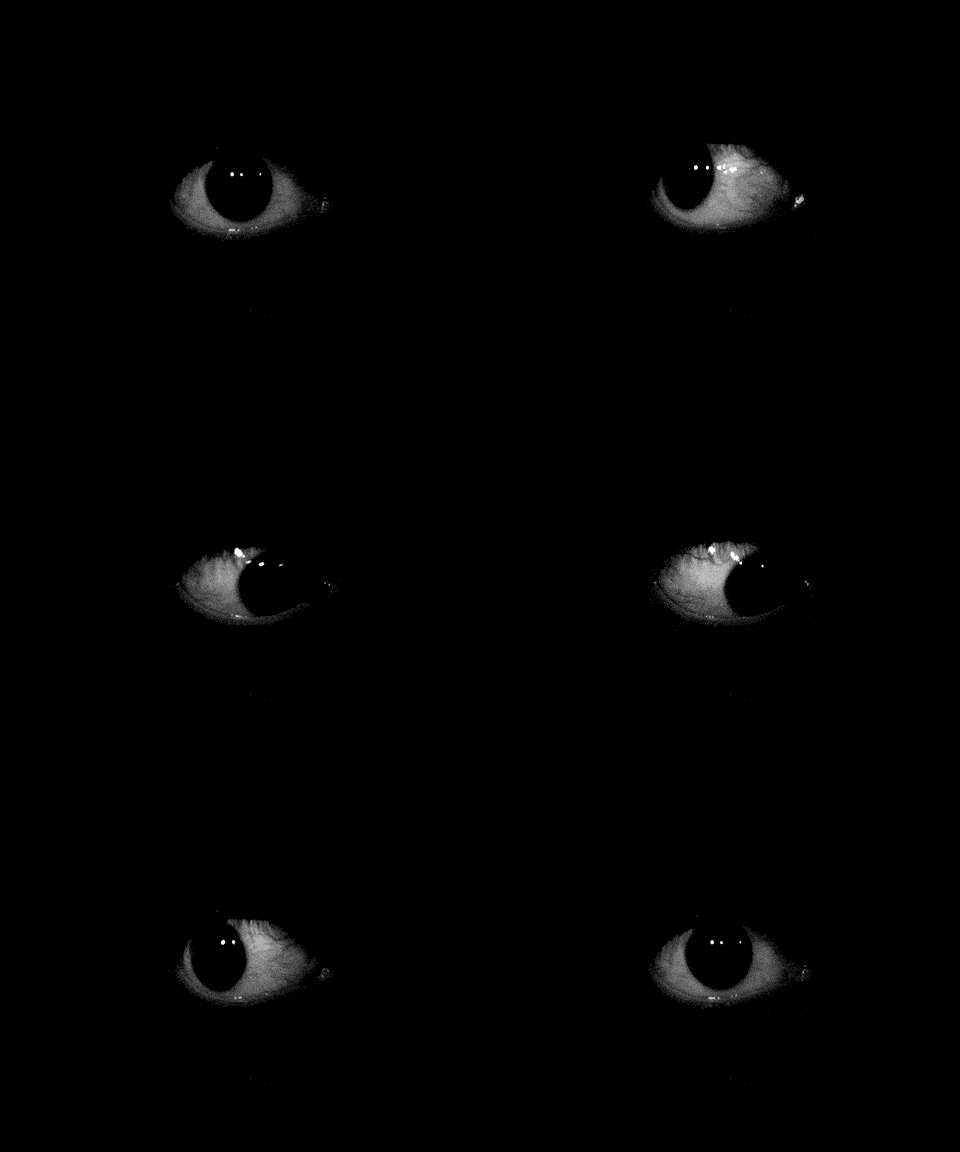


The Manson Family cult remains one of the most searched and misunderstood criminal groups in modern American history. Its name evokes Charles Manson’s stare, the phrase “Helter Skelter,” and two nights of murder in Los Angeles. Yet the familiar mythology can hide the more disturbing reality: a controlling leader assembled vulnerable young people, isolated them, reshaped their loyalties, and directed violence that destroyed multiple families.
This account separates court-established facts from later legend. It also keeps the victims at the center, rather than treating Manson as a supernatural mastermind. He did not possess mysterious powers. He exploited dependency, fear, drugs, social isolation, and a moment of profound cultural instability.
Manson Family cult at a glance
| Detail | Documented information |
|---|---|
| Leader | Charles Manson |
| Active period | Primarily the late 1960s |
| Principal base | Spahn Ranch near Los Angeles |
| Defining crimes | The Tate and LaBianca murders of August 1969 |
| Conviction | Seven counts of first-degree murder and one count of conspiracy |
| Manson’s death | November 19, 2017, while imprisoned in California |
1. The “Family” began with belonging, not violence
Manson left prison in March 1967 after spending much of his life inside institutions. He entered a changing California filled with young people searching for community, spiritual certainty, music, and escape from conventional life. He presented himself as a musician, philosopher, father figure, and guide.
The group that formed around him was not a biological family. It was a shifting commune whose members often adopted new names and identities. Manson offered attention and apparent acceptance, then increasingly made himself the center of the group’s emotional world. That progression matters because coercive groups rarely introduce themselves through their worst intentions.
The label “cult” can flatten individual experiences, so it should be used carefully. In this case, it describes a high-control group organized around one leader’s authority. Members did not all have identical roles, knowledge, or responsibility, but the group’s structure steadily reduced meaningful independence.
2. Spahn Ranch made isolation easier
The Family eventually settled at Spahn Ranch, a deteriorating former Western film set in the hills northwest of Los Angeles. Its empty facades, cabins, horses, and distance from ordinary supervision gave the group shelter while separating members from outside relationships.
According to a detailed history of Spahn Ranch, members performed chores and cared for the property in exchange for staying there. The arrangement created a self-contained environment where daily necessities, companionship, and authority increasingly ran through the group.

Isolation did not make violence inevitable. However, it reduced opportunities for competing information and made Manson’s interpretations harder to challenge. A remote communal life also blurred private boundaries. When sleep, food, transportation, sex, drugs, and approval depend on one social circle, leaving becomes psychologically and practically difficult.
3. Control grew through repetition and dependency
Popular accounts often use “brainwashing” as if it explains everything. The more useful question is how influence operated day after day. Testimony and later research describe a pattern of intense group sessions, repeated use of LSD, unstable identities, sexual control, apocalyptic teaching, and punishment through rejection or humiliation.
Manson positioned himself as the person who could interpret reality for everyone else. Contradictions became evidence of deeper wisdom, while loyalty brought approval. Members were encouraged to surrender their former selves and treat personal doubt as weakness. These techniques did not erase responsibility, but they help explain how escalating demands could begin to feel normal inside the group.
A criminological study indexed by the U.S. Office of Justice Programs examines the Family through social-learning, strain, and control theories. That perspective is more valuable than calling Manson uniquely hypnotic. It places the case within recognizable patterns of authority, dependency, and criminal reinforcement.
4. “Helter Skelter” became an apocalyptic command
Manson developed a racist prediction of an approaching conflict between Black and white Americans. He appropriated Beatles lyrics, especially “Helter Skelter,” and claimed that popular music contained messages confirming his vision. Members were taught that the Family would survive the chaos and emerge afterward.
The Beatles did not endorse or encode Manson’s ideology. He imposed his own meaning on their work. A review of the Helter Skelter belief describes how Manson made himself the necessary interpreter, turning ambiguous cultural material into instructions that reinforced his control.
Prosecutor Vincent Bugliosi later made this apocalyptic theory central to the murder case and to the bestselling narrative that followed. Later writers have challenged whether it explains every motive and decision. Those debates should not obscure the legal core: prosecutors convinced juries that Manson participated in a conspiracy that produced murder, even when he was not physically present for every killing.
5. The August 1969 murders targeted strangers
On the night of August 8 and the early hours of August 9, 1969, Family members entered the home at 10050 Cielo Drive. They killed Steven Parent, Wojciech Frykowski, Abigail Folger, Jay Sebring, and Sharon Tate Polanski, who was pregnant. The following night, members killed Leno and Rosemary LaBianca in their home.
The victims were not symbols in Manson’s story. They were people with families, careers, friendships, and futures. Repeating lurid details adds little understanding and can turn suffering into spectacle. The important fact is that seven lives were deliberately taken during those two nights.
The group’s violence also extended beyond the Tate-LaBianca case. Other Family members received convictions connected to the deaths of Gary Hinman and Donald Shea. Those cases further undermine the simplified idea of one sudden eruption. Violence developed within a broader environment of threats, criminal activity, and obedience.

6. The trial proved leadership could carry responsibility
Manson did not personally carry out every fatal act at the two principal crime scenes. The prosecution instead argued that he directed the conspiracy and exercised decisive authority over those who did. In 1971, juries convicted Manson and several followers.
The California Department of Corrections and Rehabilitation records that Manson entered state prison after convictions for seven counts of first-degree murder and one count of conspiracy to commit murder. His original death sentence became life imprisonment after California’s death penalty was invalidated in 1972. He died of natural causes in custody in 2017.
Contemporary reporting also shows how the case developed rather than appearing as one complete revelation. The Los Angeles Times archive of the 1969 indictment captures the uncertainty and fragmented information available before trial testimony assembled the prosecution’s account.
7. The Manson myth can hide ordinary warning signs
Decades of films, books, photographs, interviews, and merchandise transformed Manson into a dark celebrity. His image became larger than the communal system he controlled and, too often, larger than the victims. That emphasis encourages the comforting belief that dangerous leaders are visibly monstrous from the beginning.
The case suggests the opposite. Recruitment grew through attention and belonging. Control deepened through isolation, dependency, identity erosion, and a leader who claimed exclusive access to truth. Violence arrived after boundaries had already shifted repeatedly.
Those patterns connect the Manson Family cult to other high-control groups without making the cases identical. Evil’s Eye has also examined the isolation and apocalyptic certainty behind the Heaven’s Gate cult, as well as the political pressure and mass death associated with the Jonestown cult. Comparing methods is more useful than treating any leader as supernaturally persuasive.
Final verdict: history is darker than the legend
The Manson Family cult remains frightening not because Charles Manson possessed magical influence, but because his methods were recognizably human. He found people seeking connection, made himself essential, isolated them from alternative loyalties, and converted belonging into obedience.
Understanding that process does not excuse the killers or reduce the victims to a lesson. It strips away the celebrity mythology and reveals a preventable pattern of coercion. The responsible way to remember the case is to name the lives taken, examine how control escalated, and refuse to let the leader dominate the story forever.
Sources
- California Department of Corrections and Rehabilitation: Manson’s convictions, sentence, and death
- Los Angeles Times archive: December 1969 indictments
- History: Spahn Ranch and the Family’s communal base
- History: Manson’s appropriation of “Helter Skelter”
- Office of Justice Programs: criminological analysis of the Manson Family