
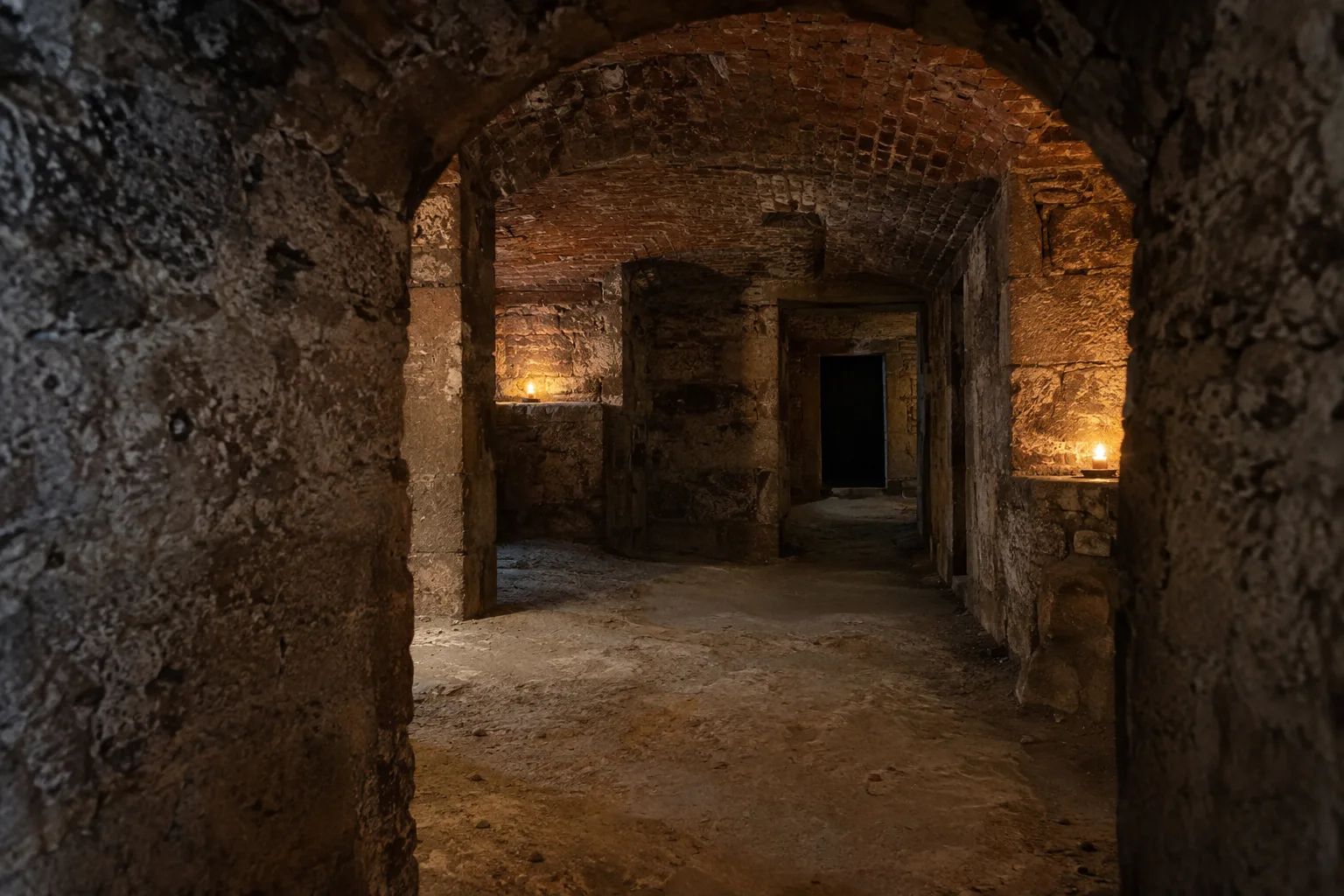
The Edinburgh Vaults put a particularly unpleasant idea within reach: an empty doorway, deep below a busy street, where somebody might be standing just beyond the light. These chambers beneath South Bridge have become a famous setting for accounts of footsteps, apparitions and a threatening presence called the Watcher. Their history is real. The claim that spirits occupy them remains unproved.
What makes the Edinburgh Vaults compelling is how closely the ghost stories cling to their physical surroundings. Thick walls divide small rooms. Candlelight reveals a doorway without revealing everything behind it. Above, Edinburgh carries on; below, the next chamber can feel much farther away than it is. To understand the fear, start with the bridge that made this hidden world possible.
In this story
A bridge with rooms inside it
South Bridge opened to traffic in 1788, carrying the city across the Cowgate valley. Historic Environment Scotland’s listing describes a structure with nineteen arches, only one of which remains visible from the street over Cowgate. Buildings enclosed the others, while businesses used the spaces beneath for storage.
That explains a common misunderstanding about the Edinburgh Vaults. They are chambers within and around a bridge structure, rather than a purpose-built underground cemetery. The city’s modern engineering report on South Bridge also records their use for storage, workshops and housing. The apparently ordinary street above conceals a much more complicated arrangement below.
The Blair Street Underground Vaults form one section of this larger network. Calling the whole place “Edinburgh’s catacombs” conjures the wrong history. Unlike the Paris Catacombs and their human remains, these rooms began as commercial space. Their darkness came with the architecture, before a ghost acquired a name.
The people behind the locked doors
A surviving door from the Edinburgh Vaults offers a firmer connection to that past than an apparition does. Mercat Tours, which operates the Blair Street site, describes a water-damaged door bearing the name Jas. Henderson. Its researchers connect James Henderson, a haberdasher, to a South Bridge address through a 1799 directory and a newspaper announcement about his business.
The operator’s account of the door and associated finds is useful partly because it acknowledges its limits. A door, a lock and a numbered plaque can explain how merchants secured their goods without proving that every object belonged to the same person or room. History becomes more persuasive when the joins remain visible.
Later accounts describe people seeking shelter in these dark, damp spaces. Mercat’s research into the vaults’ residents discusses working families and the housing pressures that pushed people underground. Their circumstances deserve care. Poverty does not make someone sinister, and a poorly documented life should not become a licence to invent a violent death.
The Watcher of the Edinburgh Vaults
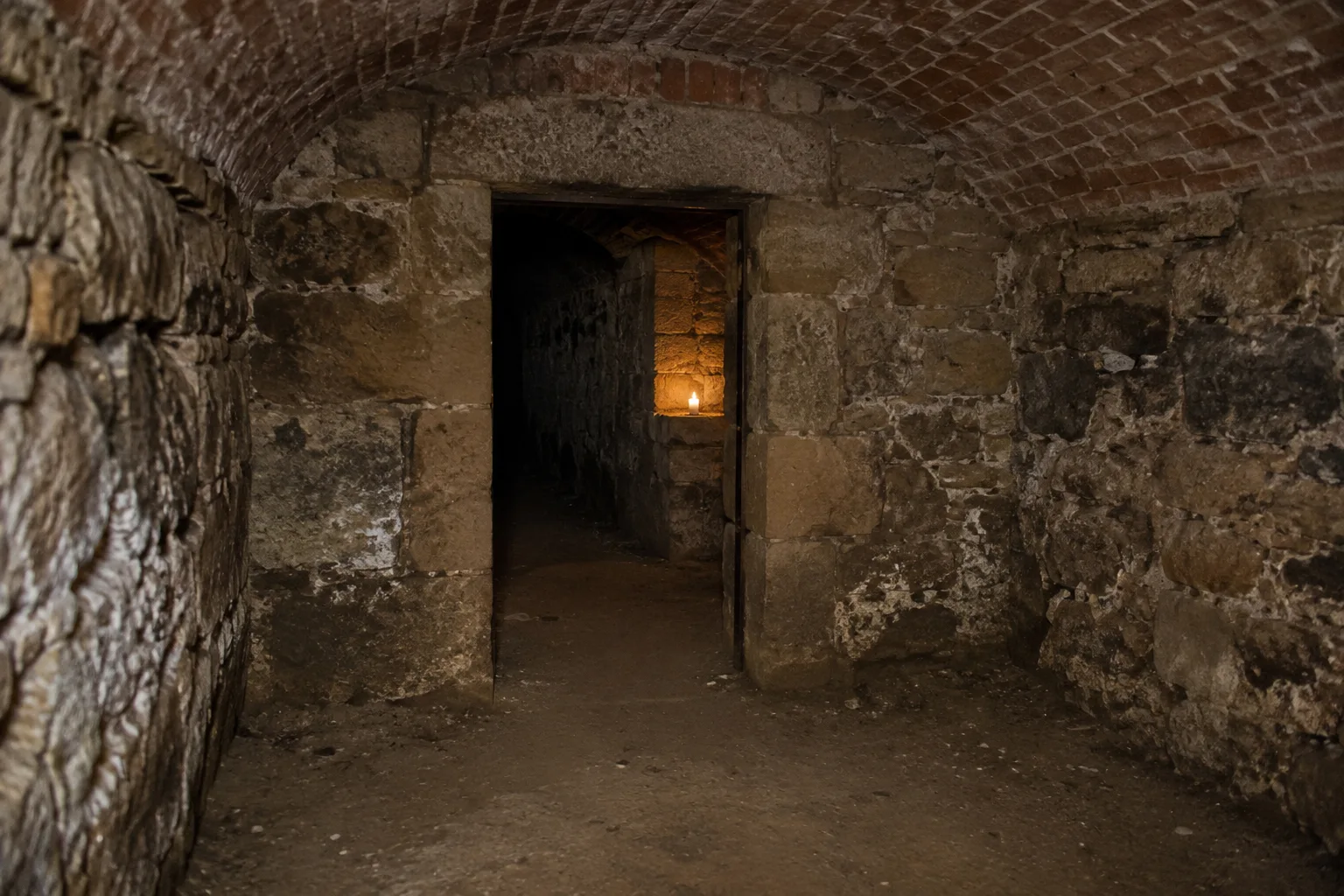
Against this background, the Watcher legend places an unwelcome observer in the passage. Mercat’s published version describes a tall figure wearing a dirty blue coat and heavy leather boots. Those boots supply his other name: Mr. Boots. The story associates him with doorways, pacing footsteps and the sense that visitors have entered somebody else’s territory.
These are reported encounters, not an identified historical person’s biography. In its account of the Watcher, Mercat considers possible identities, including a caretaker or watchman, but explicitly treats them as speculation. There is no sound basis for turning one of those suggestions into a confirmed occupation, motive or death.
The legend is effective because it gives the darkness an intention. An unlit opening becomes a place from which something might be watching. A footstep becomes a warning. Readers can recognise the power of that story while remembering who tells it: a tour operator presenting its site’s folklore. That makes it a direct source for the legend, rather than independent proof of a ghost.
When researchers took the haunting seriously
The Edinburgh Vaults also became the subject of a study published in the British Journal of Psychology in 2003. Richard Wiseman, Caroline Watt and colleagues examined unusual experiences at South Bridge and Hampton Court Palace. Participants explored the locations and recorded where they experienced something strange.
The published research summary reports more experiences in areas with a haunted reputation. Prior knowledge of those areas did not account for that pattern. Across the two studies, the locations of experiences also correlated with environmental factors, including lighting and variations in local magnetic fields.
The authors proposed that ordinary surroundings could explain at least some alleged hauntings. That conclusion has limits: a correlation does not identify the cause of every experience, and the study does not prove that one factor explains every room. Nevertheless, it supplies something a frightening anecdote cannot: a method for comparing reports with conditions in the space.
What a shadow cannot tell you
A visitor can sincerely feel watched without knowing what produced that sensation. Likewise, a dark shape in a photograph does not establish who or what stood there. Before assigning it an identity, an investigator would need to examine the lighting, other people present, camera settings and surrounding images.
That is especially relevant to a place whose ghost stories already supply a detailed character. Once somebody mentions a blue coat and boots, an ambiguous outline has a ready-made interpretation. This is an editorial caution about reading evidence, not a diagnosis of any witness or a claim that every report has the same explanation.
The distinction also matters in the Enfield Poltergeist case and its disputed evidence: an experience, its recording and the explanation offered for it are separate things. The Edinburgh Vaults remain unsettling even when those steps are kept apart. Darkness leaves room for uncertainty; a confident caption does not remove it.
Visiting the Edinburgh Vaults today
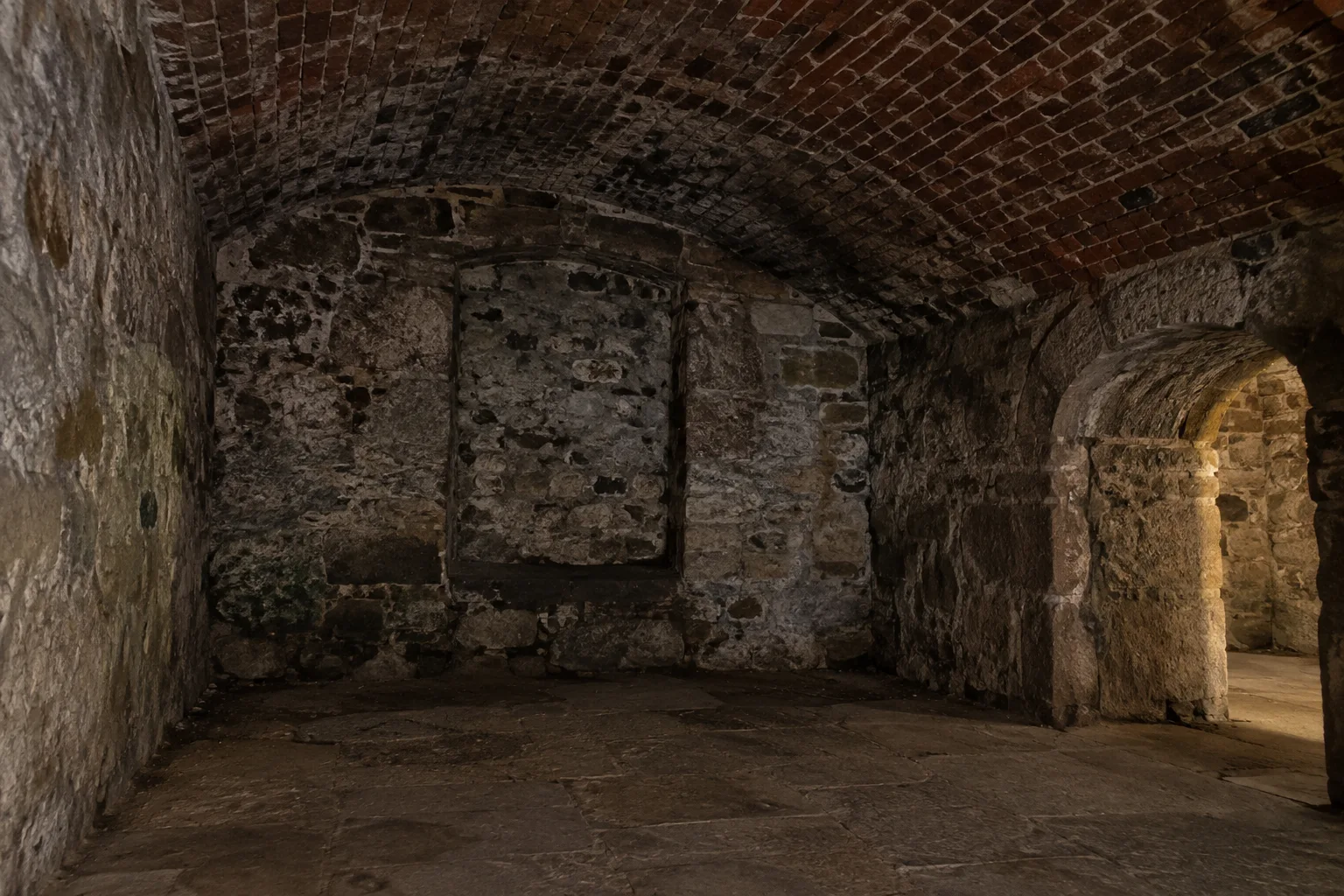
For readers planning a visit, first check which section a tour actually enters. Forever Edinburgh’s guide to the city’s underground sites lists several vault tour operators. Their routes and access differ, so “the vaults” does not describe one identical experience sold under several names.
Mercat offers both history and ghost tours of the Blair Street chambers. As checked in September 2026, its official programme also lists Halloween tours for October 23 to 31. Check the current itinerary, age guidance and accessibility information directly before booking. A seasonal storytelling programme establishes what visitors can attend, not what caused an alleged haunting.
A history tour may be the stronger choice if the objects and former residents interest you most. A ghost tour foregrounds the stories associated with the rooms. Either way, knowing which kind of experience you have booked helps you distinguish an archival finding from a storyteller’s chilling possibility.
The doorway stays empty
The most defensible answer is that the Edinburgh Vaults have a documented past and an enduring haunted reputation, but no established supernatural explanation. The Watcher belongs to the site’s reported folklore. The merchants, the storage rooms and the bridge belong to its history. Research has given readers another way to consider the strange sensations people describe.
None of that makes a dark doorway inviting. It simply leaves the reader with a more interesting kind of dread: a place where the eye has too little information, the story has supplied too much, and the next room remains out of sight.
Read next: Continue below ground with the history of the Paris Catacombs, or examine how testimony becomes a haunting narrative in the Black Monk of Pontefract case.
Sources and further reading
- Historic Environment Scotland: South Bridge and the Edinburgh Vaults
- City of Edinburgh Council: South Bridge structures report
- Mercat Tours: archives and objects from the vaults
- Mercat Tours: research into the vaults’ residents
- Mercat Tours: the Watcher legend
- Wiseman and colleagues: An investigation into alleged hauntings (2003)
- Forever Edinburgh: underground visitor information