
In Pontianak folklore, the danger often arrives before the figure does. A sound comes from the darkness. Flowers seem suddenly noticeable. The trees beside an ordinary path become a place worth watching. Across Malay ghost stories, this female spirit turns familiar surroundings into the possibility of an encounter, with details that change from one storyteller to another.
The pontianak is commonly described as the ghost of a woman who died during pregnancy or childbirth, often appearing with long hair and white clothing. In Indonesia, the related name kuntilanak is widely used. These are traditions of belief and storytelling, not a verified account of a supernatural species. Their power lies partly in how little a listener needs to imagine: a roadside, a tree, and something that sounds close enough to find.
In this story
Who is the Pontianak in Malay folklore?
Singapore’s National Library Board places the pontianak within Malay mythology and describes the traditional connection with a woman who died in childbirth. Its history of Singapore horror also shows how the figure moved through oral traditions, literature and cinema. The ghost did not begin as a recent internet invention.
The familiar appearance can suggest vulnerability before it suggests danger. Long hair, pale clothing and the outline of a woman may invite recognition rather than immediate flight. In stories that transform her into a threatening figure, the reversal makes that first impression unreliable. Something that looked human becomes difficult to read.
However, the tragedy attached to the legend deserves care. Pregnancy loss and maternal death are human experiences, not evidence of monstrosity. Describing the belief does not make it a statement about women who died, their families or any real person’s character. The story’s violence belongs to its narrative world.
Why Pontianak stories linger around trees
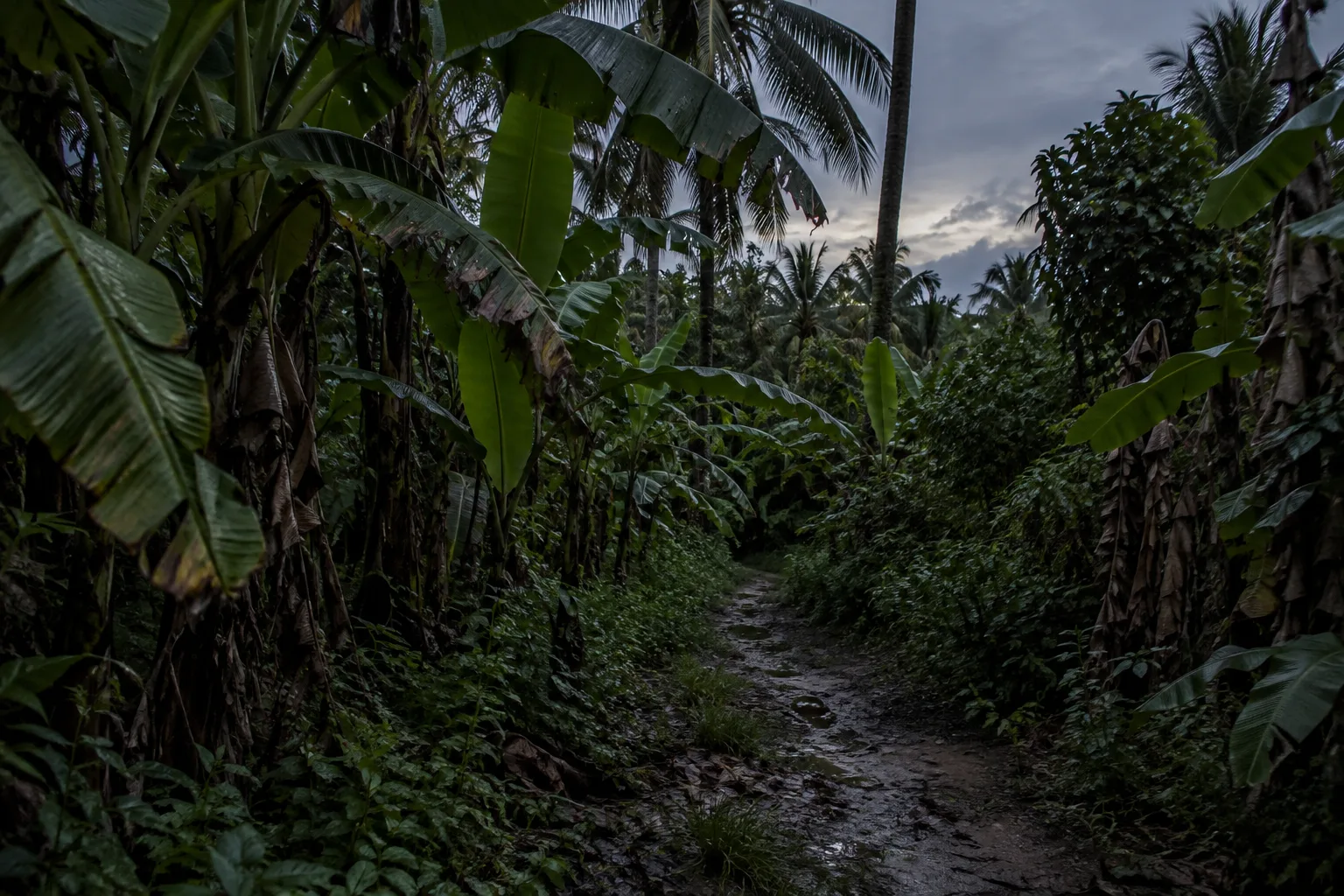
A 2014 entry in the USC Digital Folklore Archives records an informant remembering a grandmother’s warnings about banana trees. The account describes a spirit associated with the plants and a childhood instruction not to approach too closely or look upward. It is a record of what one person heard, rather than a rule shared by every community.
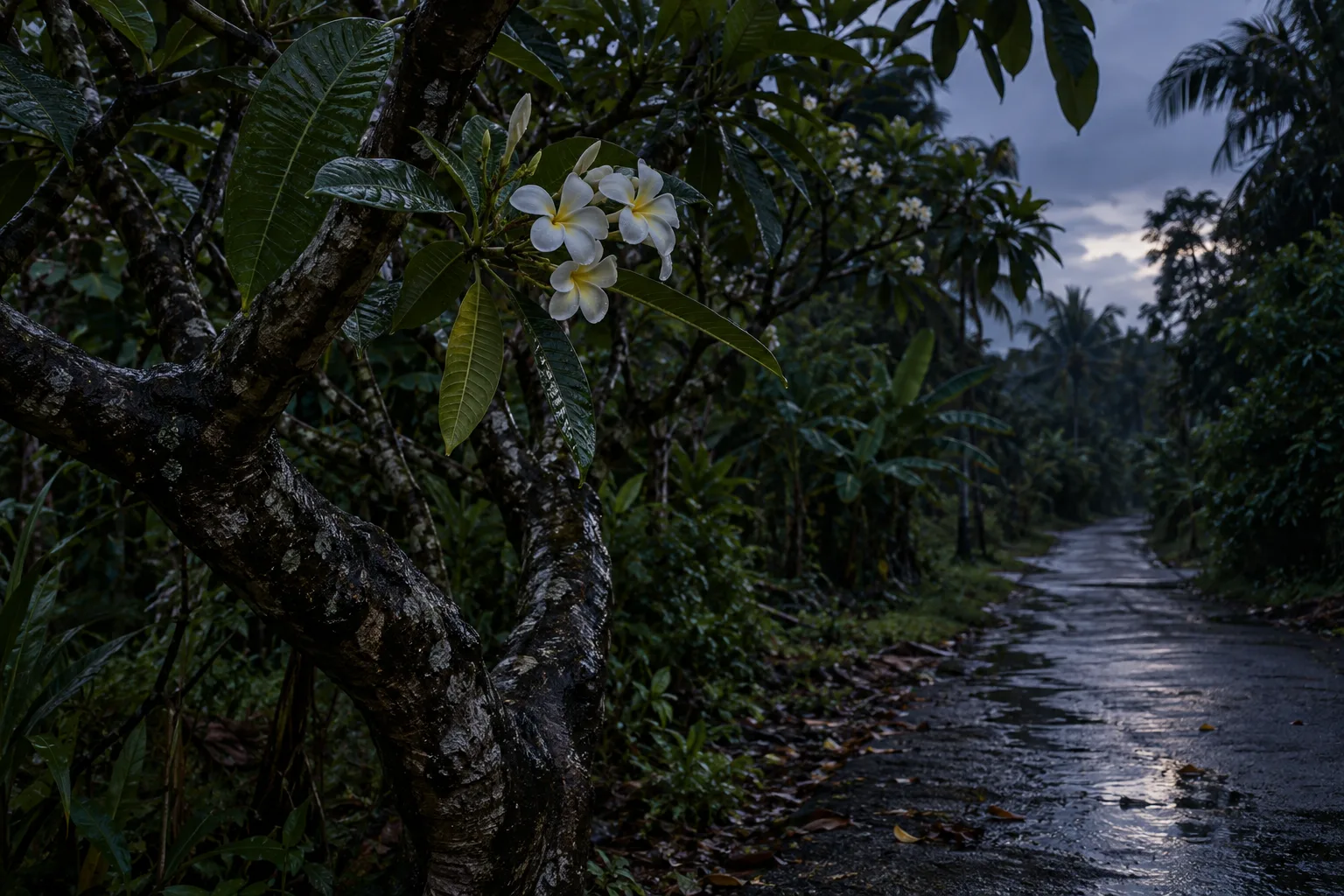
Another USC collection entry about Southeast Asian legend connects her to a frangipani tree and the sweetness of its flowers. Those differences matter. Retellings that gather banana trees, frangipani, particular sounds and particular attacks into one checklist can hide the variety within the tradition.
The setting gives the warning an everyday destination. A listener does not need a remote castle to remember it. A tree beside a lane is enough. Its leaves conceal part of the view, and its branches place unseen space above eye level. Read this way, the story teaches the imagination to keep checking an ordinary environment.
When a sound gives the darkness a direction
CNA Lifestyle’s account of the legend includes a crying baby, floral scent and a roadside encounter among its familiar motifs. These elements belong to the retelling. A cry or a flower’s scent outside the story is not, by itself, evidence of a ghost.
As a horror device, sound works differently from a clearly visible figure. It gives a listener a direction without providing a complete explanation. The impulse to identify its source can pull attention into the dark space between trees. A sympathetic response and a frightened response can begin with the same movement: turning toward it.
This is what makes the pontianak unsettling without a detailed description of an attack. The story places uncertainty at the moment before recognition. The listener is asked to imagine deciding whether to approach, while already knowing that the warning says an ordinary first impression may be wrong.
A legend that refuses one fixed set of rules
The collected accounts do not agree about every victim, setting or origin. A separate USC Pontianak entry associates the figure with late-night roads and stories told around a campfire. The banana-tree account emphasises a family warning instead. Both document circulation, but neither establishes one authorised version.
That is why describing the pontianak simply as a Southeast Asian vampire can only go so far. It is a useful comparison for an unfamiliar reader, not a guarantee that every feature of a European vampire belongs here. Nor should a character from one Malay or Indonesian narrative stand in for all the region’s beliefs.
For another story whose frightening details shift in retelling, see Okiku’s Well and the ghost legend beneath Himeji Castle. The comparison is about how stories travel and attach themselves to places. It does not make Japanese and Malay traditions interchangeable.
The city that shares the ghost’s name
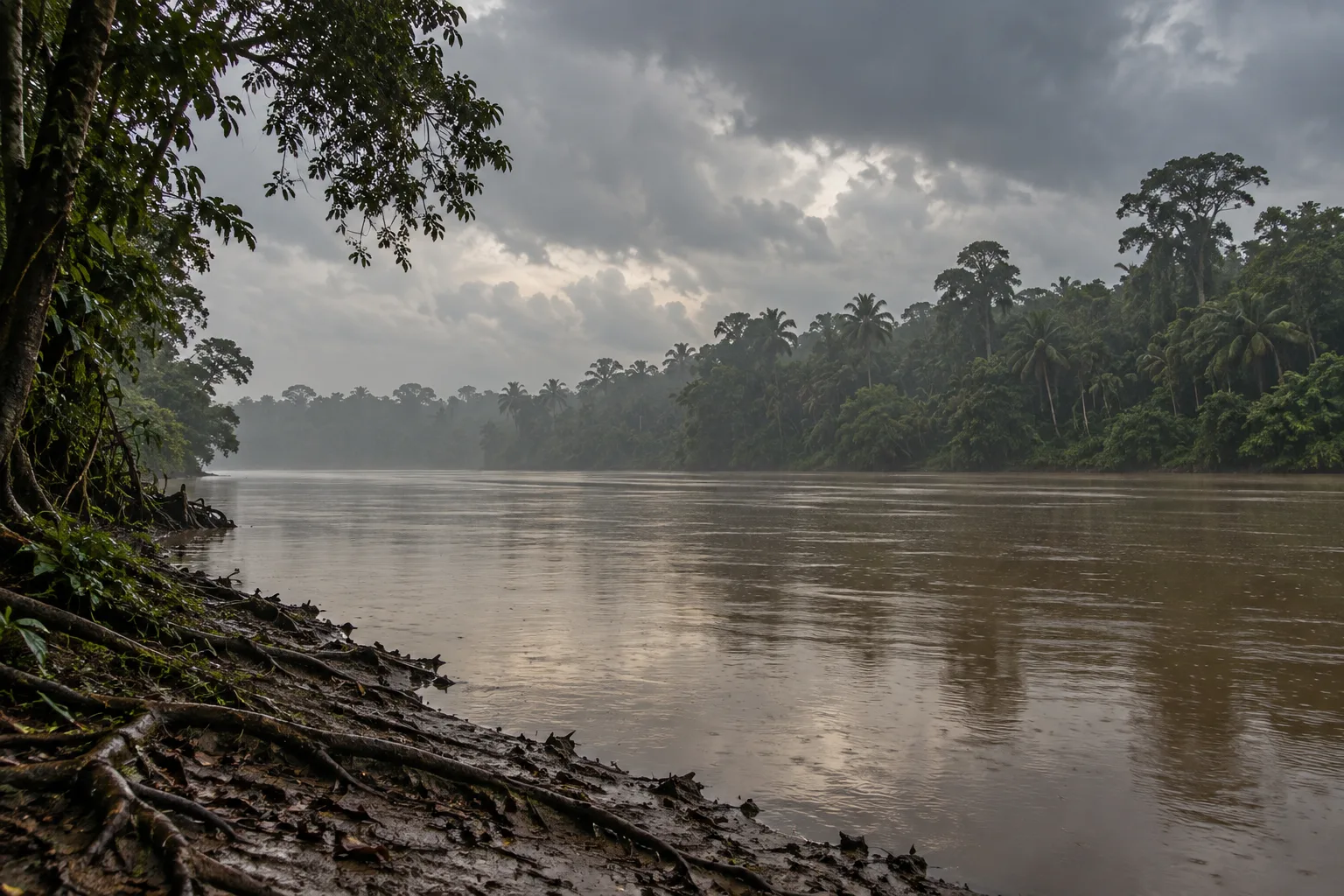
Pontianak is also the name of a living city in West Kalimantan, Indonesia. In his 2020 study, Timo Duile examines Kuntilanak narratives and the city’s founding story, including the tradition that the spirit inhabited the confluence of the Kapuas and Landak rivers before people drove her away. This is a study of narratives and their meanings, not archaeological proof of an eviction of ghosts.
JSTOR Daily’s discussion of Duile’s research explains a version involving cannon fire used to expel unwelcome presences. More importantly, it describes competing understandings of nature and spirits among people the researcher spoke with. The forest is not simply a stage on which every community imagines the same threat.
The city connection deepens the legend beyond an encounter beside a tree. It brings the story into questions of settlement, belonging and the boundary between human order and surrounding landscape. A place can be familiar and inhabited while its stories continue to point toward what once lay outside it.
What cinema changed, and what it did not invent
The National Library Board dates the premiere of the film Pontianak to 27 April 1957. It explains that the production changed the traditional backstory, giving its central woman a curse rather than simply repeating the childbirth origin. That distinction is useful whenever a screen version is treated as a definitive guide to the folklore.
Film can give a flexible oral figure a recognisable face, costume and sequence of actions. It can also make one version easier to remember than others. Nevertheless, the existence of a memorable adaptation does not turn its inventions into older tradition. Viewers need to ask which detail comes from a collected story and which comes from a screenplay.
This article concerns the legend rather than a movie review. Its strongest question remains what the figure does to ordinary settings: a familiar plant becomes a hiding place; an isolated road becomes an encounter waiting to happen. That effect does not require a specific film to be playing.
A record of belief is not proof of a haunting
A folklore archive can establish that someone told a story, remembered a warning or described a belief. It cannot automatically establish that the being in the story exists. The distinction is especially important with the pontianak, because a detailed account can sound more certain than the circumstances in which it was collected.
For a claimed encounter, useful questions include who observed it directly, when the account was recorded, what conditions affected visibility and what independent material survives. A repeated story is not an additional witness merely because a new website repeats it. Likewise, a frightening image needs a source, not just an arresting caption.
The legends surrounding Hoia Baciu Forest offer a different example of how a wooded landscape accumulates an unsettling reputation. In either setting, documenting the reputation and proving a supernatural cause are separate tasks. Keeping them apart allows the story to remain interesting without manufacturing evidence.
Why the warning outlasts the telling
Pontianak folklore survives because its menace fits inside a recognisable world. The crucial detail is often not an elaborate monster but a small change in attention: listening harder, noticing a scent, looking toward branches that were unremarkable before the story began.
The surviving sources support a rich, changing tradition of female-ghost narratives across the Malay world. They do not establish a verified haunting. That leaves the legend’s most effective uncertainty intact as storytelling: the lane is still a lane, the flowers are still flowers, but the listener now has a reason to hesitate before looking into the trees.
Sources and further reading
- National Library Board: A History of Singapore Horror
- USC Digital Folklore Archives: family and banana-tree account
- USC Digital Folklore Archives: frangipani-tree tradition
- USC Digital Folklore Archives: roadside and campfire account
- Timo Duile: Kuntilanak, Ghost Narratives and Malay Modernity (2020)
- JSTOR Daily: the city and its ghost narratives
- CNA Lifestyle: regional folklore and familiar motifs